1950s Maps of Woodstock, Connecticut
Explore 11 historic maps of Woodstock from the 1950s. These maps offer a rare glimpse into what life looked like during the 1950s — showing old roads, neighborhoods, homes, and landmarks that have changed or disappeared over time.
Whether you're researching your family's past, planning a metal detecting trip, or studying how Woodstock's landscape evolved across the 1950s, these high-resolution maps are a powerful tool for exploring the history of this region.
- Focus on a specific era: All maps on this page are from the 1950s, giving you a focused view of this time period.
- See what’s changed: Compare century-old streets, trails, and buildings to today's modern landscape using overlays and satellite layers.
- Research with precision: Use these maps for genealogy, historical research, land use analysis, or educational projects.
- View, download, or print: Maps are fully viewable online in high resolution, and can be downloaded or printed for your own records.
Start exploring Woodstock's history through authentic maps from the 1950s. This is your window into the past.
Woodstock, CT maps
(11)- 1952 Map of Southbridge, 1954 Print
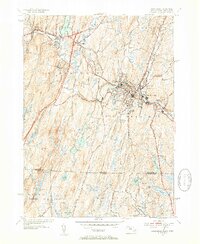 1952 Southbridge1954 Print · USGSThe Quinebaug River valley in the early fifties shows a transition from industrial mill towns to the forested borderlands of Connecticut. Local researchers can trace family landmarks like Oak Ridge Cem, the historic Old Sturbridge Village, and the Notre Dame Sem.5 unique versions available
 - 1953 Map of Eastford, 1954 Print
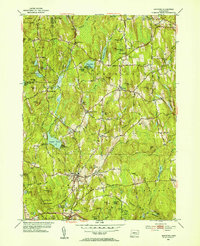 1953 Eastford1954 Print · USGSWindham County at the start of the 1950s remains a landscape of deep forests and quiet villages. Genealogists and historians can trace the foundations of local life through the Red and White Sch, the Old Cem, and the winding path of the Still River.5 unique versions available
 - 1953 Map of Webster, 1955 Print
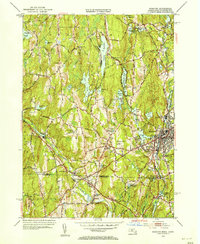 1953 Webster1955 Print · USGSThe Massachusetts and Connecticut borderlands thrive during the early fifties, anchored by the industrial hub of Webster. Researchers can trace the rail lines of the New York New Haven and Hartford RR or locate Nichols College, Fabyan, and South Charlton.3 unique versions available
 - 1955 Map of Putnam, 1956 Print
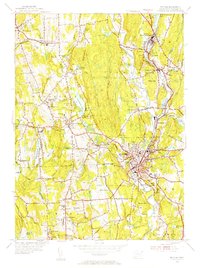 1955 Putnam1956 Print · USGSWindham County communities thrive along the Quinebaug River at mid-century as industry and education shape the landscape. Genealogists and historians can trace the legacy of local institutions like Woodstock Academy and the New York New Haven and Hartford rail corridor.6 unique versions available
 - 1956 Map of Boston, 1967 Print
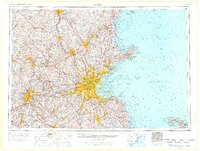 1956 Boston1967 Print · USGSThe Massachusetts coastline and industrial interior are seen here during the mid-century peak of suburban and highway expansion. Researchers can trace historic harbor defenses like Fort Revere, local landmarks such as Faneuil Hall, and the vast Parker River National Wildlife Refuge.6 unique versions available
 - 1956 Map of Albany, 1968 Print
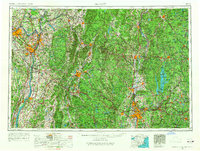 1956 Albany1968 Print · USGSThe industrial heart of the Northeast is revealed in the mid-1950s, from the Hudson Valley to the Connecticut River. Researchers can trace the legacy of the Quabbin Reservoir, locate Westover Air Force Base, or follow the Rutland RR through the Green Mountains.2 unique versions available
 - 1957 Map of Albany
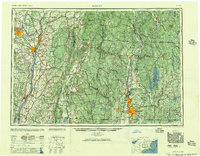 1957 Albany1957 Print · USGSThe Tri-State region and Connecticut River Valley are captured here during a period of significant postwar growth and infrastructure expansion. Genealogists and historians can trace the rail-and-river economy through landmarks like the Boston and Maine railroad, Quabbin Reservoir, and Westover Air Force Base.
 - 1957 Map of Providence
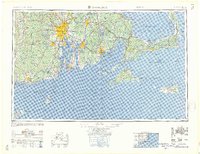 1957 Providence1957 Print · USGSCoastal New England at the height of the mid-century era shows a landscape shaped by maritime industry and Cold War defense. Genealogists and historians can trace the reach of the New York, New Haven & Hartford RR and locate legacy sites like Fort Adams and Quonset Point Naval Air Station.
 - 1958 Map of Boston
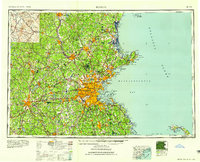 1958 Boston1958 Print · USGSEastern Massachusetts and southern New Hampshire are shown at the height of the industrial era, before the full expansion of the interstate system. Trace coastal defenses at Fort Warren, historic rail lines like the Boston and Maine, and the development of the Mass. 128 corridor.2 unique versions available
 - 1958 Map of Providence
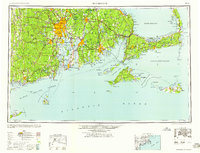 1958 Providence1958 Print · USGSThe Rhode Island and Massachusetts coastlines are shown in detail during the late 1950s, from the urban cores to the tips of the islands. Researchers can trace the mid-century footprint of Quonset Point Naval Air Station, the defense works at Fort Adams, and the rail network of the New York, New Haven and Hartford RR.
 - 1959 Map of Albany
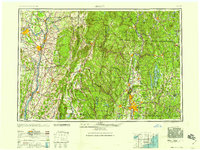 1959 Albany1959 Print · USGSThe Hudson and Connecticut River valleys are captured here during the late fifties, showing the region's dense rail networks and massive water projects. Researchers can trace the New York State Thruway or locate local landmarks like Mt Greylock and the Quabbin Reservoir.
End of results
Showing maps 1-11 of 11
Top cities near Woodstock
- Mansfield historical maps
- Windham historical maps
- Webster historical maps
- Killingly historical maps
- Southbridge historical maps
- Auburn historical maps
See more
Top neighborhoods of Woodstock
- East Woodstock historical maps
- North Woodstock historical maps
- Quasset Lake historical maps
- South Woodstock historical maps
- Lake Bungee historical maps
- Witches Woods historical maps
See more
Frequently asked questions
- What are the different types of historical maps available for Woodstock?
- What is the oldest map of Woodstock?
- Where can I purchase historical maps of Woodstock for my home or office?
- Where can I download high-res historical maps of Woodstock?
- Are there historical topographic maps available for Woodstock?
- Is there historical aerial imagery available for Woodstock?
- Where are historical maps of Woodstock sourced from?