1900s (20th Century) Maps of Alameda Park, University Place
Explore 10 historic maps of Alameda Park from the 1900s (20th Century). These maps offer a rare glimpse into what life looked like during the 1900s — showing old roads, neighborhoods, homes, and landmarks that have changed or disappeared over time.
Whether you're researching your family's past, planning a metal detecting trip, or studying how Alameda Park's landscape evolved across the 1900s, these high-resolution maps are a powerful tool for exploring the history of this region.
- Focus on a specific era: All maps on this page are from the 1900s, giving you a focused view of this time period.
- See what’s changed: Compare century-old streets, trails, and buildings to today's modern landscape using overlays and satellite layers.
- Research with precision: Use these maps for genealogy, historical research, land use analysis, or educational projects.
- View, download, or print: Maps are fully viewable online in high resolution, and can be downloaded or printed for your own records.
Start exploring Alameda Park's history through authentic maps from the 1900s. This is your window into the past.
Alameda Park, University Place maps
(10)- 1940 Map of Anderson Island
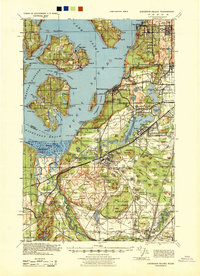 1940 Anderson Island1940 Print · USGSCoastal Washington at the start of the 1940s shows a landscape of strategic military installations and island prisons. You can trace the development of Fort Lewis, the boundaries of the Nisqually Indian Reservation, and the layout of the Federal Penitentiary on McNeil Island.
 - 1948 Map of Anderson Island, 1955 Print
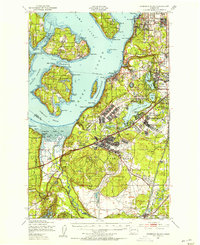 1948 Anderson Island1955 Print · USGSThe South Sound shoreline and its island communities are captured here just after the war as military and suburban footprints expanded. Genealogists and researchers can trace local landmarks from McNeil Island to the Visitation Academy and the rail stops at Nisqually Station.
 - 1948 Map of Steilacoom, 1955 Print
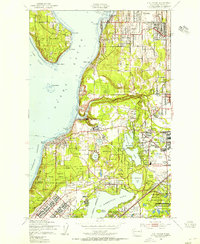 1948 Steilacoom1955 Print · USGSThe Puget Sound shoreline and its inland lakes are captured here during a period of rapid mid-century growth. Genealogists and historians can locate family plots at New Tacoma Cemetery or trace the early footprint of Fort Lewis Military Reservation and Lakewood Center.
 - 1958 Map of Seattle, 1966 Print
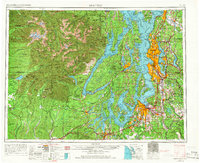 1958 Seattle1966 Print · USGSThe Puget Sound region in the mid-fifties showcases a balance of urban growth and Olympic wilderness. Trace the industrial waterfronts of Tacoma, old naval facilities like Keyport Naval Res, and mountain peaks like Mount Constance.3 unique versions available
 - 1959 Map of Steilacoom, 1960 Print
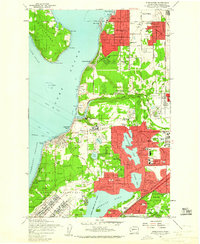 1959 Steilacoom1960 Print · USGSSteilacoom and the South Sound area are shown in the late fifties as military and institutional lands defined the local geography. Researchers can trace the Steilacoom Ferry route and find family landmarks like Clover Park High Sch and New Tacoma Cemetery.5 unique versions available
 - 1959 Map of Anderson Island, 1968 Print
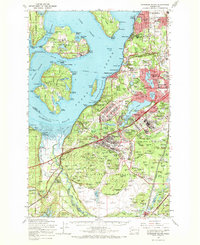 1959 Anderson Island1968 Print · USGSPierce County in the late fifties was a hub of military and institutional activity as suburban communities began to expand south of Tacoma. Trace the mid-century footprints of the Federal Penitentiary on McNeil Island, the Mount Rainier Ordnance Depot, and Lakewood Center.
 - 1962 Map of Seattle
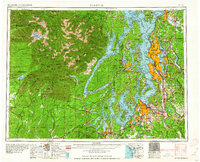 1962 Seattle1962 Print · USGSThe Puget Sound region and Olympic Peninsula are shown at a peak of mid-century growth. Genealogists and historians can trace rail lines like the Pacific Coast RR or locate landmarks such as Fort Lawton and the Bothell Power Station.
 - 1975 Map of Tacoma, 1977 Print
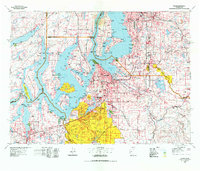 1975 Tacoma1977 Print · USGSThe Puget Sound region in the mid-seventies reveals a landscape of growing urban centers and massive federal installations. Genealogists and historians can trace the development of Tacoma and Olympia, or locate landmarks like the McNeil Island Penitentiary and Fort Lewis Military Reservation.
 - 1991 Map of Tacoma
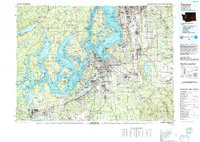 1991 Tacoma1991 Print · USGSThe South Sound and Tacoma waterfront appear here in the early nineties, showing a landscape defined by deep-water inlets and massive federal installations. Researchers can trace the development of Lakewood Center or locate the historic rail lines of the Burlington Northern Railroad and Union Pacific Railroad.
 - 1997 Map of Steilacoom, 2003 Print
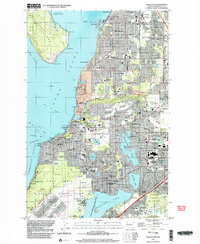 1997 Steilacoom2003 Print · USGSSteilacoom and the surrounding lakeside communities are shown in great detail during the late 1990s as suburban life and military installations matured. Genealogists and local historians can locate many cemeteries, including Byrd Cem, and trace the grounds of the Western Washington State Hospital.
End of results
Showing maps 1-10 of 10
Frequently asked questions
- What are the different types of historical maps available for Alameda Park?
- What is the oldest map of Alameda Park?
- Where can I purchase historical maps of Alameda Park for my home or office?
- Where can I download high-res historical maps of Alameda Park?
- Are there historical topographic maps available for Alameda Park?
- Is there historical aerial imagery available for Alameda Park?
- Where are historical maps of Alameda Park sourced from?