1900s (20th Century) Maps of Corea, Guaynabo
Explore 6 historic maps of Corea from the 1900s (20th Century). These maps offer a rare glimpse into what life looked like during the 1900s — showing old roads, neighborhoods, homes, and landmarks that have changed or disappeared over time.
Whether you're researching your family's past, planning a metal detecting trip, or studying how Corea's landscape evolved across the 1900s, these high-resolution maps are a powerful tool for exploring the history of this region.
- Focus on a specific era: All maps on this page are from the 1900s, giving you a focused view of this time period.
- See what’s changed: Compare century-old streets, trails, and buildings to today's modern landscape using overlays and satellite layers.
- Research with precision: Use these maps for genealogy, historical research, land use analysis, or educational projects.
- View, download, or print: Maps are fully viewable online in high resolution, and can be downloaded or printed for your own records.
Start exploring Corea's history through authentic maps from the 1900s. This is your window into the past.
Corea, Guaynabo maps
(6)- 1946 Map of Naranjito
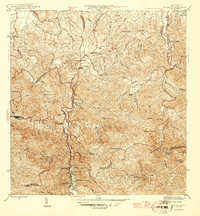 1946 Naranjito1946 Print · USGSNaranjito and the surrounding mountains of central Puerto Rico appear in the mid-1940s as a landscape of agricultural colonias and emerging utilities. Researchers can locate numerous rural chapels like the Iglesia Guadiana and trace the path of the Acueducto de San Juan through the hills.3 unique versions available
 - 1947 Map of Naranjito NE
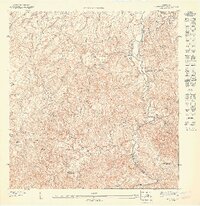 1947 Naranjito NE1947 Print · USGSBayamón and Guaynabo appear in high detail during the late 1940s, highlighting a landscape of rural colonias and steep mountain ridges. Genealogists and historians can trace the footpaths and properties around Colonia Tió, Iglesia de Minillas, and the Río Bayamón.
 - 1952 Map of Naranjito, 1953 Print
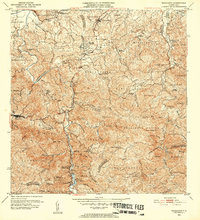 1952 Naranjito1953 Print · USGSNaranjito and the central highlands are captured here in the early fifties, showing a landscape of traditional agricultural colonias and developing barrios. Genealogists can locate specific family landmarks and local institutions like Iglesia de Minillas, Escuela Don Manolo, and the Represa de Comerio.2 unique versions available
 - 1957 Map of Naranjito, 1959 Print
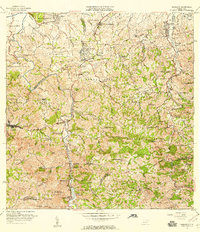 1957 Naranjito1959 Print · USGSNaranjito and the central highlands of Puerto Rico appear in detail during the late 1950s, showing a landscape defined by sharp ridges and deep river valleys. Researchers can trace rural life through landmarks like Iglesia de la Monserrate and the Represa de San Juan reservoir.
 - 1963 Map of Naranjito, 1965 Print
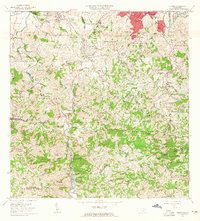 1963 Naranjito1965 Print · USGSNaranjito and the Puerto Rican interior are shown here during a period of rapid development in the 1960s. Researchers can trace rural school locations like Escuela Dajaos Sexto or explore the early power network at Planta Hidroeléctrica Comerío No 2.
 - 1969 Map of Naranjito, 1972 Print
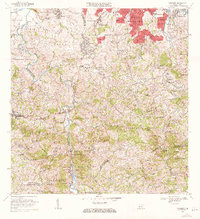 1969 Naranjito1972 Print · USGSThe Naranjito and Bayamón regions undergo significant growth in the late sixties as residential developments meet industrial river infrastructure. Researchers can trace the development of Royal Town or locate the Planta Hidroeléctrica Comerio Num 1 and Escuela Miguel Cervantes Saavedra.3 unique versions available
End of results
Showing maps 1-6 of 6
Top cities near Corea
- San Juan historical maps
- Bayamón historical maps
- Carolina historical maps
- Caguas historical maps
- Guaynabo historical maps
- Trujillo Alto historical maps
See more
Frequently asked questions
- What are the different types of historical maps available for Corea?
- What is the oldest map of Corea?
- Where can I purchase historical maps of Corea for my home or office?
- Where can I download high-res historical maps of Corea?
- Are there historical topographic maps available for Corea?
- Is there historical aerial imagery available for Corea?
- Where are historical maps of Corea sourced from?