1940s Maps of Kibler, Arkansas
Explore 6 historic maps of Kibler from the 1940s. These maps offer a rare glimpse into what life looked like during the 1940s — showing old roads, neighborhoods, homes, and landmarks that have changed or disappeared over time.
Whether you're researching your family's past, planning a metal detecting trip, or studying how Kibler's landscape evolved across the 1940s, these high-resolution maps are a powerful tool for exploring the history of this region.
- Focus on a specific era: All maps on this page are from the 1940s, giving you a focused view of this time period.
- See what’s changed: Compare century-old streets, trails, and buildings to today's modern landscape using overlays and satellite layers.
- Research with precision: Use these maps for genealogy, historical research, land use analysis, or educational projects.
- View, download, or print: Maps are fully viewable online in high resolution, and can be downloaded or printed for your own records.
Start exploring Kibler's history through authentic maps from the 1940s. This is your window into the past.
Kibler, AR maps
(6)- 1943 Map of Fort Smith
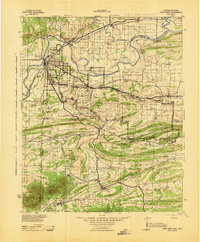 1943 Fort Smith1943 Print · USGSFort Smith and the Arkansas River valley are shown here during the height of the Second World War as the region became a major military hub. Genealogists and researchers can locate several rural schools and churches, such as St Marys School and Pleasant Ridge Church and Cem, alongside industrial sites like the Strip Mine and Smelter.
 - 1946 Map of Fort Smith
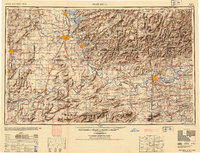 1946 Fort Smith1946 Print · USGSThe Arkansas-Oklahoma borderlands appear here in the mid-forties, as new reservoirs began to transform the river valleys. Genealogists and historians can trace rail-served towns from Muskogee to Fort Smith and locate landmarks like Camp Chaffee.
 - 1947 Map of Lavaca, 1954 Print
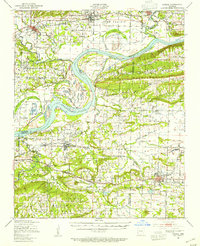 1947 Lavaca1954 Print · USGSThe Arkansas River valley in the late 1940s reveals a landscape of growing energy production and military expansion. Genealogists can trace family roots through Nixon Cem, Harmony Ch, and the streets of Charleston and Lavaca.
 - 1947 Map of Van Buren, 1954 Print
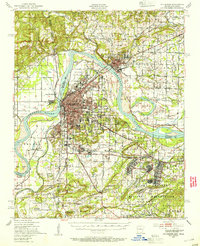 1947 Van Buren1954 Print · USGSThe riverfront cities of Fort Smith and Van Buren are shown in the late 1940s, just as the regional industrial footprint was expanding. Researchers can trace the rail lines of the Missouri Pacific or locate local landmarks like St Scholastica Academy and the Zinc Smelter.
 - 1947 Map of Van Buren, 1969 Print
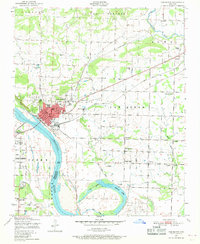 1947 Van Buren1969 Print · USGSVan Buren and the northern reaches of Fort Smith are shown in the late 1940s during a period of heavy industrial activity. Researchers can find numerous strip mines, the zinc smelter, and several country churches including Sunnyside Church.3 unique versions available
 - 1948 Map of Alma, 1971 Print
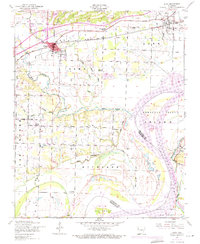 1948 Alma1971 Print · USGSCrawford County settlements and the Arkansas River valley are captured here at mid-century, just as the Ozark Reservoir began to reshape the shoreline. Genealogists can trace family landmarks like Bills Cemetery and Pleasant Home Church or locate the site of an Abandoned mine near Yoestown.2 unique versions available
End of results
Showing maps 1-6 of 6
Top cities near Kibler
- Fort Smith historical maps
- Van Buren historical maps
- Greenwood historical maps
- Alma historical maps
- Barling historical maps
- Pocola historical maps
See more
Frequently asked questions
- What are the different types of historical maps available for Kibler?
- What is the oldest map of Kibler?
- Where can I purchase historical maps of Kibler for my home or office?
- Where can I download high-res historical maps of Kibler?
- Are there historical topographic maps available for Kibler?
- Is there historical aerial imagery available for Kibler?
- Where are historical maps of Kibler sourced from?