1900s (20th Century) Maps of Aguanga, California
Explore 12 historic maps of Aguanga from the 1900s (20th Century). These maps offer a rare glimpse into what life looked like during the 1900s — showing old roads, neighborhoods, homes, and landmarks that have changed or disappeared over time.
Whether you're researching your family's past, planning a metal detecting trip, or studying how Aguanga's landscape evolved across the 1900s, these high-resolution maps are a powerful tool for exploring the history of this region.
- Focus on a specific era: All maps on this page are from the 1900s, giving you a focused view of this time period.
- See what’s changed: Compare century-old streets, trails, and buildings to today's modern landscape using overlays and satellite layers.
- Research with precision: Use these maps for genealogy, historical research, land use analysis, or educational projects.
- View, download, or print: Maps are fully viewable online in high resolution, and can be downloaded or printed for your own records.
Start exploring Aguanga's history through authentic maps from the 1900s. This is your window into the past.
Aguanga, CA maps
(12)- 1903 Map of Ramona
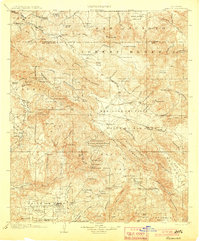 1903 Ramona1903 Print · USGSSan Diego County's high country and interior valleys are captured here at the start of the twentieth century, during a time of mountain ranching and early gold mining. Researchers can trace the early footprints of Julian, Ramona, and Mesa Grande, alongside the boundaries of the San Jacinto Forest Reserve.6 unique versions available
 - 1904 Map of Southern California Sheet No. 2
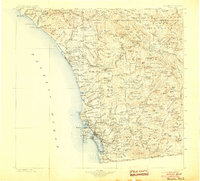 1904 Southern California Sheet No. 21904 Print · USGSSouthern California during the early 1900s shows the transition from vast ranchos to coastal rail towns. Genealogists and researchers can trace the Southern California R.R. through Oceanside, explore old land grants like Mission Viejo, and locate early settlements from Fallbrook to Julian.5 unique versions available
 - 1939 Map of Palomar Mountain, 1957 Print
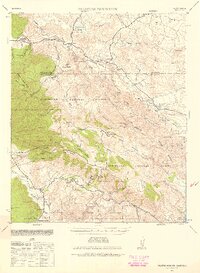 1939 Palomar Mountain1957 Print · USGSNorthern San Diego County is shown in the late 1930s as a landscape of high valleys and remote mountain outposts. Researchers can find the iconic Observatory, the historic Stage Sta, and the borders of the La Jolla Indian Reservation.3 unique versions available
 - 1947 Map of Santa Ana, 1949 Print
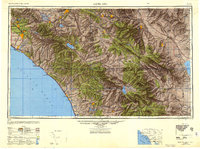 1947 Santa Ana1949 Print · USGSSouthern California is depicted here in the late forties, showing the expansion of the Inland Empire and the Orange County coast. Researchers can trace the early layout of Palm Springs or locate long-standing tribal lands like the Pala Indian Reservation and Rincon Indian Res.
 - 1949 Map of Santa Ana
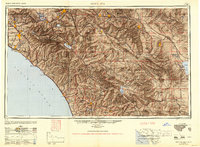 1949 Santa Ana1949 Print · USGSSouthern California underwent a profound transformation in the late 1940s as military installations and citrus groves shared the landscape. Researchers can trace early coastal growth at Laguna Beach, military history at Camp Pendleton, and the rail corridors of the Pacific Electric.
 - 1954 Map of Aguanga, 1955 Print
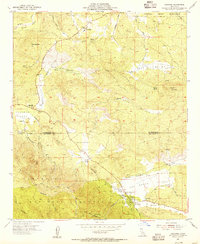 1954 Aguanga1955 Print · USGSThe Aguanga area in the mid-1950s remained a landscape of historic cattle ranches and stage routes. Genealogists and historians can trace the legacy of early travel at the Oak Grove Stage Station Historical Marker or locate the ranching footprint of Dry Ranch and Oak Grove.9 unique versions available
 - 1956 Map of Santa Ana
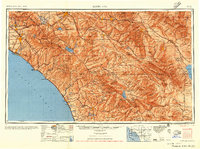 1956 Santa Ana1956 Print · USGSSouthern California underwent massive mid-century transformation as suburban growth met major military and water projects. Trace the postwar expansion of Santa Ana and Riverside, the layout of Camp Pendleton, and the path of the Colorado River Aqueduct.
 - 1959 Map of Santa Ana, 1971 Print
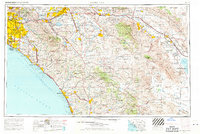 1959 Santa Ana1971 Print · USGSSouthern California is captured in a decade of transformation, from the Orange County coast to the desert floor. Researchers can trace the mid-century footprints of Camp Pendleton, March Air Force Base, and the original Ortega Highway.3 unique versions available
 - 1960 Map of Santa Ana
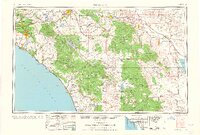 1960 Santa Ana1960 Print · USGSSouthern California's coastal plains and inland deserts meet in this mid-century survey of the burgeoning Orange and Riverside county corridors. Researchers can trace the layout of early freeway systems, find tribal lands like the Soboba Indian Reservation, and locate military landmarks such as March Field.2 unique versions available
 - 1965 Map of Santa Ana
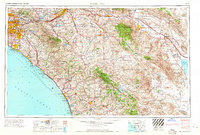 1965 Santa Ana1965 Print · USGSSouthern California is captured in a decade of rapid growth, showing the coastal expansion from Santa Ana down to Oceanside. Genealogists and historians can trace the mid-century development of places like Garden Grove or the rural reaches of Escondido and the Palomar Observatory.
 - 1982 Map of Borrego Valley, 1983 Print
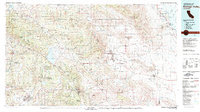 1982 Borrego Valley1983 Print · USGSThe high desert and coastal mountains of San Diego County come together in the early eighties. Researchers can trace the boundaries of the Los Coyotes Indian Reservation or locate the Desert Queen Mine and Palomar Observatory.2 unique versions available
 - 1997 Map of Aguanga, 2000 Print
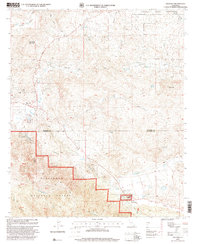 1997 Aguanga2000 Print · USGSSouthern California’s interior transition from ranching valleys to national forest is captured here during the late 1990s. Genealogists and historians can locate the Oak Grove Stage Station Historical Marker and Camp Wright Historical Marker near Oak Grove.
End of results
Showing maps 1-12 of 12
Top cities near Aguanga
- Murrieta historical maps
- Temecula historical maps
- Palm Springs historical maps
- Valley Center historical maps
Frequently asked questions
- What are the different types of historical maps available for Aguanga?
- What is the oldest map of Aguanga?
- Where can I purchase historical maps of Aguanga for my home or office?
- Where can I download high-res historical maps of Aguanga?
- Are there historical topographic maps available for Aguanga?
- Is there historical aerial imagery available for Aguanga?
- Where are historical maps of Aguanga sourced from?