1950s Maps of Lamond Riggs, Washington
Explore 6 historic maps of Lamond Riggs from the 1950s. These maps offer a rare glimpse into what life looked like during the 1950s — showing old roads, neighborhoods, homes, and landmarks that have changed or disappeared over time.
Whether you're researching your family's past, planning a metal detecting trip, or studying how Lamond Riggs's landscape evolved across the 1950s, these high-resolution maps are a powerful tool for exploring the history of this region.
- Focus on a specific era: All maps on this page are from the 1950s, giving you a focused view of this time period.
- See what’s changed: Compare century-old streets, trails, and buildings to today's modern landscape using overlays and satellite layers.
- Research with precision: Use these maps for genealogy, historical research, land use analysis, or educational projects.
- View, download, or print: Maps are fully viewable online in high resolution, and can be downloaded or printed for your own records.
Start exploring Lamond Riggs's history through authentic maps from the 1950s. This is your window into the past.
Lamond Riggs, Washington maps
(6)- 1951 Map of Washington East
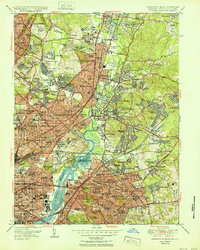 1951 Washington East1951 Print · USGSThe Maryland and District of Columbia borderlands are caught in a period of intense post-war development. Local historians can trace the foundations of the University of Maryland, find the Franciscan Monastery, and locate vanished landmarks like Riggs Mill.
 - 1951 Map of Washington West
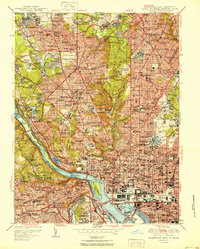 1951 Washington West1951 Print · USGSWashington D.C. and its Maryland and Virginia suburbs appear here in the early fifties, just as the metropolitan area was beginning its massive post-war growth. Researchers can locate vanished streetscapes and institutional landmarks like the U S Soldiers Home, Glenwood Cem, and the historic Washington Cathedral.
 - 1956 Map of Washington West, 1958 Print
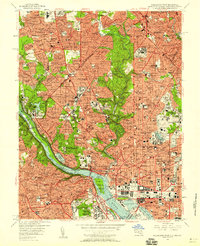 1956 Washington West1958 Print · USGSMid-century Washington and its Maryland and Virginia suburbs appear here during a transformative era of growth. Genealogists and historians can trace neighborhood development and find landmarks like Arlington National Cemetery, the U S Capitol, and Georgetown University.
 - 1956 Map of Washington East, 1959 Print
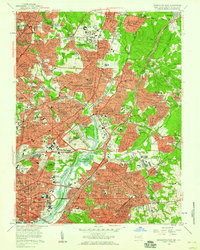 1956 Washington East1959 Print · USGSThe northern reaches of the capital and its Maryland suburbs come into focus during the mid-fifties, showing a landscape defined by institutional campuses and rail lines. Genealogists and historians can trace significant burial grounds like Mt Olivet Cemetery or locate historic landmarks such as Bird Stadium and the National Training School for Boys.
 - 1957 Map of Washington East, 1962 Print
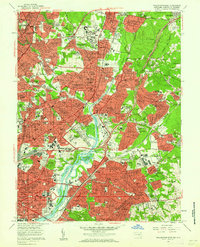 1957 Washington East1962 Print · USGSThe eastern edges of the District and Maryland's inner suburbs are captured here at the height of post-war growth. Researchers can trace the mid-century layout of local landmarks like the National Arboretum, the College Park Airport, and Mt Olivet Cemetery.
 - 1957 Map of Washington, 1966 Print
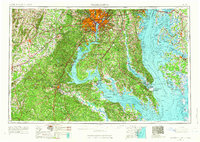 1957 Washington1966 Print · USGSThe mid-Atlantic region during the mid-fifties and early sixties reveals a landscape of growing suburbs and vital military outposts. Researchers can trace historic river towns and shorelines from Alexandria to the Hooper Islands and St Clements Island.5 unique versions available
End of results
Showing maps 1-6 of 6
Frequently asked questions
- What are the different types of historical maps available for Lamond Riggs?
- What is the oldest map of Lamond Riggs?
- Where can I purchase historical maps of Lamond Riggs for my home or office?
- Where can I download high-res historical maps of Lamond Riggs?
- Are there historical topographic maps available for Lamond Riggs?
- Is there historical aerial imagery available for Lamond Riggs?
- Where are historical maps of Lamond Riggs sourced from?