1900s (20th Century) Maps of Victory Township, Iowa
Explore 11 historic maps of Victory Township from the 1900s (20th Century). These maps offer a rare glimpse into what life looked like during the 1900s — showing old roads, neighborhoods, homes, and landmarks that have changed or disappeared over time.
Whether you're researching your family's past, planning a metal detecting trip, or studying how Victory Township's landscape evolved across the 1900s, these high-resolution maps are a powerful tool for exploring the history of this region.
- Focus on a specific era: All maps on this page are from the 1900s, giving you a focused view of this time period.
- See what’s changed: Compare century-old streets, trails, and buildings to today's modern landscape using overlays and satellite layers.
- Research with precision: Use these maps for genealogy, historical research, land use analysis, or educational projects.
- View, download, or print: Maps are fully viewable online in high resolution, and can be downloaded or printed for your own records.
Start exploring Victory Township's history through authentic maps from the 1900s. This is your window into the past.
Victory Township, IA maps
(11)- 1952 Map of Panora, 1954 Print
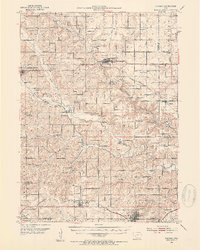 1952 Panora1954 Print · USGSGuthrie County and parts of Adair and Dallas counties are shown here in the early 1950s as a thriving rail and river corridor. Genealogists can trace family roots through several rural churches and schools like Victory Union Church, Pioneer Sch, and Rosehill Cem.2 unique versions available
 - 1954 Map of Bagley, 1956 Print
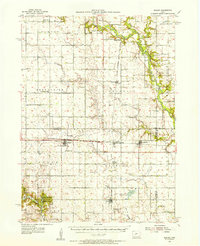 1954 Bagley1956 Print · USGSGuthrie and Greene counties are shown in the mid-fifties as the railroad network still linked small agricultural towns. Genealogists can trace family roots through Greenbrier Cem and St Marys Ch or locate the many Flowing Well sites across the prairie.
 - 1954 Map of Omaha, 1967 Print
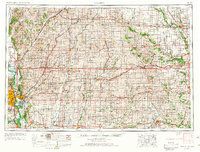 1954 Omaha1967 Print · USGSMid-century development radiates from the river bluffs into the agricultural heartland during this period of post-war growth. Genealogists and historians can trace rail-connected towns like Atlantic and Red Oak or locate the sprawling grounds of Offutt Air Force Base and Manawa Lake.3 unique versions available
 - 1957 Map of Omaha
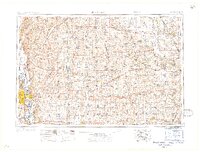 1957 Omaha1957 Print · USGSWestern Iowa and the Missouri River valley are seen here in the mid-fifties during the height of the rail-and-road era. Researchers can trace the sprawling rail lines of the Chicago And North Western or locate Cold War landmarks like Offutt Air Force Base.
 - 1958 Map of Omaha
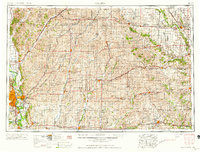 1958 Omaha1958 Print · USGSOmaha and Council Bluffs stand at the center of this mid-fifties landscape, where the Missouri River splits the urban plains of Nebraska from the rolling hills of western Iowa. Genealogists can trace the rail lines of the Wabash RR and Illinois Central RR to rural settlements like Missouri Valley and Red Oak.2 unique versions available
 - 1971 Map of Bayard, 1973 Print
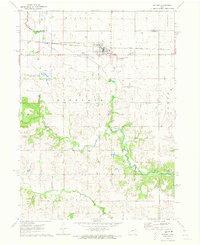 1971 Bayard1973 Print · USGSBayard and the surrounding Guthrie County townships are shown in the early 1970s, defined by the Chicago Milwaukee St Paul and Pacific rail line. Researchers can locate the Highland Cem, trace the Middle Raccoon River, or explore the Mc Cord Pond State Wildlife Management Area.
 - 1971 Map of Guthrie Center West, 1973 Print
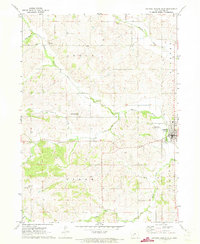 1971 Guthrie Center West1973 Print · USGSGuthrie County’s agricultural landscape is captured here in the early seventies, showing the western outskirts of the county seat. Genealogists and local historians can locate Wichita Cem, the rural Townhall, and the layout of Guthrie Center near the Fairground.
 - 1982 Map of Guthrie Center East, 1983 Print
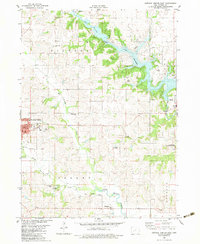 1982 Guthrie Center East1983 Print · USGSGuthrie County’s agricultural and river landscape is captured here in the early eighties as rail lines were being replaced by new landmarks. Local historians can trace old property and civic roots at Victory Union Cem, the Old Railroad Grade near Monteith, and Lake Panorama.
 - 1982 Map of Bagley, 1983 Print
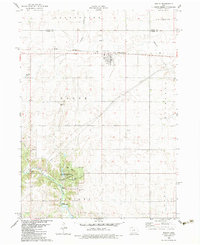 1982 Bagley1983 Print · USGSGuthrie and Greene counties intersect in this early 1980s view of the Iowa countryside as agricultural life centered around the rail lines. Genealogists and researchers can trace the rural landscape through Dodge Center Cem, the Springbrook State Park woodlands, and the original Bagley townsite.
 - 1984 Map of Guthrie Center, 1985 Print
 1984 Guthrie Center1985 Print · USGSWest-central Iowa's river valleys and farming townships are shown here in the mid-1980s, highlighting a network of conservation areas and historic rail towns. Genealogists and local historians can locate Violet Hill Cem, trace the Chicago and North Western railroad, or explore the grounds of Springbrook State Park.
 - 1993 Map of Guthrie Center
 1993 Guthrie Center1993 Print · USGSWestern Iowa in the early 1990s showcases a network of river-valley towns and essential rail corridors. Researchers can trace local landmarks like Violet Hill Cem and the Chicago and North Western RR through Coon Rapids and Panora.
End of results
Showing maps 1-11 of 11
Top cities near Victory Township
- Stuart historical maps
- Guthrie Center historical maps
- Coon Rapids historical maps
- Panora historical maps
- Adair historical maps
- Dexter historical maps
See more
Top neighborhoods of Victory Township
Frequently asked questions
- What are the different types of historical maps available for Victory Township?
- What is the oldest map of Victory Township?
- Where can I purchase historical maps of Victory Township for my home or office?
- Where can I download high-res historical maps of Victory Township?
- Are there historical topographic maps available for Victory Township?
- Is there historical aerial imagery available for Victory Township?
- Where are historical maps of Victory Township sourced from?