1900s (20th Century) Maps of Parkwood, Louisville
Explore 11 historic maps of Parkwood from the 1900s (20th Century). These maps offer a rare glimpse into what life looked like during the 1900s — showing old roads, neighborhoods, homes, and landmarks that have changed or disappeared over time.
Whether you're researching your family's past, planning a metal detecting trip, or studying how Parkwood's landscape evolved across the 1900s, these high-resolution maps are a powerful tool for exploring the history of this region.
- Focus on a specific era: All maps on this page are from the 1900s, giving you a focused view of this time period.
- See what’s changed: Compare century-old streets, trails, and buildings to today's modern landscape using overlays and satellite layers.
- Research with precision: Use these maps for genealogy, historical research, land use analysis, or educational projects.
- View, download, or print: Maps are fully viewable online in high resolution, and can be downloaded or printed for your own records.
Start exploring Parkwood's history through authentic maps from the 1900s. This is your window into the past.
Parkwood, Louisville maps
(11)- 1909 Map of Kosmosdale
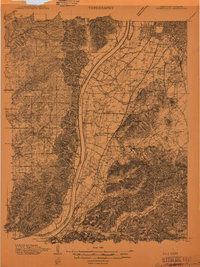 1909 Kosmosdale1909 Print · USGSSouthwest of Louisville at the turn of the century, the river valley meets the steep slopes of Muldraughs Hill. Researchers can trace early rural life through several family-named schoolhouses and small settlements like Kosmosdale, Valley Sta, and the County Infirmary.
 - 1912 Map of Kosmosdale
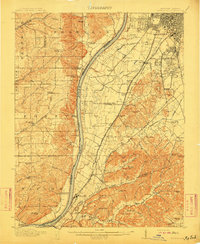 1912 Kosmosdale1912 Print · USGSThe Ohio River valley and the Kentucky Knobs come alive in this pre-war survey, showing the expansion of southern Louisville and the rural hills of Jefferson and Bullitt counties. Researchers can locate vanished landmarks like Locust Point P.O. and the County Infirmary, or trace the old riverboat stops at Stewarts Landing.4 unique versions available
 - 1950 Map of Kosmosdale, 1959 Print
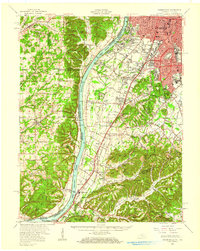 1950 Kosmosdale1959 Print · USGSGreater Louisville and the Ohio River valley are captured here at mid-century, showing the city's industrial south side meeting rural river towns. Genealogists and historians can trace family locations through Lanesville Cem, the Waverly Hills Sanatorium, and Churchill Downs.
 - 1955 Map of Louisville West, 1957 Print
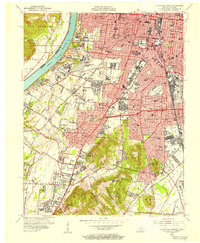 1955 Louisville West1957 Print · USGSLouisville and its southwestern suburbs are captured here during a decade of significant growth and post-war industrial activity. Researchers can trace historic landmarks like Churchill Downs, the Waverly Hills Sanatorium, and neighborhood schools like Virginia Ave Sch.
 - 1956 Map of Louisville, 1971 Print
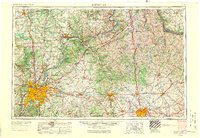 1956 Louisville1971 Print · USGSThe Ohio River valley and the Kentucky Bluegrass are captured here during a period of rapid mid-century growth and industrial activity. Genealogists and historians can trace rail-centered towns and military land use at Fort Knox and the Jefferson Proving Ground.2 unique versions available
 - 1960 Map of Louisville West, 1961 Print
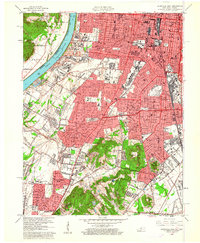 1960 Louisville West1961 Print · USGSLouisville and its southern suburbs are captured here during a era of major post-war expansion and highway development. Genealogists and historians can trace family roots through numerous neighborhood landmarks like Hazelwood Sanatorium, St Denis, and Churchill Downs.
 - 1964 Map of Louisville
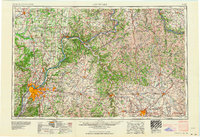 1964 Louisville1964 Print · USGSThe Ohio River valley and Kentucky Bluegrass are captured in the mid-1960s, showing a region balanced between industrial growth and its agrarian roots. Genealogists and historians can trace the development of county seats like Shelbyville and Paris, or locate established institutions such as Georgetown College and Bernheim Forest.
 - 1965 Map of Louisville West, 1966 Print
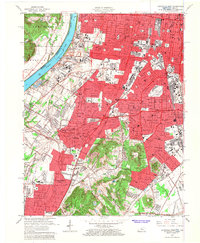 1965 Louisville West1966 Print · USGSThe southwest Louisville corridor in the mid-sixties shows an urban landscape balancing industrial rail hubs with burgeoning suburbs. Researchers can trace the footprints of the U S Naval Ordnance Plant, the Hazelwood Sanatorium, and family sites like Farnsley Cem.
 - 1983 Map of Louisville West, 1984 Print
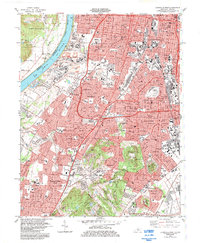 1983 Louisville West1984 Print · USGSGreater Louisville and its southwestern neighborhoods are shown here just after the post-war suburban boom transformed the landscape. Researchers can trace historic family burial sites at St Stephens Cem or locate community anchors like Simmons University and the U S Naval Ordnance Plant.3 unique versions available
 - 1986 Map of Louisville
 1986 Louisville1986 Print · USGSMid-1980s Louisville and southern Indiana are shown here during a decade of significant suburban growth and infrastructure development. Researchers can trace the layout of Cave Hill Cemetery, the expansion of Standiford Field, and industrial sites like the Indiana Army Ammunition Plant.2 unique versions available
 - 1998 Map of Louisville West, 2000 Print
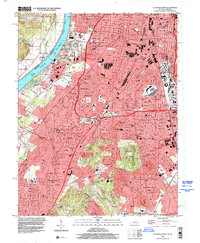 1998 Louisville West2000 Print · USGSThe western reaches of Louisville and the Ohio River shoreline appear here at the close of the century. Local historians can trace neighborhood growth through parish schools and landmarks like Churchill Downs, Waverly Hills, and Iroquois Park.
End of results
Showing maps 1-11 of 11
Top cities near Parkwood
- Louisville historical maps
- Jeffersonville historical maps
- New Albany historical maps
- Jeffersontown historical maps
- Clarksville historical maps
- Shively historical maps
See more
Frequently asked questions
- What are the different types of historical maps available for Parkwood?
- What is the oldest map of Parkwood?
- Where can I purchase historical maps of Parkwood for my home or office?
- Where can I download high-res historical maps of Parkwood?
- Are there historical topographic maps available for Parkwood?
- Is there historical aerial imagery available for Parkwood?
- Where are historical maps of Parkwood sourced from?