1900s (20th Century) Maps of Hound Ears, North Carolina
Explore 10 historic maps of Hound Ears from the 1900s (20th Century). These maps offer a rare glimpse into what life looked like during the 1900s — showing old roads, neighborhoods, homes, and landmarks that have changed or disappeared over time.
Whether you're researching your family's past, planning a metal detecting trip, or studying how Hound Ears's landscape evolved across the 1900s, these high-resolution maps are a powerful tool for exploring the history of this region.
- Focus on a specific era: All maps on this page are from the 1900s, giving you a focused view of this time period.
- See what’s changed: Compare century-old streets, trails, and buildings to today's modern landscape using overlays and satellite layers.
- Research with precision: Use these maps for genealogy, historical research, land use analysis, or educational projects.
- View, download, or print: Maps are fully viewable online in high resolution, and can be downloaded or printed for your own records.
Start exploring Hound Ears's history through authentic maps from the 1900s. This is your window into the past.
Hound Ears, NC maps
(10)- 1902 Map of Cranberry
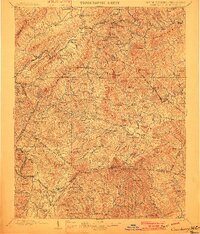 1902 Cranberry1902 Print · USGSThe North Carolina and Tennessee borderlands are captured here at the turn of the century as early railroads began penetrating the high ridges. Genealogists can trace family names and old settlements like Mountain City, Shoun Crossroads, and the industry at Rhea Forge.6 unique versions available
 - 1934 Map of Boone
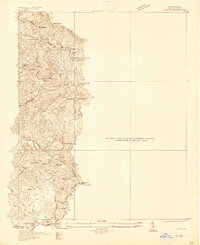 1934 Boone1934 Print · USGSWatauga County's high country is captured here during the mid-1930s, showing a network of mountain communities and early state highways. You can trace the locations of the County Home, the rural crossroads at Shulls Mills, and local landmarks like the Blue Moon Service Sta.
 - 1936 Map of Blowing Rock
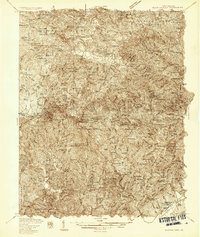 1936 Blowing Rock1936 Print · USGSThe North Carolina high country around Boone and Blowing Rock is documented here in the mid-1930s. Genealogists and researchers can trace family-named landmarks and mountain institutions, from the COUNTY HOME to remote sites like Bailey Camp Sch and St Marys Ch.
 - 1942 Map of Blowing Rock
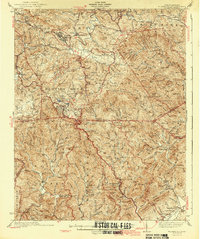 1942 Blowing Rock1942 Print · USGSWatauga and Caldwell Counties are shown here during the late nineteen-thirties and early forties, capturing the traditional highland communities and early development of the Blue Ridge Parkway. Genealogists can locate family landmarks like Shulls Mills, Poplar Grove Ch, and Liberty Hill Sch.4 unique versions available
 - 1953 Map of Winston-Salem, 1974 Print
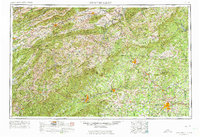 1953 Winston-Salem1974 Print · USGSThe North Carolina Piedmont and Virginia highlands meet in the mid-1950s, a landscape defined by the tobacco and textile hubs of the Blue Ridge foothills. Researchers can trace the rail-and-river geography connecting Winston-Salem to mountain towns like Mount Airy and Galax.2 unique versions available
 - 1955 Map of Winston-Salem
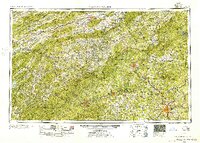 1955 Winston-Salem1955 Print · USGSThe Central Blue Ridge and Piedmont transition are captured here in the mid-fifties, from the industrial hub of Winston-Salem to the high peaks of Southwest Virginia. Genealogists can trace family landmarks like Richmond Hill Ch, Siloam Ch, and the old rail stops along the Southern Railway.
 - 1959 Map of Boone, 1962 Print
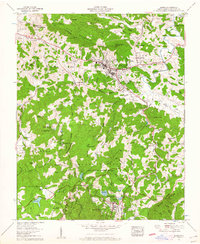 1959 Boone1962 Print · USGSWatauga County at the end of the fifties reveals a growing mountain landscape centered on the college town of Boone. Genealogists and historians can trace family cemeteries like Adams Cem and Vannoy Cem or explore early recreation sites at Chetola Lake and Camp Sky Ranch.5 unique versions available
 - 1962 Map of Winston-Salem
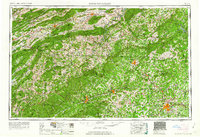 1962 Winston-Salem1962 Print · USGSThe North Carolina Piedmont meets the Virginia highlands in the early sixties, showing the rail corridors and mountain gaps of the southern Appalachians. Researchers can trace the Blue Ridge Parkway or locate family sites near Winston-Salem, Mount Airy, and Hanging Rock Mountain.
 - 1985 Map of Boone, 1986 Print
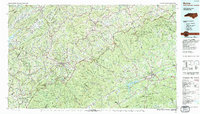 1985 Boone1986 Print · USGSThe High Country and Blue Ridge Mountains come into focus during the mid-eighties as Boone and its surrounding wilderness areas undergo modern expansion. Genealogists and historians can trace family-named ridges and landmarks near Appalachian State University, the Cranberry Mines, and Valle Crucis.2 unique versions available
 - 1994 Map of Boone, 1998 Print
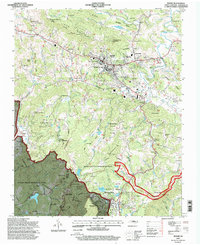 1994 Boone1998 Print · USGSThe High Country of Watauga County comes alive in the mid-nineties as the university town of Boone expands toward the Blue Ridge. Genealogists and historians can trace family burial sites like Piny Grove Cem and rural landmarks from Shulls Mills to Three Forks Ch.
End of results
Showing maps 1-10 of 10
Top cities near Hound Ears
- Boone historical maps
- Lenoir historical maps
- Blowing Rock historical maps
- Banner Elk historical maps
- Newland historical maps
- Seven Devils historical maps
See more
Frequently asked questions
- What are the different types of historical maps available for Hound Ears?
- What is the oldest map of Hound Ears?
- Where can I purchase historical maps of Hound Ears for my home or office?
- Where can I download high-res historical maps of Hound Ears?
- Are there historical topographic maps available for Hound Ears?
- Is there historical aerial imagery available for Hound Ears?
- Where are historical maps of Hound Ears sourced from?