1900s (20th Century) Maps of Haversham, Westerly
Explore 11 historic maps of Haversham from the 1900s (20th Century). These maps offer a rare glimpse into what life looked like during the 1900s — showing old roads, neighborhoods, homes, and landmarks that have changed or disappeared over time.
Whether you're researching your family's past, planning a metal detecting trip, or studying how Haversham's landscape evolved across the 1900s, these high-resolution maps are a powerful tool for exploring the history of this region.
- Focus on a specific era: All maps on this page are from the 1900s, giving you a focused view of this time period.
- See what’s changed: Compare century-old streets, trails, and buildings to today's modern landscape using overlays and satellite layers.
- Research with precision: Use these maps for genealogy, historical research, land use analysis, or educational projects.
- View, download, or print: Maps are fully viewable online in high resolution, and can be downloaded or printed for your own records.
Start exploring Haversham's history through authentic maps from the 1900s. This is your window into the past.
Haversham, Westerly maps
(11)- 1919 Map of Charlestown
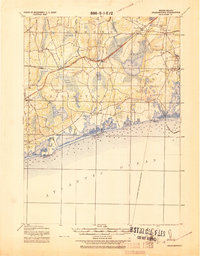 1919 Charlestown1919 Print · USGSCoastal Rhode Island just after the Great War shows a landscape of rail-connected mill villages and sprawling salt ponds. Researchers can trace the legacy of the R.I. Agricultural College or locate landmarks like the King Philip Monument and Indian Burying Hill.
 - 1921 Map of Charlestown
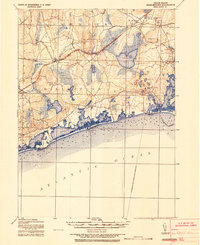 1921 Charlestown1921 Print · USGSThe Rhode Island coastline near Charlestown is shown in the early twentieth century before modern development altered the barrier beaches. Trace family history through the inland rail junctions and schools like R.I. Agricultural College and Wood River Junction.
 - 1942 Map of Block Island, 1943 Print
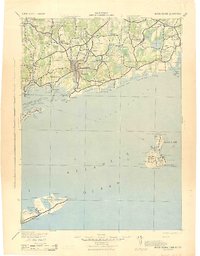 1942 Block Island1943 Print · USGSThe coastal borderlands of Rhode Island and Connecticut are captured here during the wartime years, documenting a landscape defined by rail and sea. Researchers can trace the NY NH & H RR through historic mill villages or locate landmarks like the Silex Mine and Indian Burying Hill.2 unique versions available
 - 1944 Map of Quonochontaug
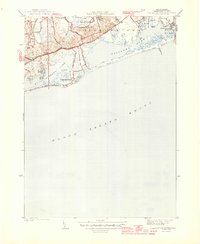 1944 Quonochontaug1944 Print · USGSThe Rhode Island shoreline appears in mid-century detail during the early 1940s, highlighting the expansive lagoons and salt ponds of the coast. Genealogists and local historians can trace the early layouts of Shelter Harbor, Quonochontaug, and Haversham.2 unique versions available
 - 1947 Map of Providence, 1948 Print
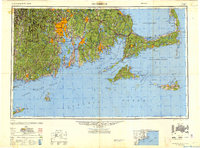 1947 Providence1948 Print · USGSSouthern New England is captured in the mid-1940s, showing a landscape defined by busy industrial ports and expanding military installations. Researchers can trace the rail lines of the N.Y. N.H. & H. RR or locate coastal defenses like Fort Adams and Quonset Point.5 unique versions available
 - 1948 Map of Providence, 1951 Print
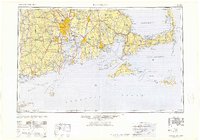 1948 Providence1951 Print · USGSSouthern New England’s coastal reaches are captured here in the late 1940s, from the industrial heart of Providence to the tip of Provincetown. Genealogists and historians can trace rail lines like the Central Vermont Railway and locate active military sites such as Otis Air Force Base and Fort Rodman.
 - 1953 Map of Quonochontaug
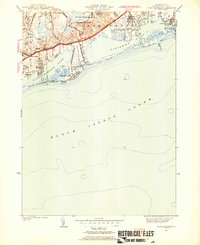 1953 Quonochontaug1953 Print · USGSThe Rhode Island shoreline in the early fifties shows a coastal landscape shaped by military aviation and growing seasonal tourism. Genealogists and local historians can trace the mid-century footprints of Shelter Harbor, the U S Naval Auxiliary Air Station, and the Drive-In Theater.5 unique versions available
 - 1957 Map of Providence
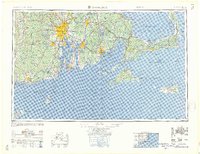 1957 Providence1957 Print · USGSCoastal New England at the height of the mid-century era shows a landscape shaped by maritime industry and Cold War defense. Genealogists and historians can trace the reach of the New York, New Haven & Hartford RR and locate legacy sites like Fort Adams and Quonset Point Naval Air Station.
 - 1958 Map of Providence
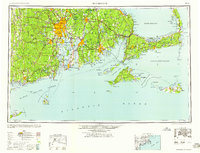 1958 Providence1958 Print · USGSThe Rhode Island and Massachusetts coastlines are shown in detail during the late 1950s, from the urban cores to the tips of the islands. Researchers can trace the mid-century footprint of Quonset Point Naval Air Station, the defense works at Fort Adams, and the rail network of the New York, New Haven and Hartford RR.
 - 1963 Map of Providence
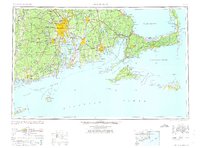 1963 Providence1963 Print · USGSSouthern New England's coastal and industrial heartland is captured here in the early sixties, from the Rhode Island mainland to the far reaches of the Cape. Researchers can trace mid-century growth in Providence or locate landmarks on Marthas Vineyard and Nantucket Island.
 - 1984 Map of Block Island
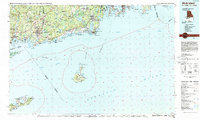 1984 Block Island1984 Print · USGSThe coastal borderlands of Rhode Island, Connecticut, and New York are captured here in the mid-eighties, from the rail hubs of Westerly to the shores of Block Island. Genealogists and historians can trace the shoreline's evolution through landmarks like the Pequot Indian Res, New Shoreham, and Narragansett Pier.
End of results
Showing maps 1-11 of 11
Frequently asked questions
- What are the different types of historical maps available for Haversham?
- What is the oldest map of Haversham?
- Where can I purchase historical maps of Haversham for my home or office?
- Where can I download high-res historical maps of Haversham?
- Are there historical topographic maps available for Haversham?
- Is there historical aerial imagery available for Haversham?
- Where are historical maps of Haversham sourced from?