Old Maps of Gulliver Oaks, Fountain Inn for Academic Research
Study the evolution of Gulliver Oaks with 11 high-resolution historic maps. Whether you're teaching, researching, or modeling changes in land use, these maps provide essential visual documentation of urban, environmental, and geographic change.
- Analyze long-term change: Track patterns in development, transportation, and natural features.
- Ideal for environmental or urban studies: Support academic projects with primary historical map data.
- Use in the classroom or lab: Educators and researchers rely on these maps to bring historical context to life.
These maps are a powerful tool for teaching, research, and visualizing how Gulliver Oaks has changed over the decades.
Gulliver Oaks, Fountain Inn maps
(11)- 1954 Map of Greenville, 1965 Print
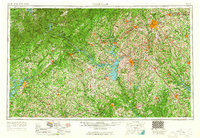 1954 Greenville1965 Print · USGSThe Upstate and Northeast Georgia are captured here during a decade of massive transformation as new reservoirs reshaped the Piedmont. Genealogists and hikers can trace the Appalachian Trail over Brasstown Bald or locate old community centers like Demorest, Westminster, and Royston.3 unique versions available
 - 1957 Map of Fountain Inn, 1958 Print
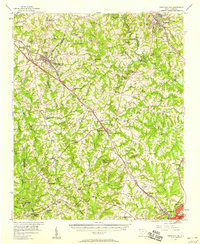 1957 Fountain Inn1958 Print · USGSThe South Carolina upstate's rural textile and transit corridor is captured here in the late fifties, following the rail line through Fountain Inn and Gray Court. Genealogists can trace family landmarks and rural life at Hickory Tavern, Knighton Chapel, and Bryson High Sch.
 - 1958 Map of Greenville
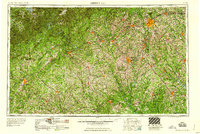 1958 Greenville1958 Print · USGSThe Piedmont and Blue Ridge foothills come alive in this mid-century survey of the Upstate and Northeast Georgia. Trace the regional rail-and-river economy through the Southern Railway corridors and early reservoir developments like Lake Sidney Lanier.
 - 1983 Map of Fountain Inn
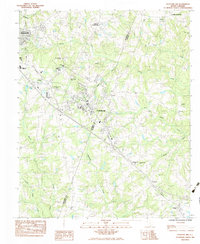 1983 Fountain Inn1983 Print · USGSThe Upstate's growth and rural roots are visible here in the early eighties as residential expansion begins to surround traditional farming communities. Trace family history and local land use at Old Shady Oak Ch, the SEABOARD rail line, and Gaylord Crossroads.
 - 1984 Map of Greenville
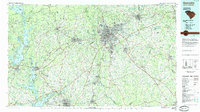 1984 Greenville1984 Print · USGSThe South Carolina Upstate undergoes rapid suburban growth in the mid-eighties as modern interstates begin to reshape the landscape. Researchers can trace historic rail lines like the Greenville and Northern Railway and locate local landmarks such as Clemson University and Paris Mountain State Park.
 - 1991 Map of Greenville
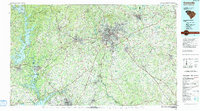 1991 Greenville1991 Print · USGSThe South Carolina Upstate was a landscape of rapid growth and engineering in the early nineties. Researchers can trace the expansion of Greenville and Spartanburg, find Clemson University, or study the massive reservoirs of Hartwell Lake and Lake Keowee.
 - 2011 Map of Fountain Inn, 2011 Print
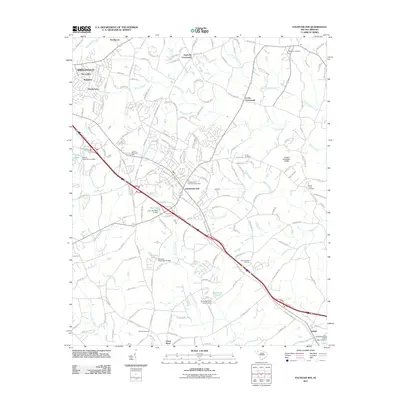 2011 Fountain Inn2011 Print · USGSUpper South Carolina in the early twenty-first century reveals a landscape of growing towns and deep-rooted rural communities. Family historians can trace local lineages through Fountain Inn Municipal Cemetery, Jones Cemetery, and the church at Bethany Church.
 - 2014 Map of Fountain Inn, 2014 Print
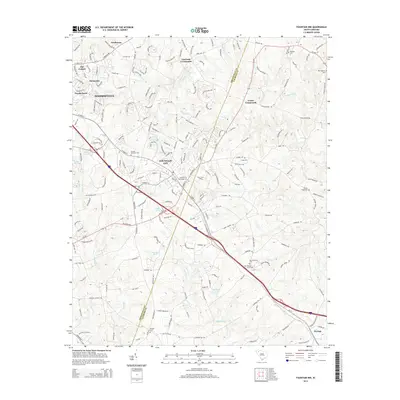 2014 Fountain Inn2014 Print · USGSThe Upstate South Carolina corridor around Fountain Inn and Simpsonville is shown in the mid-2010s during a period of steady residential growth. Researchers can trace family roots through several local burial sites like Bethany Cem, Jones Cem, and the Fountain Inn Municipal Cem.
 - 2017 Map of Fountain Inn, 2017 Print
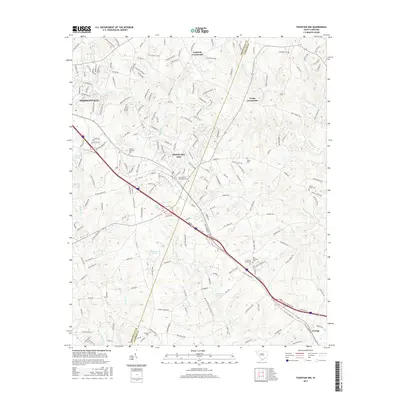 2017 Fountain Inn2017 Print · USGSThe borderlands of Greenville and Laurens counties are mapped here in the late 2010s. Researchers can locate several community landmarks including Fountain Inn Municipal Cemetery, New Harmony Cemetery, and the Cannon Memorial Park.
 - 2020 Map of Fountain Inn, 2020 Print
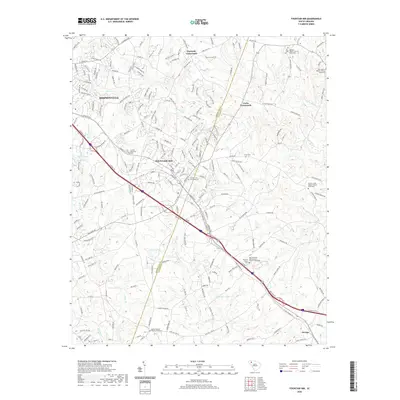 2020 Fountain Inn2020 Print · USGSThe Upstate borderlands of Greenville and Laurens counties come into focus in this recent study of the area. Researchers can trace numerous family-named landmarks and local burial sites, such as the Durbin Cem and Beulah Baptist Church Graveyard.
 - 2024 Map of Fountain Inn, 2024 Print
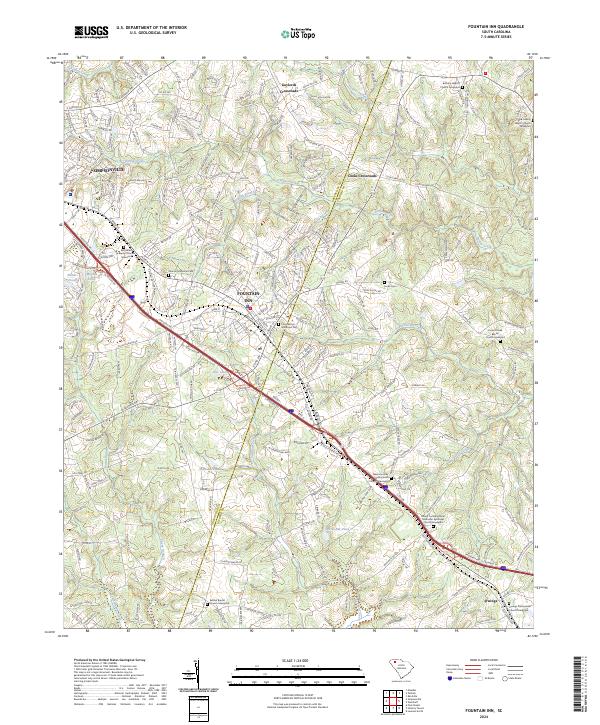 2024 Fountain Inn2024 Print · USGSThe Greenville and Laurens county line comes alive in this contemporary survey of the South Carolina Upstate. Researchers can trace family history through numerous church grounds and cemeteries, including Bethlehem Baptist Church Graveyard and Owings Presbyterian Church Graveyard.
End of results
Showing maps 1-11 of 11
Frequently asked questions
- What are the different types of historical maps available for Gulliver Oaks?
- What is the oldest map of Gulliver Oaks?
- Where can I purchase historical maps of Gulliver Oaks for my home or office?
- Where can I download high-res historical maps of Gulliver Oaks?
- Are there historical topographic maps available for Gulliver Oaks?
- Is there historical aerial imagery available for Gulliver Oaks?
- Where are historical maps of Gulliver Oaks sourced from?