1900s (20th Century) Maps of Post Office Historic District, Greenville
Explore 5 historic maps of Post Office Historic District from the 1900s (20th Century). These maps offer a rare glimpse into what life looked like during the 1900s — showing old roads, neighborhoods, homes, and landmarks that have changed or disappeared over time.
Whether you're researching your family's past, planning a metal detecting trip, or studying how Post Office Historic District's landscape evolved across the 1900s, these high-resolution maps are a powerful tool for exploring the history of this region.
- Focus on a specific era: All maps on this page are from the 1900s, giving you a focused view of this time period.
- See what’s changed: Compare century-old streets, trails, and buildings to today's modern landscape using overlays and satellite layers.
- Research with precision: Use these maps for genealogy, historical research, land use analysis, or educational projects.
- View, download, or print: Maps are fully viewable online in high resolution, and can be downloaded or printed for your own records.
Start exploring Post Office Historic District's history through authentic maps from the 1900s. This is your window into the past.
Post Office Historic District, Greenville maps
(5)- 1953 Map of Andalusia, 1965 Print
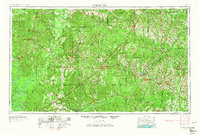 1953 Andalusia1965 Print · USGSSouth Alabama in the mid-twentieth century remains a land of pine forests and river-fed settlements. You can trace the vital rail corridors of the Louisville & Nashville and locate regional centers such as Andalusia, Brewton, and Monroeville.3 unique versions available
 - 1957 Map of Andalusia
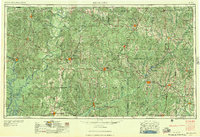 1957 Andalusia1957 Print · USGSSouthern Alabama in the mid-1950s was a landscape defined by timbered stretches and the rhythmic flow of the Alabama River. Researchers can trace the legacy of the rail era through the Central of Georgia tracks and the storied river bluffs at Choctaw Bluff.
 - 1971 Map of Greenville West, 1973 Print
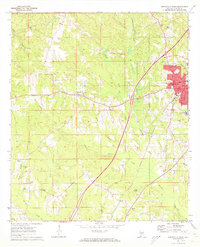 1971 Greenville West1973 Print · USGSButler County in the early seventies shows the city of Greenville expanding westward into a landscape of rural churches and creek branches. Genealogists can trace family roots at Magnolia Cemetery or locate historic congregations like Pleasant Hill Ch and Giddens Ch.2 unique versions available
 - 1971 Map of Greenville East, 1973 Print
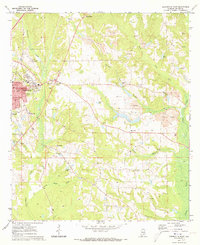 1971 Greenville East1973 Print · USGSGreenville and the surrounding Butler County hills are captured here in the early seventies as the local economy balanced rail transit and surface mining. Genealogists can locate family landmarks like Pioneer Cem, Lomax-Hannon Jr College, and rural outposts such as Mashville.2 unique versions available
 - 1986 Map of Greenville
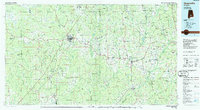 1986 Greenville1986 Print · USGSMid-century South Central Alabama comes alive in this survey of the creek-laced timberlands and rail-dependent towns between the Gulf Coastal Plain and the Piedmont. Researchers can trace family roots through numerous country landmarks like Magnolia Cem, Spring Hill Ch, and the Butler County State Wildlife Management Area.2 unique versions available
End of results
Showing maps 1-5 of 5
Frequently asked questions
- What are the different types of historical maps available for Post Office Historic District?
- What is the oldest map of Post Office Historic District?
- Where can I purchase historical maps of Post Office Historic District for my home or office?
- Where can I download high-res historical maps of Post Office Historic District?
- Are there historical topographic maps available for Post Office Historic District?
- Is there historical aerial imagery available for Post Office Historic District?
- Where are historical maps of Post Office Historic District sourced from?