Old Maps of Pinebrook, California for Metal Detecting
Plan your next treasure hunt with 17 historic maps of Pinebrook. Find old homesites, ghost towns, trails, and gathering spots that may be lost to time — perfect for identifying promising metal detecting locations.
- Locate forgotten sites: Uncover places like long-lost settlements, abandoned rail lines, or gathering spots.
- Plan better hunts: Use map overlays combined with LiDAR or satellite views to narrow in on historically rich areas.
- Made for detectorists: Thousands of hobbyists use these maps to discover relics, coins, and hidden history.
Use these historic maps to boost your research and find new opportunities beneath the surface of Pinebrook.
Pinebrook, CA maps
(17)- 1891 Map of Big Trees
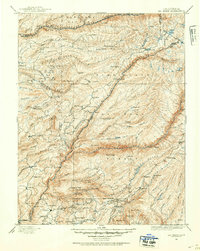 1891 Big Trees1891 Print · USGSThe Sierra Nevada high country and gold country are seen here in the 1890s, a period defined by the mining economy and early mountain passage. Historians can trace early routes like the Bloods Toll Road and locate sites such as Sheep Ranch, the Keltz Mine, and Swiss Ranch.
 - 1894 Map of Big Trees
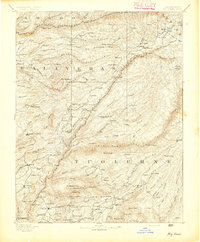 1894 Big Trees1894 Print · USGSCentral California's high Sierra region is documented here in the 1890s, where river crossings and giant sequoia groves defined the landscape. Researchers can trace old mountain routes through Abbott Ferry and Parrott Ferry or locate early mining sites like the Riverside Mine.
 - 1897 Map of Big Trees
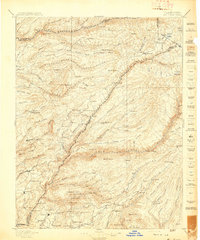 1897 Big Trees1897 Print · USGSThe Sierra Nevada foothills and deep river canyons of the late nineteenth century are mapped here in detail before modern development. Genealogists and historians can trace early mountain life through landmarks like Bloods Toll, the Riverside Mine, and historic crossings at Abbott Ferry.
 - 1901 Map of Big Trees
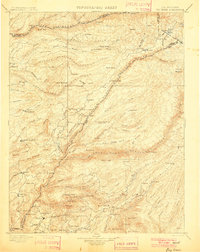 1901 Big Trees1901 Print · USGSThe High Sierra and Gold Country meet in this turn-of-the-century look at the groves and mining camps of the Mokelumne and Stanislaus watersheds. Trace the early boundaries of the Calaveras Grove, locate the Riverside Mine, or find river crossings like Parrott Ferry.9 unique versions available
 - 1947 Map of Sacramento, 1948 Print
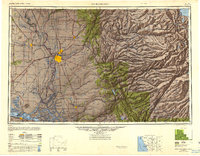 1947 Sacramento1948 Print · USGSThe Sacramento Valley meets the high Sierra during a period of post-war expansion. Trace the historic river delta islands like Grand Island or locate early airfield footprints at McClellan Air Force Base and Mather Air Force Base.2 unique versions available
 - 1948 Map of Sacramento, 1951 Print
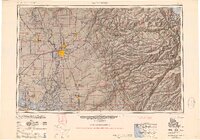 1948 Sacramento1951 Print · USGSPost-war Northern California comes alive in this regional survey, capturing the era of expansion between the Central Valley and the High Sierra. Researchers can trace the rail networks of the Central California Traction and Sacramento Northern RR or locate landmarks like the State Capitol and University of California Davis.
 - 1948 Map of Columbia, 1953 Print
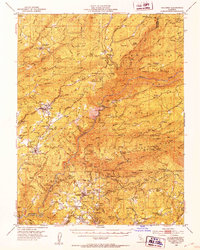 1948 Columbia1953 Print · USGSTuolumne and Calaveras counties in the late 1940s reveal a landscape shaped by the gold rush and emerging state preservation. Genealogists can trace family homesteads near Columbia and Murphys, or locate industrial sites like the Sheep Ranch Mine and Experimental Mine.6 unique versions available
 - 1948 Map of Stanislaus, 1966 Print
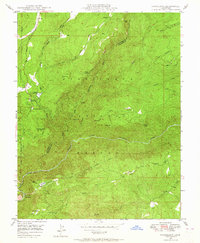 1948 Stanislaus1966 Print · USGSThe Stanislaus National Forest comes alive in this post-war survey of the Tuolumne and Calaveras county line. Researchers can trace the development of Avery and Hathaway Pines, or locate remote points like Douds Landing, Avery Ranch, and the McCormick Lookout.4 unique versions available
 - 1949 Map of Stanislaus
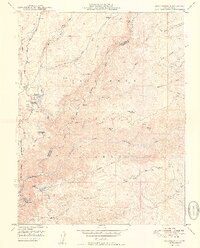 1949 Stanislaus1949 Print · USGSThe Stanislaus National Forest comes alive in the late 1940s as mountain settlements and timber operations shape the high country. Trace the path of the Lumber RR, find local landmarks like Avery Ranch, and locate the Calaveras Ranger Sta.2 unique versions available
 - 1956 Map of Sacramento
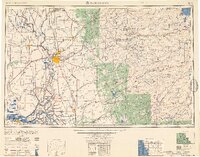 1956 Sacramento1956 Print · USGSMid-century California unfolds from the delta to the high Sierra, capturing a landscape of growing valley cities and burgeoning military airbases. Genealogists and historians can trace the rail lines and river towns from Woodland to Lodi, or explore the foothill settlements of Placerville and Jackson.2 unique versions available
 - 1957 Map of Sacramento, 1966 Print
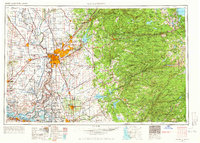 1957 Sacramento1966 Print · USGSIn the mid-twentieth century, the California heartland was a hub of river transport, rail lines, and military airbases. Genealogists and historians can trace the development of Gold Country towns like Angels Camp and Sonora or follow the path of the Southern Pacific RR through the growing suburbs of Sacramento.4 unique versions available
 - 1993 Map of San Andreas, 1994 Print
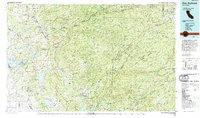 1993 San Andreas1994 Print · USGSThe Mother Lode and High Sierra foothills come alive in the 1990s, showcasing a region defined by historic gold mining and massive water projects. Genealogists and historians can locate old mining sites and rural settlements like Volcano, San Andreas, and Mokelumne Hill.
 - 2001 Map of Stanislaus, 2004 Print
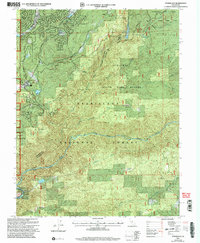 2001 Stanislaus2004 Print · USGSThe Sierra Nevada foothills at the start of the millennium show a mix of tight-knit residential communities and protected timberlands. Genealogists and local historians can locate specific sites like Avery Ranch, Douds Landing, and Lakemont Pines.
 - 2012 Map of Stanislaus, 2012 Print
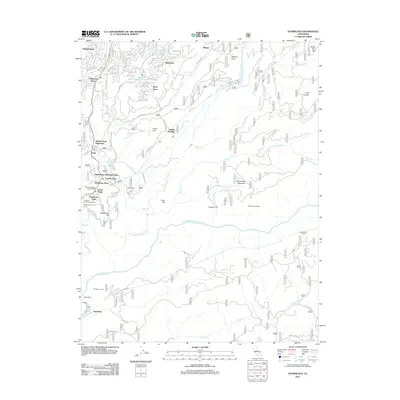 2012 Stanislaus2012 Print · USGSThe foothills of the Sierra Nevada come into focus here during the early twenty-first century, showing a landscape shaped by water and timber. Local historians can trace the paths of the Utica Ditch and Stanislaus Tunnel, or locate family sites near Avery Ranch and Douds Landing.
 - 2015 Map of Stanislaus, 2015 Print
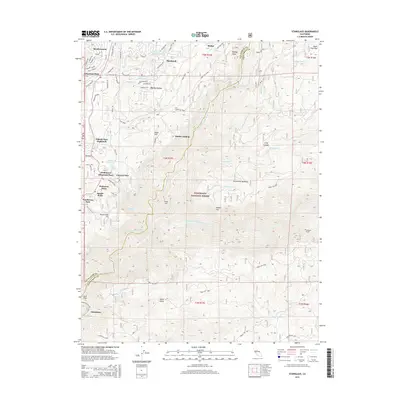 2015 Stanislaus2015 Print · USGSThe northern Sierra foothills are documented here in the mid-2010s, showing a blend of forest conservation and mountain residential growth. Researchers can trace the path of the Utica Ditch and locate local settlements like Hathaway Pines, Avery, and Pinebrook.
 - 2018 Map of Stanislaus, 2018 Print
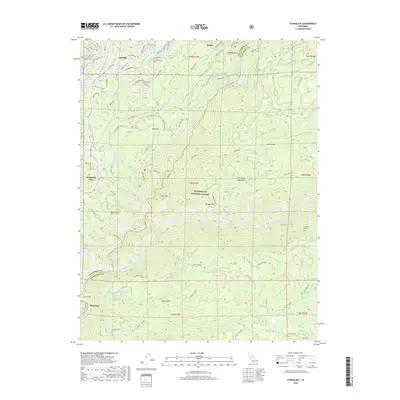 2018 Stanislaus2018 Print · USGSArnold and the river forks of the central Sierra Nevada are documented in this recent survey of Tuolumne and Calaveras counties. Genealogists and researchers can trace the paths of the Utica Ditch, locate Hunter Reservoir, and identify landmarks like McKays Point.
 - 2021 Map of Stanislaus, 2021 Print
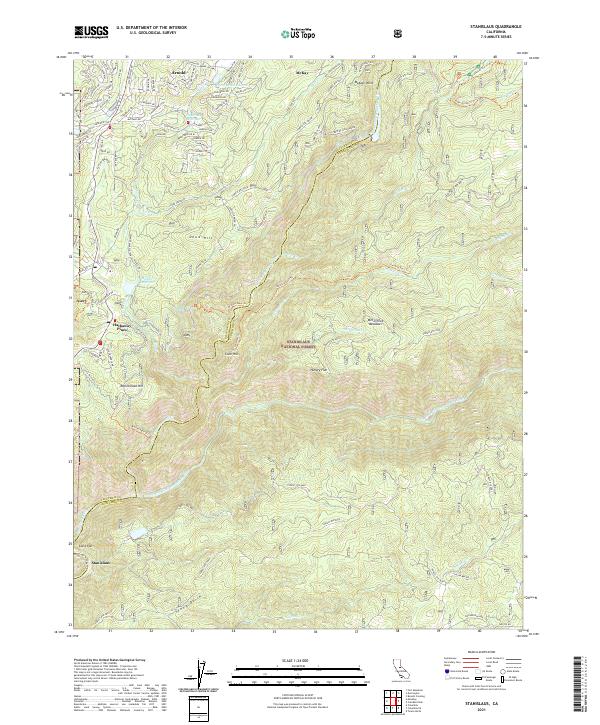 2021 Stanislaus2021 Print · USGSUpper Calaveras and Tuolumne counties are shown here as they appeared recently, centered on the steep river canyons and high timberlands. Researchers can trace the path of the Utica Ditch and locate the mountain settlements of Arnold, Hathaway Pines, and Avery.
End of results
Showing maps 1-17 of 17
Frequently asked questions
- What are the different types of historical maps available for Pinebrook?
- What is the oldest map of Pinebrook?
- Where can I purchase historical maps of Pinebrook for my home or office?
- Where can I download high-res historical maps of Pinebrook?
- Are there historical topographic maps available for Pinebrook?
- Is there historical aerial imagery available for Pinebrook?
- Where are historical maps of Pinebrook sourced from?