1900s (20th Century) Maps of Linton, Kentucky
Explore 7 historic maps of Linton from the 1900s (20th Century). These maps offer a rare glimpse into what life looked like during the 1900s — showing old roads, neighborhoods, homes, and landmarks that have changed or disappeared over time.
Whether you're researching your family's past, planning a metal detecting trip, or studying how Linton's landscape evolved across the 1900s, these high-resolution maps are a powerful tool for exploring the history of this region.
- Focus on a specific era: All maps on this page are from the 1900s, giving you a focused view of this time period.
- See what’s changed: Compare century-old streets, trails, and buildings to today's modern landscape using overlays and satellite layers.
- Research with precision: Use these maps for genealogy, historical research, land use analysis, or educational projects.
- View, download, or print: Maps are fully viewable online in high resolution, and can be downloaded or printed for your own records.
Start exploring Linton's history through authentic maps from the 1900s. This is your window into the past.
Linton, KY maps
(7)- 1951 Map of Model, 1953 Print
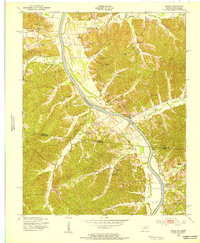 1951 Model1953 Print · USGSThe Kentucky-Tennessee state line follows the ridge tops and river bends of the 1950s Cumberland Valley. Genealogists can trace family names through dozens of hilltop burial sites like Bethlehem Cem and rural centers such as Model and Tobaccoport.
 - 1956 Map of Nashville, 1971 Print
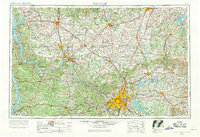 1956 Nashville1971 Print · USGSThe Tennessee-Kentucky borderlands come into focus in the mid-1960s as major reservoir projects transformed the Cumberland and Tennessee river valleys. Researchers can trace the rail networks of the Louisville and Nashville and visit sites like Fort Campbell and Fort Donelson National Military Park.2 unique versions available
 - 1957 Map of Model, 1960 Print
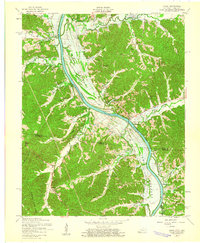 1957 Model1960 Print · USGSThe Cumberland River valley is caught in a moment of transition during the late fifties as the rising waters of Lake Barkley begin to reshape the state line. Genealogists can trace family landmarks like Tobacconport, the Mt Vernon School, and the Watkins Cemetery before the local geography was permanently altered.
 - 1957 Map of Model, 1963 Print
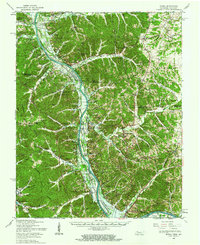 1957 Model1963 Print · USGSThe Tennessee and Kentucky borderlands meet here in the late fifties as the Cumberland River valley prepares for the rising waters of Lake Barkley. Genealogists can trace family landmarks like the Gatlin Cem or explore the rural hubs of Bumpus Mills and Tobaccoport.
 - 1959 Map of Nashville
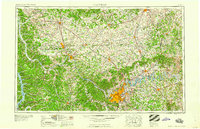 1959 Nashville1959 Print · USGSMiddle Tennessee and Southern Kentucky come into focus during the late fifties, showing the region's transition into a modern transportation and military hub. Researchers can trace the sprawling Fort Campbell Military Reservation or locate historic rail stops along the Tennessee Central Ry and Illinois Central RR.
 - 1967 Map of Linton, 1970 Print
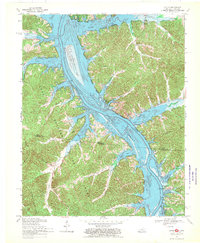 1967 Linton1970 Print · USGSThe Kentucky and Tennessee borderlands appear here in the late sixties as the newly formed Lake Barkley reshaped the river valley. Researchers can trace the layout of Linton, Model, and Tobaccoport alongside landmarks like Big Joe Spring and Fox Ridge.2 unique versions available
 - 1980 Map of Hopkinsville, 1983 Print
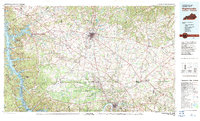 1980 Hopkinsville1983 Print · USGSThe Kentucky and Tennessee borderlands appear here at the start of the 1980s, centered on the massive Fort Campbell Military Reservation. Trace the impact of the Cumberland River impoundment at Lake Barkley or locate rail hubs like Guthrie and Elkton.
End of results
Showing maps 1-7 of 7
Top cities near Linton
Frequently asked questions
- What are the different types of historical maps available for Linton?
- What is the oldest map of Linton?
- Where can I purchase historical maps of Linton for my home or office?
- Where can I download high-res historical maps of Linton?
- Are there historical topographic maps available for Linton?
- Is there historical aerial imagery available for Linton?
- Where are historical maps of Linton sourced from?