1900s (20th Century) Maps of Camp Ousamequin, Halifax
Explore 12 historic maps of Camp Ousamequin from the 1900s (20th Century). These maps offer a rare glimpse into what life looked like during the 1900s — showing old roads, neighborhoods, homes, and landmarks that have changed or disappeared over time.
Whether you're researching your family's past, planning a metal detecting trip, or studying how Camp Ousamequin's landscape evolved across the 1900s, these high-resolution maps are a powerful tool for exploring the history of this region.
- Focus on a specific era: All maps on this page are from the 1900s, giving you a focused view of this time period.
- See what’s changed: Compare century-old streets, trails, and buildings to today's modern landscape using overlays and satellite layers.
- Research with precision: Use these maps for genealogy, historical research, land use analysis, or educational projects.
- View, download, or print: Maps are fully viewable online in high resolution, and can be downloaded or printed for your own records.
Start exploring Camp Ousamequin's history through authentic maps from the 1900s. This is your window into the past.
Camp Ousamequin, Halifax maps
(12)- 1920 Map of Abington
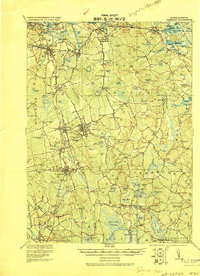 1920 Abington1920 Print · USGSThe South Shore was a bustling network of rail and industry at the end of the Great War. You can trace the path of the Hanover Branch and Old Colony RR, or find historic sites like the Old Oaken Bucket Homestead and Weymouth Landing.
 - 1935 Map of Hanover
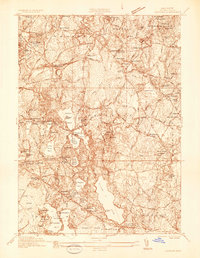 1935 Hanover1935 Print · USGSThe northern Plymouth County ponds and woodlands are shown here in the mid-1930s as industry and early leisure began to reshape the landscape. Genealogists can trace family plots at Magoun Cem and Pine Grove Cemetery, or locate historic hubs like Schoosett and Curtis Crossing.
 - 1940 Map of Hanover
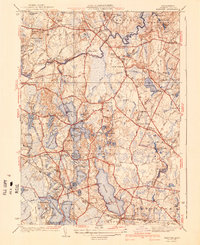 1940 Hanover1940 Print · USGSThe pond-strewn landscape of Plymouth County is captured here in the years before mid-century suburbanization. You can trace early schoolhouse locations like the Smith Sch, find ancestral plots in the Pine Grove Cem, and follow the old line of the New York New Haven and Hartford RR.3 unique versions available
 - 1948 Map of Boston
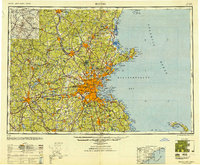 1948 Boston1948 Print · USGSEastern Massachusetts and southern New Hampshire appear at an industrial peak in the late 1940s, just as suburban growth began to accelerate. Genealogists and historians can trace rail lines like the Boston and Albany RR or locate coastal landmarks like Graves Lighthouse and Fort Devens.2 unique versions available
 - 1948 Map of Hanover, 1956 Print
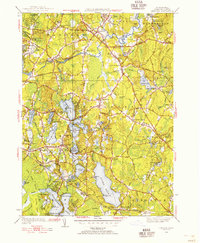 1948 Hanover1956 Print · USGSMid-century Plymouth County is captured here at a time when the rail-and-river economy still shaped life in Hanover and Pembroke. Genealogists can locate family sites near Lady of the Lake Ch, Fern Hill Cem, or the old Thomas Sch.2 unique versions available
 - 1956 Map of Boston, 1967 Print
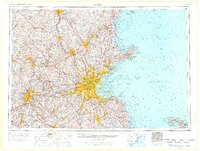 1956 Boston1967 Print · USGSThe Massachusetts coastline and industrial interior are seen here during the mid-century peak of suburban and highway expansion. Researchers can trace historic harbor defenses like Fort Revere, local landmarks such as Faneuil Hall, and the vast Parker River National Wildlife Refuge.6 unique versions available
 - 1958 Map of Boston
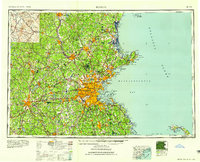 1958 Boston1958 Print · USGSEastern Massachusetts and southern New Hampshire are shown at the height of the industrial era, before the full expansion of the interstate system. Trace coastal defenses at Fort Warren, historic rail lines like the Boston and Maine, and the development of the Mass. 128 corridor.2 unique versions available
 - 1961 Map of Boston
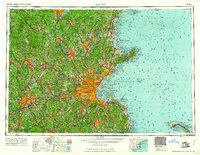 1961 Boston1961 Print · USGSThe Massachusetts coastline and its industrial interior are detailed here in the mid-twentieth century, from the Monadnock highlands to Cape Cod. Researchers can trace the rail routes of the Boston and Maine or locate landmarks like Fort Devens and the Wachusett Reservoir.2 unique versions available
 - 1962 Map of Hanover, 1964 Print
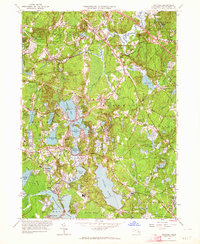 1962 Hanover1964 Print · USGSPlymouth County in the early sixties reveals a landscape of sprawling cranberry bogs and growing residential villages nestled between major glacial ponds. Genealogists and historians can locate family landmarks like Briggs Cem, the First Baptist Ch, and old rail points at Winslows Crossing and Curtis Crossing.2 unique versions available
 - 1977 Map of Hanover, 1981 Print
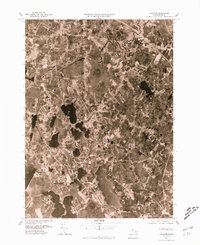 1977 Hanover1981 Print · USGSPlymouth County during the late seventies is revealed through detailed aerial imagery of the South Shore's inland villages and waterways. Researchers can trace land use and local development around Hanover, Bryantville, and the shores of Silver Lake.
 - 1978 Map of Hanover, 1979 Print
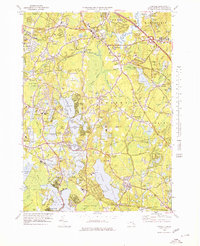 1978 Hanover1979 Print · USGSThe South Shore landscape in the late seventies is defined by its massive pond systems and specialized agriculture. Genealogists can trace family names through Sylvester Ch and Sachem Lodge Cem while exploring the Cranberry Bogs near Monponsett.2 unique versions available
 - 1984 Map of Provincetown, 1986 Print
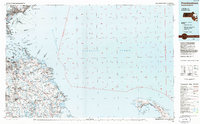 1984 Provincetown1986 Print · USGSThe Massachusetts coastline and the tip of Cape Cod appear here during the mid-eighties, highlighting the region's dense coastal settlements and maritime defenses. You can locate family landmarks in Marshfield, trace the grounds of the North Truro Air Force Station, and explore the islands of Boston Harbor like Peddocks Island.2 unique versions available
End of results
Showing maps 1-12 of 12
Top cities near Camp Ousamequin
- Boston historical maps
- Brockton historical maps
- Quincy historical maps
- Plymouth historical maps
- Taunton historical maps
- Weymouth historical maps
See more
Frequently asked questions
- What are the different types of historical maps available for Camp Ousamequin?
- What is the oldest map of Camp Ousamequin?
- Where can I purchase historical maps of Camp Ousamequin for my home or office?
- Where can I download high-res historical maps of Camp Ousamequin?
- Are there historical topographic maps available for Camp Ousamequin?
- Is there historical aerial imagery available for Camp Ousamequin?
- Where are historical maps of Camp Ousamequin sourced from?