1900s (20th Century) Maps of Waynesville, Missouri
Explore 13 historic maps of Waynesville from the 1900s (20th Century). These maps offer a rare glimpse into what life looked like during the 1900s — showing old roads, neighborhoods, homes, and landmarks that have changed or disappeared over time.
Whether you're researching your family's past, planning a metal detecting trip, or studying how Waynesville's landscape evolved across the 1900s, these high-resolution maps are a powerful tool for exploring the history of this region.
- Focus on a specific era: All maps on this page are from the 1900s, giving you a focused view of this time period.
- See what’s changed: Compare century-old streets, trails, and buildings to today's modern landscape using overlays and satellite layers.
- Research with precision: Use these maps for genealogy, historical research, land use analysis, or educational projects.
- View, download, or print: Maps are fully viewable online in high resolution, and can be downloaded or printed for your own records.
Start exploring Waynesville's history through authentic maps from the 1900s. This is your window into the past.
Waynesville, MO maps
(13)- 1936 Map of Waynesville
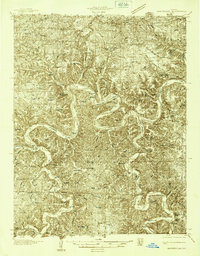 1936 Waynesville1936 Print · USGSPulaski County during the mid-1930s is defined by its winding river valleys and the expansion of the Gardner National Forest. Researchers can trace ancestral locations through an extensive network of rural landmarks, including the Old Indian Lead Mine, Riddle Bridge, and the Sweet Home Ch.
 - 1942 Map of Waynesville
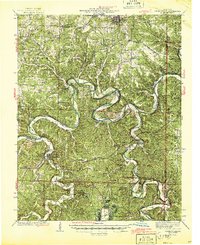 1942 Waynesville1942 Print · USGSPulaski County during the early 1940s shows a landscape of deep river bends and the emergence of wartime infrastructure. Genealogists can trace family roots through numerous sites like Burchard Cem, the Old Indian Lead Mine, and the original footprint of Fort Leonard Wood.
 - 1943 Map of Richland
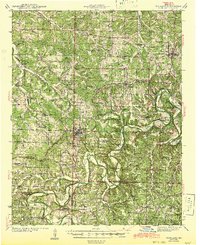 1943 Richland1943 Print · USGSThe Missouri Ozarks during the early 1940s are documented here, showing the rural communities of Pulaski and Camden counties connected by the rail lines. Genealogists can locate family landmarks like Manes Cem, Buzzard Roost Sch, and Wair Chapel.
 - 1944 Map of Waynesville
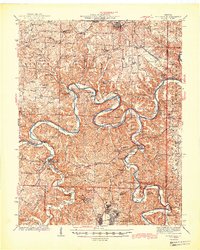 1944 Waynesville1944 Print · USGSPulaski County at the peak of the Second World War shows a landscape in transition as the new Fort Leonard Wood takes shape among the Ozark hills. Genealogists and researchers can trace family-named sites like Wheelers Mill, Riddle Bridge, and the Joiner Cem along the winding Gasconade River.2 unique versions available
 - 1954 Map of Springfield
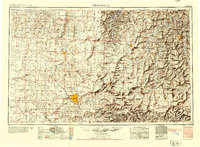 1954 Springfield1954 Print · USGSThe Missouri Ozarks are captured here during the post-war era, showing the expansion of Springfield and the surrounding river valleys. Genealogists and historians can trace local landmarks like Mount Comfort Cemetery and the Fort Leonard Wood military grounds.6 unique versions available
 - 1954 Map of Waynesville, 1958 Print
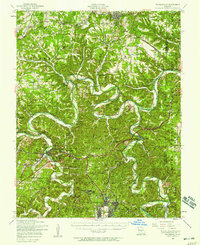 1954 Waynesville1958 Print · USGSThe Missouri Ozarks are captured here during the mid-fifties, showing the expansion of Fort Leonard Wood and the winding course of the Gasconade River. Researchers can locate dozens of country landmarks, from the Dixon Lookout Tower to rural sites like Wheeler Mill and the Pisgah School.2 unique versions available
 - 1954 Map of Richland, 1958 Print
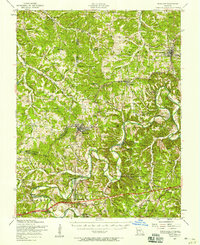 1954 Richland1958 Print · USGSThe Gasconade River valley and the St. Louis-San Francisco rail line define this mid-Missouri landscape during the mid-fifties. Genealogists can trace family names through dozens of rural sites, including Thornsberry Cemetery, Makarie Bridge, and several early schoolhouses.2 unique versions available
 - 1954 Map of Waynesville, 1959 Print
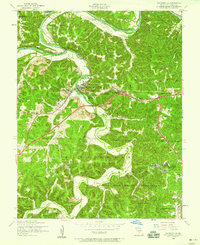 1954 Waynesville1959 Print · USGSWaynesville and the surrounding Ozark hollows are captured in the mid-fifties as the local landscape adapted to the presence of the neighboring military reservation. Genealogists can trace family landmarks and rural institutions like Gospel Ridge Union Church, Storie Cem, and the Old Indian Lead Mine.5 unique versions available
 - 1954 Map of Ozark Springs, 1959 Print
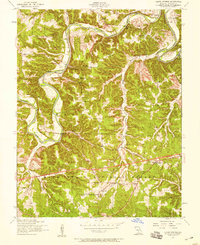 1954 Ozark Springs1959 Print · USGSPulaski County, Missouri, is shown here in the mid-1950s as a landscape of deep river bends and rural education nodes. Genealogists can trace family landmarks like Pauley Cem or locate several decommissioned sites such as Hickory Grove School.3 unique versions available
 - 1958 Map of Springfield
 1958 Springfield1958 Print · USGSThe Missouri Ozarks are captured during the mid-century era of growth, centered on the bustling hub of Springfield. Genealogists and historians can trace family roots through numerous landmarks like Ebenezer Church, Stockton Cem, and the various county courthouses.
 - 1959 Map of Springfield
 1959 Springfield1959 Print · USGSThe Missouri Ozarks are captured here during a decade of postwar growth and increasing highway connectivity. Researchers can trace the legacy of the St Louis-San Francisco RR and locate early sites in Springfield, Lebanon, and Mountain Grove.
 - 1976 Map of Waynesville, 1980 Print
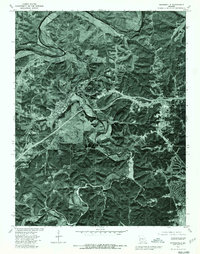 1976 Waynesville1980 Print · USGSWaynesville and St Robert appear in detailed aerial photography during the mid-seventies as the region continued to develop around the military installation. Researchers can trace land use patterns near Fort Leonard Wood and follow the natural curves of the Gasconade River.
 - 1982 Map of Lebanon, 1983 Print
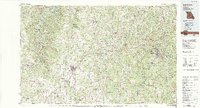 1982 Lebanon1983 Print · USGSThe Missouri Ozarks are captured in the early eighties as Interstate 44 and the St Louis-San Francisco rail line link growing towns with the Fort Leonard Wood Military Reservation. Genealogists and historians can trace family-named sites like Flatwood Church and old post offices at Sleeper and Nebo.
End of results
Showing maps 1-13 of 13
Top cities near Waynesville
- Saint Robert historical maps
- Richland historical maps
- Dixon historical maps
- Crocker historical maps
- Powellville historical maps
Frequently asked questions
- What are the different types of historical maps available for Waynesville?
- What is the oldest map of Waynesville?
- Where can I purchase historical maps of Waynesville for my home or office?
- Where can I download high-res historical maps of Waynesville?
- Are there historical topographic maps available for Waynesville?
- Is there historical aerial imagery available for Waynesville?
- Where are historical maps of Waynesville sourced from?