1900s (20th Century) Maps of Mark Twain Estates, Nevada
Explore 9 historic maps of Mark Twain Estates from the 1900s (20th Century). These maps offer a rare glimpse into what life looked like during the 1900s — showing old roads, neighborhoods, homes, and landmarks that have changed or disappeared over time.
Whether you're researching your family's past, planning a metal detecting trip, or studying how Mark Twain Estates's landscape evolved across the 1900s, these high-resolution maps are a powerful tool for exploring the history of this region.
- Focus on a specific era: All maps on this page are from the 1900s, giving you a focused view of this time period.
- See what’s changed: Compare century-old streets, trails, and buildings to today's modern landscape using overlays and satellite layers.
- Research with precision: Use these maps for genealogy, historical research, land use analysis, or educational projects.
- View, download, or print: Maps are fully viewable online in high resolution, and can be downloaded or printed for your own records.
Start exploring Mark Twain Estates's history through authentic maps from the 1900s. This is your window into the past.
Mark Twain Estates, NV maps
(9)- 1950 Map of Virginia City, 1955 Print
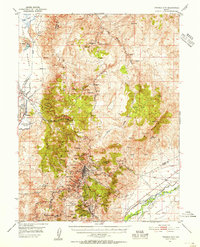 1950 Virginia City1955 Print · USGSVirginia City and the Comstock mining corridor are seen here at mid-century, amidst a dense concentration of historic shafts and early settlement sites. Researchers can trace the legacy of silver mining through Gold Hill, the Utah Shaft, and several cemeteries that overlook the mountain ranges.3 unique versions available
 - 1952 Map of Virginia City
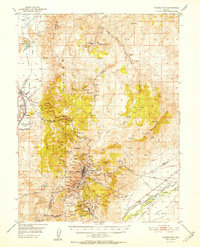 1952 Virginia City1952 Print · USGSStorey County's mining heartland is revealed in the mid-century, documenting the legendary Comstock Lode settlements and engineering works. Researchers can trace the massive Sutro Tunnel, locate the Lousetown (Site), and find family roots in Gold Hill or Virginia City.2 unique versions available
 - 1957 Map of Reno, 1963 Print
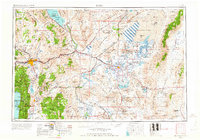 1957 Reno1963 Print · USGSWestern Nevada in the early sixties is a land of sprawling desert sinks and rising mountain ranges. Genealogists and historians can trace the rail-and-river network connecting Reno, the mining legacy of Rawhide Mine, and the boundaries of the Pyramid Lake Indian Reservation.5 unique versions available
 - 1959 Map of Reno
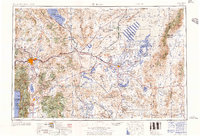 1959 Reno1959 Print · USGSWestern Nevada in the late fifties was a land of expanding military airbases and high-desert irrigation projects. You can trace the lineage of the Comstock era through Carson City, locate the Pony Express Monument, or study the rail networks of the Southern Pacific RR.
 - 1960 Map of Reno
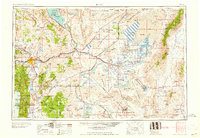 1960 Reno1960 Print · USGSThe high desert of western Nevada comes alive in this mid-century survey of the Reno-Tahoe region. Genealogists and historians can trace rail lines like the Southern Pacific RR and locate remote outposts such as Olinghouse, Nixon, and the Olinghouse Mine.2 unique versions available
 - 1960 Map of Virginia City, 1976 Print
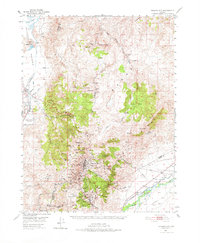 1960 Virginia City1976 Print · USGSThe Comstock Lode is shown in detail at mid-century, mapping the industrial footprint of the silver mining boom. Genealogists and historians can locate mining infrastructure, the Sutro Tunnel, and settlements like Gold Hill, Silver City, and American Flat.
 - 1967 Map of Flowery Peak, 1970 Print
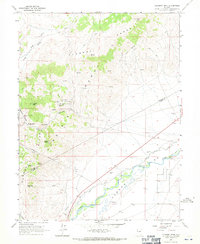 1967 Flowery Peak1970 Print · USGSStorey County mining and Carson River irrigation are captured in detail during the late sixties. Researchers can trace the subterranean path of the Sutro Tunnel or locate historic extraction sites like the Lady Bryan Mine and Monte Cristo (Site).4 unique versions available
 - 1979 Map of Carson City, 1980 Print
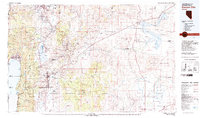 1979 Carson City1980 Print · USGSWestern Nevada in the late seventies reveals a landscape of historic mining districts and expanding mountain communities. Researchers can trace the Comstock Lode through Virginia City, locate the Stewart Indian School, or explore the shores of Lake Tahoe near Incline Village.2 unique versions available
 - 1994 Map of Flowery Peak
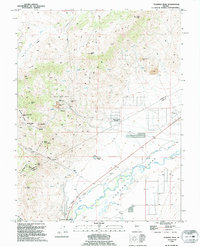 1994 Flowery Peak1994 Print · USGSStorey County's mining heritage is on full display here in the 1990s, from the high peaks of the Flowery Range down to the Carson River. You can trace the path of the Sutro Tunnel and locate historical sites like the Berry Glory Hole and Monte Cristo (Site).
End of results
Showing maps 1-9 of 9
Frequently asked questions
- What are the different types of historical maps available for Mark Twain Estates?
- What is the oldest map of Mark Twain Estates?
- Where can I purchase historical maps of Mark Twain Estates for my home or office?
- Where can I download high-res historical maps of Mark Twain Estates?
- Are there historical topographic maps available for Mark Twain Estates?
- Is there historical aerial imagery available for Mark Twain Estates?
- Where are historical maps of Mark Twain Estates sourced from?