1900s (20th Century) Maps of Big East Fork, North Carolina
Explore 10 historic maps of Big East Fork from the 1900s (20th Century). These maps offer a rare glimpse into what life looked like during the 1900s — showing old roads, neighborhoods, homes, and landmarks that have changed or disappeared over time.
Whether you're researching your family's past, planning a metal detecting trip, or studying how Big East Fork's landscape evolved across the 1900s, these high-resolution maps are a powerful tool for exploring the history of this region.
- Focus on a specific era: All maps on this page are from the 1900s, giving you a focused view of this time period.
- See what’s changed: Compare century-old streets, trails, and buildings to today's modern landscape using overlays and satellite layers.
- Research with precision: Use these maps for genealogy, historical research, land use analysis, or educational projects.
- View, download, or print: Maps are fully viewable online in high resolution, and can be downloaded or printed for your own records.
Start exploring Big East Fork's history through authentic maps from the 1900s. This is your window into the past.
Big East Fork, NC maps
(10)- 1905 Map of Pisgah, 1956 Print
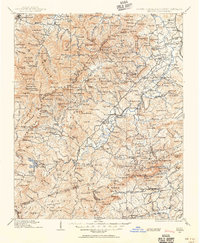 1905 Pisgah1956 Print · USGSThe North Carolina high country around the turn of the century reveals a land of timber tracts and emerging mountain retreats. Genealogists and hikers can trace early routes to Buck Spring Lodge, follow the Southern RR tracks, and locate vanished settlements like Angeline and Calhoun.
 - 1906 Map of Pisgah, 1934 Print
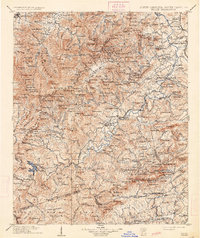 1906 Pisgah1934 Print · USGSThe Blue Ridge highlands at the turn of the century reveal a landscape of mountain river valleys and early timber frontiers. Genealogists and historians can trace family-named bridges and crossings like Graham Bridge or locate vanished settlements such as Grange and Retreat.2 unique versions available
 - 1935 Map of Shining Rock
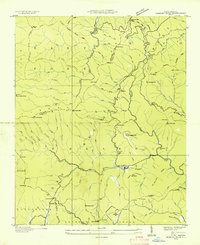 1935 Shining Rock1935 Print · USGSThe high country of Transylvania and Haywood counties is mapped here in the mid-1930s as federal conservation efforts took hold. Researchers can trace the early footprint of CCC Camp F 1 and locate landmarks like Silvermine and Lookingglass Rock.
 - 1946 Map of Shining Rock, 1947 Print
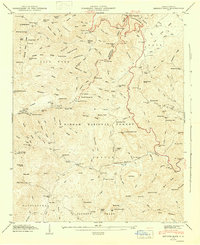 1946 Shining Rock1947 Print · USGSThe North Carolina high country is captured here just after the war as the Blue Ridge Parkway begins to reshape the region. Researchers can trace the early layout of the Fish Rearing Station or locate landmarks like Looking Glass Rock and Picklesimer Fields.7 unique versions available
 - 1955 Map of Knoxville
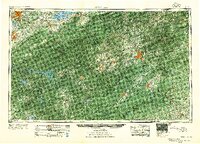 1955 Knoxville1955 Print · USGSThe Southern Appalachians and the Smoky Mountains are shown here at a peak of mid-century development and conservation. Genealogists and historians can trace the early road networks connecting Gatlinburg, Waynesville, and the Cherokee Indian Reservation across the high ridges.
 - 1957 Map of Knoxville, 1966 Print
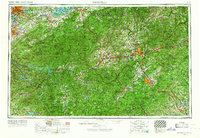 1957 Knoxville1966 Print · USGSThe Southern Appalachians of Tennessee and North Carolina are mapped here during the mid-twentieth century as new highways reached the high country. Genealogists and historians can trace the topography between Knoxville and Asheville, locating family landmarks near Fontana Lake or along the Blue Ridge Parkway.4 unique versions available
 - 1960 Map of Knoxville
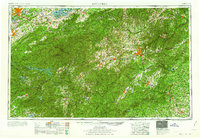 1960 Knoxville1960 Print · USGSThe Southern Appalachians come alive in the 1950s, showing the intersection of new national park tourism and deep-rooted mountain industry. Trace old rail lines like the Clinchfield RR and find high-altitude landmarks from Mt Le Conte to the Cherokee Indian Reservation.2 unique versions available
 - 1964 Map of Knoxville
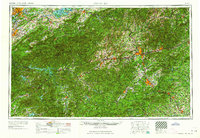 1964 Knoxville1964 Print · USGSThe Southern Appalachians and Great Smokies are captured here during the mid-sixties, showing the rugged borderlands of Tennessee and North Carolina. Researchers can trace historic mountain routes like U S 441, the expanse of Pisgah National Forest, and the growing footprints of Asheville and Knoxville.
 - 1986 Map of Hendersonville
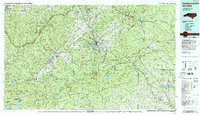 1986 Hendersonville1986 Print · USGSThe Blue Ridge foothills of North and South Carolina are documented here in the mid-eighties as modern highways began to reshape mountain travel. Local historians can trace the paths of the Southern Railway through Hendersonville or locate landmarks like Looking Glass Rock and Inman Mills.2 unique versions available
 - 1997 Map of Shining Rock, 2001 Print
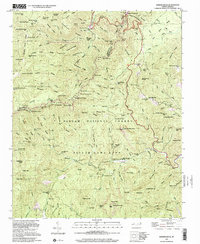 1997 Shining Rock2001 Print · USGSThe high peaks of the Blue Ridge south of Asheville are captured here in the late 1990s, showcasing a landscape of protected wilderness and national forest. Trace the locations of the old Silvermine, the Fish Rearing Station, and the Pilot Mtn Lookout Tower.
End of results
Showing maps 1-10 of 10
Top cities near Big East Fork
- Asheville historical maps
- Waynesville historical maps
- Brevard historical maps
- Mills River historical maps
- Canton historical maps
- Bent Creek historical maps
See more
Frequently asked questions
- What are the different types of historical maps available for Big East Fork?
- What is the oldest map of Big East Fork?
- Where can I purchase historical maps of Big East Fork for my home or office?
- Where can I download high-res historical maps of Big East Fork?
- Are there historical topographic maps available for Big East Fork?
- Is there historical aerial imagery available for Big East Fork?
- Where are historical maps of Big East Fork sourced from?