Old Maps of Woodall, Oklahoma
Explore 16 old maps of Woodall, spanning from 1901 to today. These high-resolution historic maps reveal how streets, neighborhoods, landmarks, and natural features evolved over time — perfect for genealogy, metal detecting, research, and local history exploration.
What you can do with these maps:
- See how Woodall changed over time: Compare historical maps to modern-day views to trace roads, homesites, rail lines & more.
- View detailed metadata: Each map includes creators, publishers, year, scale, and archive source.
- Overlay maps with satellite & LiDAR: Visualize the past alongside modern tools to explore terrain & human change.
- Trusted historical sources: Maps sourced from the USGS, Library of Congress, and other archives.
- Access maps your way: View online, download high-res files, or order prints for personal or research use.
Start exploring old maps of Woodall to uncover forgotten places, hidden landmarks, and the deep history beneath your feet.
Woodall, OK maps
(16)- 1901 Map of Muscogee
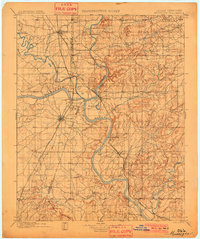 1901 Muscogee1901 Print · USGSIndian Territory at the turn of the century shows a landscape shaped by river commerce and the coming of the railroads. Genealogists can trace family roots through early settlements like Tullahassee and Webbers Falls, or locate historic river crossings such as Whisky Ford.6 unique versions available
 - 1905 Map of Muscogee
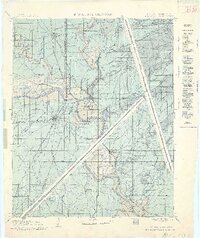 1905 Muscogee1905 Print · USGSIndian Territory at the turn of the century shows a landscape transitioning from tribal nations to a rail-centered economy. Researchers can trace ancestral river crossings and early settlements like Fort Gibson, Tenkillers Ferry, and Gibson Sta.
 - 1946 Map of Fort Smith
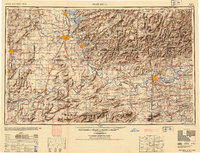 1946 Fort Smith1946 Print · USGSThe Arkansas-Oklahoma borderlands appear here in the mid-forties, as new reservoirs began to transform the river valleys. Genealogists and historians can trace rail-served towns from Muskogee to Fort Smith and locate landmarks like Camp Chaffee.
 - 1948 Map of Hulbert, 1957 Print
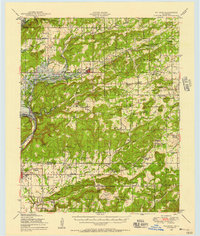 1948 Hulbert1957 Print · USGSCherokee County at mid-century reveals a landscape of rural schoolhouses and family cemeteries just as the reservoir began to reshape the river valley. Genealogists can trace family roots through sites like Sequoyah Indian Sch, Lost City, and the Fort Gibson National Cem.3 unique versions available
 - 1950 Map of Hulbert
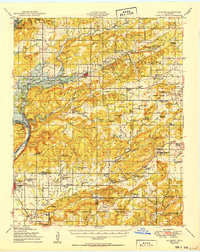 1950 Hulbert1950 Print · USGSOklahoma's Cherokee County appears here at a pivotal moment just after the war, as the Gibson Reservoir begins to reshape the landscape. Researchers can trace dozens of rural landmarks, including the Sequoyah Indian School, the Fort Gibson National Cemetery, and the Camp Gruber Military Reservation.2 unique versions available
 - 1965 Map of Fort Smith
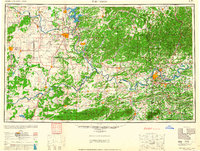 1965 Fort Smith1965 Print · USGSEastern Oklahoma and Western Arkansas are captured here during a period of massive post-war change as new reservoirs reshaped the river valleys. Genealogists and historians can trace the rail networks of the Midland Valley RR and find established communities like Stilwell, Sallisaw, and Stigler.
 - 1967 Map of Fort Smith
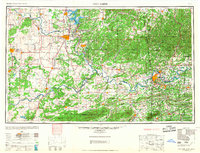 1967 Fort Smith1967 Print · USGSThe Arkansas River valley and the foothills of the Ozarks are captured here during a period of significant military and industrial activity. Researchers can trace the sprawling bounds of Camp Chaffee and Camp Gruber or locate vanished rail stops along the Midland Valley RR.
 - 1972 Map of Hulbert SE, 1974 Print
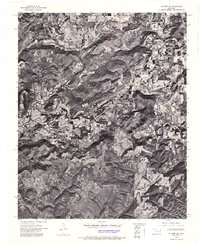 1972 Hulbert SE1974 Print · USGSCherokee County, Oklahoma, is seen from the air in the early seventies, capturing the rural landscape of the Ozark foothills. Researchers can trace the wooded slopes of Redberry Mountain and the banks of Bayou Manard and Greenleaf Creek.
 - 1974 Map of Zeb, 1978 Print
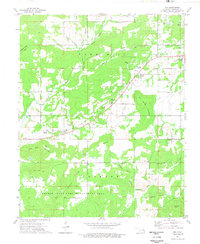 1974 Zeb1978 Print · USGSCherokee County in the mid-1970s shows a landscape of small settlements and family cemeteries nestled between the Cookson hills. Genealogists can trace family lines through the Jones Cem, Lowrey Cem, and Hendricks Cem or find old school sites like Stone Chapel Sch.
 - 1978 Map of Muskogee, 1979 Print
 1978 Muskogee1979 Print · USGSThe confluence of the Arkansas, Verdigris, and Neosho Rivers defines the Muskogee region in the late seventies. Genealogists and historians can trace the footprints of Camp Gruber (Abandoned), the campus of Bacone College, and early aviation at Hatbox Field.
 - 1978 Map of Fort Smith, 1979 Print
 1978 Fort Smith1979 Print · USGSThe Arkansas-Oklahoma borderlands in the late seventies show a landscape shaped by massive river reservoirs and sprawling military reservations. Trace the historic rail lines of the Missouri Pacific RR and locate regional landmarks like Fort Gibson, Tenkiller Ferry Lake, and Barling.2 unique versions available
 - 2010 Map of Zeb, 2010 Print
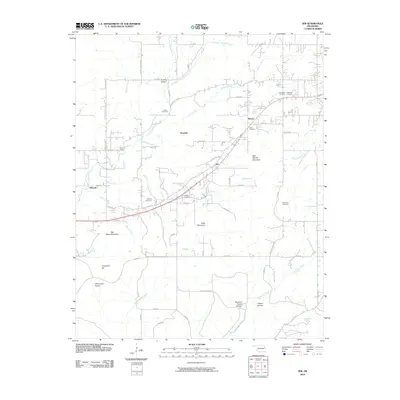 2010 Zeb2010 Print · USGSCherokee County, Oklahoma, is documented here in the early twenty-first century, showcasing a rural landscape defined by Ozark foothills and numerous springs. Genealogists can trace family heritage through sites like Lowrey Cemetery, Price Cemetery, and the hills around Woodall and Metory.
 - 2012 Map of Zeb, 2012 Print
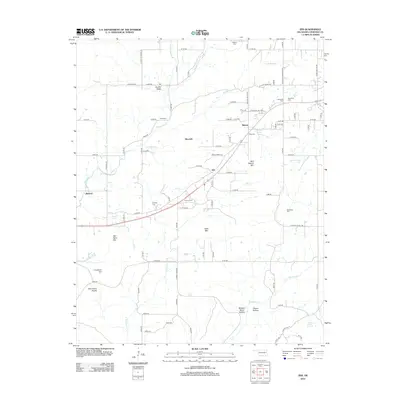 2012 Zeb2012 Print · USGSCherokee County at the start of the 2010s reveals a landscape of high ridges and family burial grounds. Genealogists can trace local history through sites like Steeley Cem and Holland Cem or locate the springs at Metory and Eureka Valley.
 - 2016 Map of Zeb, 2016 Print
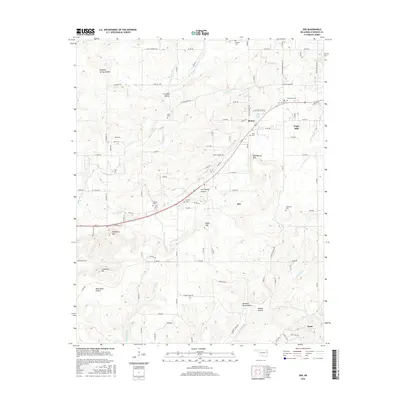 2016 Zeb2016 Print · USGSCherokee County in the 2010s shows a landscape of deep hollows and high prairies east of the Illinois River. Genealogists can locate family landmarks like Hendricks Cem and Holland Cem near the communities of Park Hill and Metory.
 - 2019 Map of Zeb, 2019 Print
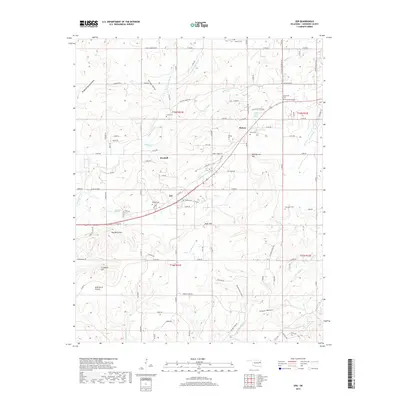 2019 Zeb2019 Print · USGSCherokee County at the end of the 2010s reveals a rural landscape deeply marked by family history and spring-fed creeks. Genealogists can locate several burial sites including Lowrey Cem and Holland Cem near the small communities of Zeb and Woodall.
 - 2022 Map of Zeb, 2022 Print
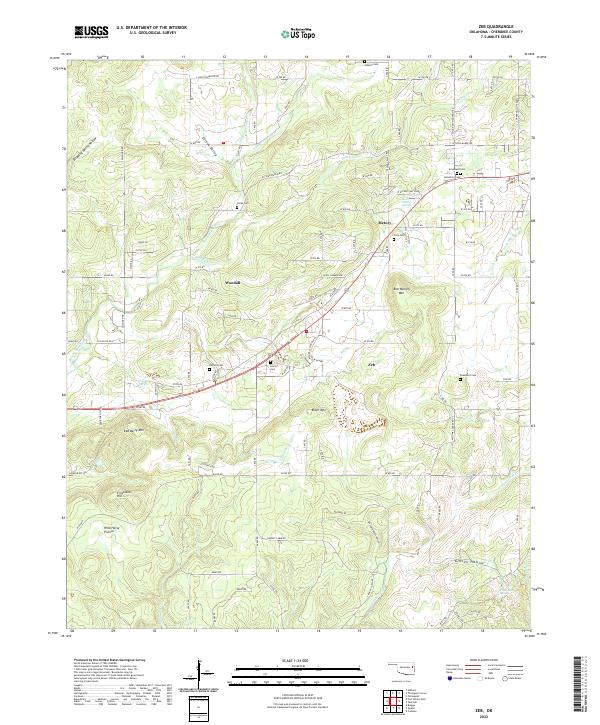 2022 Zeb2022 Print · USGSOklahoma's Cherokee County uplands are documented here during the early twenty-first century, showing a rural landscape defined by community anchors and springs. Researchers can trace family history through numerous sites like Greenleaf Cem and Lowrey Cem or locate old homesteads near Wild Horse Prairie.
End of results
Showing maps 1-16 of 16
Top cities near Woodall
- Muskogee historical maps
- Tahlequah historical maps
- Hulbert historical maps
- Braggs historical maps
- Paradise Hill historical maps
Frequently asked questions
- What are the different types of historical maps available for Woodall?
- What is the oldest map of Woodall?
- Where can I purchase historical maps of Woodall for my home or office?
- Where can I download high-res historical maps of Woodall?
- Are there historical topographic maps available for Woodall?
- Is there historical aerial imagery available for Woodall?
- Where are historical maps of Woodall sourced from?