Old Maps of Martindale, Earl Township
Explore 15 old maps of Martindale, spanning from 1906 to today. These high-resolution historic maps reveal how streets, neighborhoods, landmarks, and natural features evolved over time — perfect for genealogy, metal detecting, research, and local history exploration.
What you can do with these maps:
- See how Martindale changed over time: Compare historical maps to modern-day views to trace roads, homesites, rail lines & more.
- View detailed metadata: Each map includes creators, publishers, year, scale, and archive source.
- Overlay maps with satellite & LiDAR: Visualize the past alongside modern tools to explore terrain & human change.
- Trusted historical sources: Maps sourced from the USGS, Library of Congress, and other archives.
- Access maps your way: View online, download high-res files, or order prints for personal or research use.
Start exploring old maps of Martindale to uncover forgotten places, hidden landmarks, and the deep history beneath your feet.
Martindale, Earl Township maps
(15)- 1906 Map of New Holland, 1962 Print
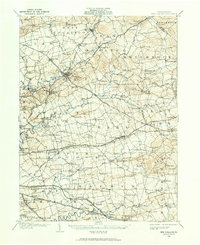 1906 New Holland1962 Print · USGSLancaster County at the start of the twentieth century shows a landscape transitioning from turnpikes to electric railways. Genealogists can trace family roots through an extensive network of rural landmarks, including Heller Church, Red Well School, and the early Waterworks at Ephrata.
 - 1908 Map of New Holland
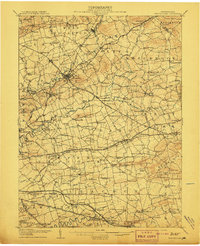 1908 New Holland1908 Print · USGSLancaster County at the turn of the century shows a thriving landscape of rural schoolhouses and turnpike villages. Genealogists can locate family landmarks like Middle Creek Church, Heller Church, and dozens of local schools from Stony Hill School to Clay School.6 unique versions available
 - 1941 Map of New Holland
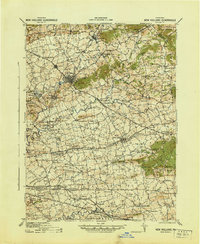 1941 New Holland1941 Print · USGSLancaster County’s agricultural heartland is documented here just as the modern highway era arrived. Genealogists and local historians can trace family locations through dozens of named rural landmarks like Heller Church, Fetter School, and the Pennsylvania RR corridor.
 - 1950 Map of Harrisburg, 1952 Print
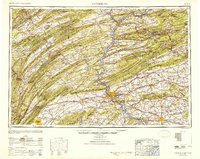 1950 Harrisburg1952 Print · USGSMid-century Central Pennsylvania comes alive through its dense rail networks and river valley settlements during the post-war industrial era. Genealogists and historians can trace family roots through hubs like Harrisburg, locate Carlisle Barracks, or follow the Pennsylvania RR through the Lebanon Valley.
 - 1956 Map of Terre Hill, 1957 Print
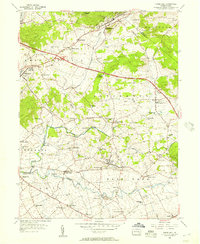 1956 Terre Hill1957 Print · USGSMid-century Lancaster County is captured here at the meeting of tradition and transit, just as the turnpike began reshaping the countryside. Genealogists can trace family roots through numerous local landmarks like Wide Hollow Sch, Red Run Ch, and the many small crossroads settlements like Fivepointville.6 unique versions available
 - 1957 Map of Harrisburg
 1957 Harrisburg1957 Print · USGSMid-century Central Pennsylvania comes into focus as a bustling network of rail, river, and mountain ridges. Genealogists and historians can trace the development of the State Capitol and surrounding hubs like Middletown, Columbia, and Pottsville.7 unique versions available
 - 1961 Map of Harrisburg
 1961 Harrisburg1961 Print · USGSCentral Pennsylvania is shown at a mid-century peak of industrial and military activity, from the Susquehanna water gaps to the fertile Dutch Country. Genealogists and historians can trace the rail corridors of the Pennsylvania RR and find landmarks like Carlisle Barracks or the Anthracite Coal Fields.2 unique versions available
 - 1964 Map of Harrisburg
 1964 Harrisburg1964 Print · USGSCentral Pennsylvania in the mid-fifties reveals a landscape shaped by ridge-and-valley geology and critical Cold War infrastructure. Researchers can trace the massive Indiantown Gap Military Reservation or the rail corridors of the Pennsylvania RR and Reading RR.
 - 1984 Map of Harrisburg, 1985 Print
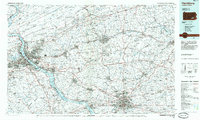 1984 Harrisburg1985 Print · USGSCentral Pennsylvania in the mid-eighties shows a landscape defined by the winding Susquehanna River and the industrial growth of its river towns. Researchers can trace the rail corridors of Amtrak and Conrail or explore the bounds of Fort Indiantown Gap Military Reservation.2 unique versions available
 - 1999 Map of Terre Hill, 2001 Print
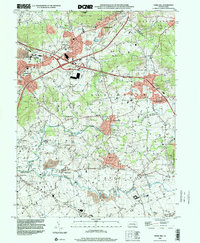 1999 Terre Hill2001 Print · USGSNortheastern Lancaster County at the end of the century retains its traditional rural layout despite the path of the Pennsylvania Turnpike. Genealogists and historians can trace numerous local landmarks including Salem Cem, Reddenbach Ch, and the many schools of East Earl.
 - 2010 Map of Terre Hill, 2010 Print
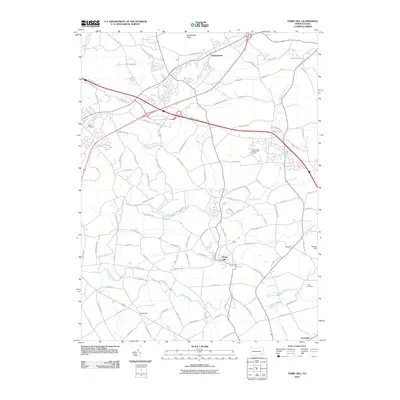 2010 Terre Hill2010 Print · USGSNortheastern Lancaster County in the early 2000s remains a landscape of rolling hills and traditional settlements. Genealogists and local historians can trace family locations near Salem Cemetery, the borough of Terre Hill, and the historic banks of the Conestoga River.
 - 2013 Map of Terre Hill, 2013 Print
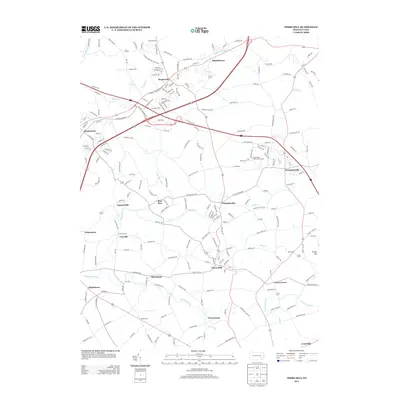 2013 Terre Hill2013 Print · USGSLancaster County's patchwork of colonial-era villages and fertile valleys is captured here in the early twenty-first century. Genealogists and local historians can trace family-named landmarks and historic settlements from Terre Hill and Reamstown to the banks of the Conestoga River.
 - 2016 Map of Terre Hill, 2016 Print
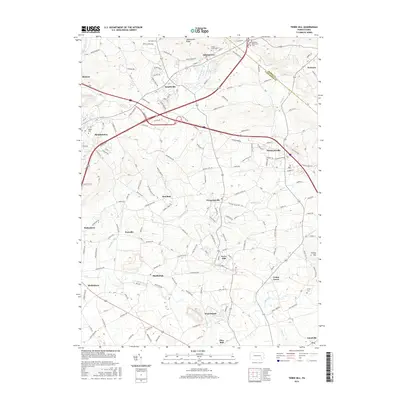 2016 Terre Hill2016 Print · USGSLancaster and Berks Counties are shown in the mid-2010s, where traditional Pennsylvania Dutch Country settlements meet the rising terrain of Adamstown Ridge. Genealogists can locate family landmarks such as Gehmans Mennonite Ch, Salem Cem, and the village of Terre Hill.
 - 2019 Map of Terre Hill, 2019 Print
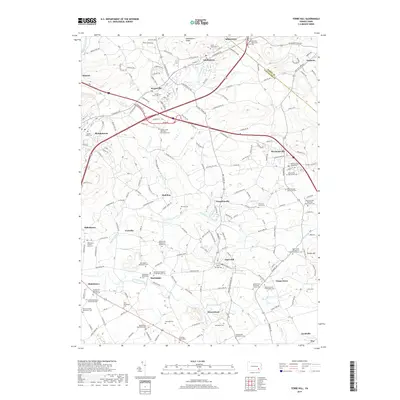 2019 Terre Hill2019 Print · USGSThe Pennsylvania Dutch Country landscape is revealed in this modern survey of the Berks and Lancaster County border. Genealogists and historians can locate numerous faith-based landmarks like the Weaverland Mennonite Cem, Old Welsh Cem, and Messner's Grave Yard.
 - 2023 Map of Terre Hill, 2023 Print
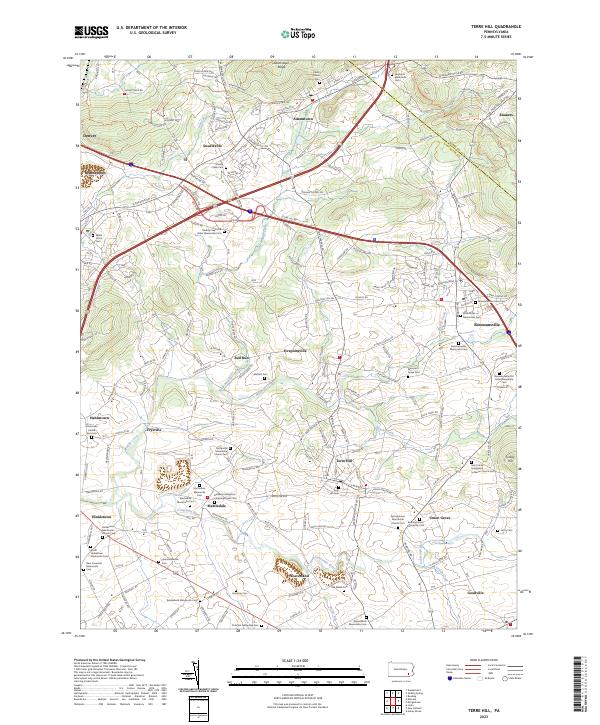 2023 Terre Hill2023 Print · USGSLancaster County's sectarian heartland comes into focus in this recent study of the area between the Conestoga River and Adamstown Ridge. Genealogists can trace family lineages through a remarkable density of local burial sites, including Messner's Grave Yard, Old Welsh Cem, and the Hahnstown United Zion Cem.
End of results
Showing maps 1-15 of 15
Top cities near Martindale
- Reading historical maps
- Lancaster historical maps
- West Lampeter Township historical maps
- Ephrata historical maps
- Wyomissing historical maps
- Lititz historical maps
See more
Frequently asked questions
- What are the different types of historical maps available for Martindale?
- What is the oldest map of Martindale?
- Where can I purchase historical maps of Martindale for my home or office?
- Where can I download high-res historical maps of Martindale?
- Are there historical topographic maps available for Martindale?
- Is there historical aerial imagery available for Martindale?
- Where are historical maps of Martindale sourced from?