1900s (20th Century) Maps of White Bluff, Tennessee
Explore 9 historic maps of White Bluff from the 1900s (20th Century). These maps offer a rare glimpse into what life looked like during the 1900s — showing old roads, neighborhoods, homes, and landmarks that have changed or disappeared over time.
Whether you're researching your family's past, planning a metal detecting trip, or studying how White Bluff's landscape evolved across the 1900s, these high-resolution maps are a powerful tool for exploring the history of this region.
- Focus on a specific era: All maps on this page are from the 1900s, giving you a focused view of this time period.
- See what’s changed: Compare century-old streets, trails, and buildings to today's modern landscape using overlays and satellite layers.
- Research with precision: Use these maps for genealogy, historical research, land use analysis, or educational projects.
- View, download, or print: Maps are fully viewable online in high resolution, and can be downloaded or printed for your own records.
Start exploring White Bluff's history through authentic maps from the 1900s. This is your window into the past.
White Bluff, TN maps
(9)- 1930 Map of White Bluff, 1953 Print
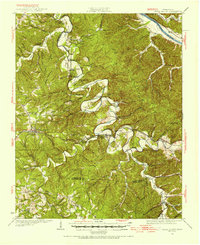 1930 White Bluff1953 Print · USGSMiddle Tennessee in the 1930s is defined by the serpentine bends of the Harpeth River and the steam-era dominance of the Nashville Chattanooga and St Louis RR. Genealogists and historians can locate vanished country schools like Opossum Sch and trace early road networks including the Dickson Turnpike.
 - 1933 Map of White Bluff
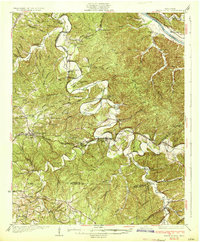 1933 White Bluff1933 Print · USGSThe Tennessee river country in the early thirties is defined here by the winding loops of the Harpeth River and the rail line through White Bluff. Genealogists and researchers can trace rural life through landmarks like Mound Bottom, Frog Pond Ch, and Opossum Sch.
 - 1936 Map of Burns
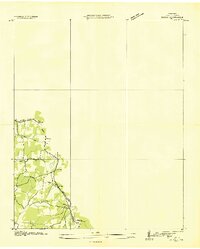 1936 Burns1936 Print · USGSDickson County's rural landscape is captured during the mid-1930s as modern infrastructure began to reshape the Tennessee interior. Researchers can trace the path of the N C AND ST L railroad through Tidwell and Pomona or locate the site of the Herbertson Sch.
 - 1953 Map of Burns, 1958 Print
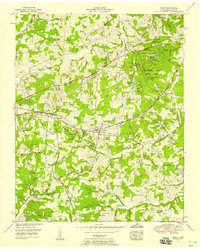 1953 Burns1958 Print · USGSMid-century Dickson County centers on the railroad towns of Burns and Colesburg as the local economy shifts from industry to recreation. Genealogists and historians can locate numerous family burial sites such as Dugan Cem or trace the early layout of Montgomery Bell State Park.5 unique versions available
 - 1956 Map of Nashville, 1971 Print
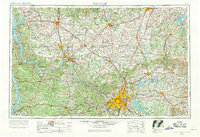 1956 Nashville1971 Print · USGSThe Tennessee-Kentucky borderlands come into focus in the mid-1960s as major reservoir projects transformed the Cumberland and Tennessee river valleys. Researchers can trace the rail networks of the Louisville and Nashville and visit sites like Fort Campbell and Fort Donelson National Military Park.2 unique versions available
 - 1959 Map of Nashville
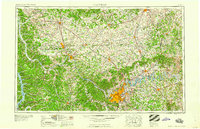 1959 Nashville1959 Print · USGSMiddle Tennessee and Southern Kentucky come into focus during the late fifties, showing the region's transition into a modern transportation and military hub. Researchers can trace the sprawling Fort Campbell Military Reservation or locate historic rail stops along the Tennessee Central Ry and Illinois Central RR.
 - 1966 Map of Harpeth Valley, 1967 Print
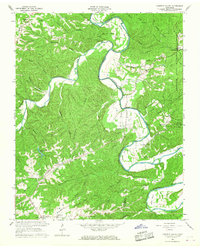 1966 Harpeth Valley1967 Print · USGSThe Harpeth River meanders through the Dickson and Cheatham county line in the mid-1960s, revealing a landscape of high ridges and rural valley settlements. Genealogists and researchers can trace family-named locations such as Petway, Griffintown, and the Taylortown Ch Cem.3 unique versions available
 - 1966 Map of White Bluff, 1967 Print
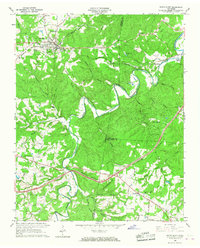 1966 White Bluff1967 Print · USGSThe wooded ridges of Dickson and Cheatham Counties are captured here in the mid-sixties as Interstate development began to reach the area. Genealogists can locate family landmarks like Pinkerton Cem, James Sch, and the rail stops at Craggie Hope and White Bluff.3 unique versions available
 - 1985 Map of Dickson
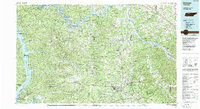 1985 Dickson1985 Print · USGSMid-Tennessee in the mid-1980s was defined by the intersection of the Cumberland and Tennessee rivers and a massive network of wildlife refuges. Researchers can trace the Seaboard System rail lines connecting Waverly, Dickson, and White Bluff, or locate old landmarks near Fort Donelson National Military Park.
End of results
Showing maps 1-9 of 9
Top cities near White Bluff
- Nashville historical maps
- Dickson historical maps
- Fairview historical maps
- Ashland City historical maps
- Kingston Springs historical maps
- Pegram historical maps
See more
Top neighborhoods of White Bluff
Frequently asked questions
- What are the different types of historical maps available for White Bluff?
- What is the oldest map of White Bluff?
- Where can I purchase historical maps of White Bluff for my home or office?
- Where can I download high-res historical maps of White Bluff?
- Are there historical topographic maps available for White Bluff?
- Is there historical aerial imagery available for White Bluff?
- Where are historical maps of White Bluff sourced from?