1900s (20th Century) Maps of Tryon, Tennessee
Explore 11 historic maps of Tryon from the 1900s (20th Century). These maps offer a rare glimpse into what life looked like during the 1900s — showing old roads, neighborhoods, homes, and landmarks that have changed or disappeared over time.
Whether you're researching your family's past, planning a metal detecting trip, or studying how Tryon's landscape evolved across the 1900s, these high-resolution maps are a powerful tool for exploring the history of this region.
- Focus on a specific era: All maps on this page are from the 1900s, giving you a focused view of this time period.
- See what’s changed: Compare century-old streets, trails, and buildings to today's modern landscape using overlays and satellite layers.
- Research with precision: Use these maps for genealogy, historical research, land use analysis, or educational projects.
- View, download, or print: Maps are fully viewable online in high resolution, and can be downloaded or printed for your own records.
Start exploring Tryon's history through authentic maps from the 1900s. This is your window into the past.
Tryon, TN maps
(11)- 1912 Map of Mt Guyot
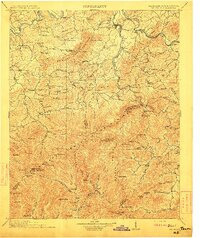 1912 Mt Guyot1912 Print · USGSThe Tennessee and North Carolina borderlands come into focus in the early twentieth century, prior to the creation of the Great Smoky Mountains National Park. Trace ancestral locations like Cataloochee and Smokemont or follow the Southern RR to Newport.5 unique versions available
 - 1935 Map of English Mountain
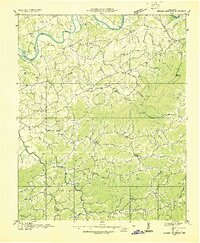 1935 English Mountain1935 Print · USGSSevier County and the foothills of the Smokies are seen here during the mid-thirties as the national park was taking shape. Genealogists can trace family roots through scores of rural institutions like Smoky Mtn Academy, Pittman Center, and the Crockettville Sch.
 - 1935 Map of Clevenger
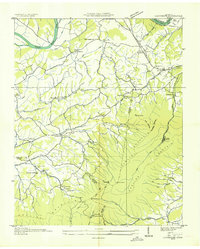 1935 Clevenger1935 Print · USGSJefferson and Cocke Counties are shown in the mid-1930s, featuring the rural communities nestled against the slopes of English Mountain. Genealogists and historians can locate family landmarks like Bridges Ch, trace the site of CCC Camp No 1467, or find the old Blowing Cave Mill.
 - 1939 Map of Clevenger, 1954 Print
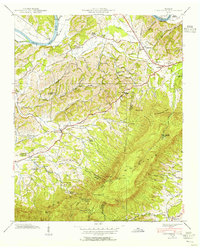 1939 Clevenger1954 Print · USGSJefferson and Cocke counties meet along the French Broad River in the late thirties, just as the local highway network was expanding. Genealogists can trace early homesteads and landmarks like Blowing Cave Mill, Bird Crossroads, and the Bogard Ch Rainwater Sch.
 - 1940 Map of Clevenger
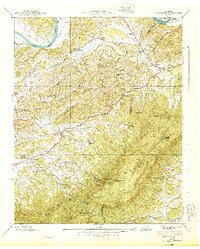 1940 Clevenger1940 Print · USGSJefferson and Cocke counties are captured here in the late 1930s, showing a landscape of high ridges and river bottomlands. Researchers can find numerous rural landmarks like the Blowing Cave Mill, the Bogard Ch Rainwater Sch, and the riverside community of Dutch Bottoms.2 unique versions available
 - 1955 Map of Knoxville
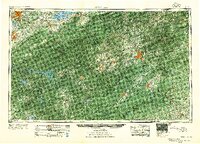 1955 Knoxville1955 Print · USGSThe Southern Appalachians and the Smoky Mountains are shown here at a peak of mid-century development and conservation. Genealogists and historians can trace the early road networks connecting Gatlinburg, Waynesville, and the Cherokee Indian Reservation across the high ridges.
 - 1957 Map of Knoxville, 1966 Print
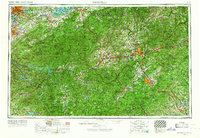 1957 Knoxville1966 Print · USGSThe Southern Appalachians of Tennessee and North Carolina are mapped here during the mid-twentieth century as new highways reached the high country. Genealogists and historians can trace the topography between Knoxville and Asheville, locating family landmarks near Fontana Lake or along the Blue Ridge Parkway.4 unique versions available
 - 1960 Map of Knoxville
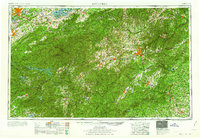 1960 Knoxville1960 Print · USGSThe Southern Appalachians come alive in the 1950s, showing the intersection of new national park tourism and deep-rooted mountain industry. Trace old rail lines like the Clinchfield RR and find high-altitude landmarks from Mt Le Conte to the Cherokee Indian Reservation.2 unique versions available
 - 1961 Map of Chestnut Hill, 1964 Print
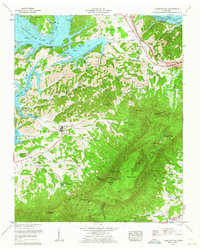 1961 Chestnut Hill1964 Print · USGSThe foothills of the Smokies in the early sixties are defined here by the rise of English Mountain above the French Broad River. Genealogists and historians can trace numerous family-named landmarks and rural hubs, from Blowing Cave Mill to Dickey School Ch and Reidtown.3 unique versions available
 - 1964 Map of Knoxville
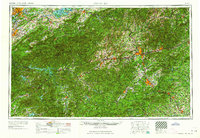 1964 Knoxville1964 Print · USGSThe Southern Appalachians and Great Smokies are captured here during the mid-sixties, showing the rugged borderlands of Tennessee and North Carolina. Researchers can trace historic mountain routes like U S 441, the expanse of Pisgah National Forest, and the growing footprints of Asheville and Knoxville.
 - 1983 Map of Knoxville, 1984 Print
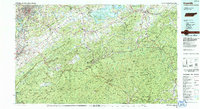 1983 Knoxville1984 Print · USGSThe Tennessee valley and the rising Smokies are captured here in the early eighties, showing the region as the tourism and transit hub of the Southern Appalachians. Researchers can trace the layout of the University of Tennessee or locate rural landmarks like Shady Grove Ch and Pleasant Hill Cem.
End of results
Showing maps 1-11 of 11
Top cities near Tryon
- Morristown historical maps
- Sevierville historical maps
- Jefferson City historical maps
- Newport historical maps
- Pigeon Forge historical maps
- Dandridge historical maps
See more
Frequently asked questions
- What are the different types of historical maps available for Tryon?
- What is the oldest map of Tryon?
- Where can I purchase historical maps of Tryon for my home or office?
- Where can I download high-res historical maps of Tryon?
- Are there historical topographic maps available for Tryon?
- Is there historical aerial imagery available for Tryon?
- Where are historical maps of Tryon sourced from?