1900s (20th Century) Maps of Hoovers, Utah
Explore 6 historic maps of Hoovers from the 1900s (20th Century). These maps offer a rare glimpse into what life looked like during the 1900s — showing old roads, neighborhoods, homes, and landmarks that have changed or disappeared over time.
Whether you're researching your family's past, planning a metal detecting trip, or studying how Hoovers's landscape evolved across the 1900s, these high-resolution maps are a powerful tool for exploring the history of this region.
- Focus on a specific era: All maps on this page are from the 1900s, giving you a focused view of this time period.
- See what’s changed: Compare century-old streets, trails, and buildings to today's modern landscape using overlays and satellite layers.
- Research with precision: Use these maps for genealogy, historical research, land use analysis, or educational projects.
- View, download, or print: Maps are fully viewable online in high resolution, and can be downloaded or printed for your own records.
Start exploring Hoovers's history through authentic maps from the 1900s. This is your window into the past.
Hoovers, UT maps
(6)- 1932 Map of Sevier, 1975 Print
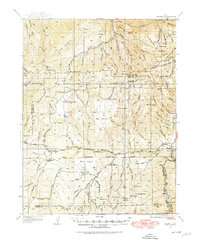 1932 Sevier1975 Print · USGSThe high plateau country of central Utah comes into focus in the early 1930s, showing a landscape defined by the Denver & Rio Grande Western railroad and remote mountain peaks. Genealogists and local historians can trace family-named landmarks like Parker Ranch or locate early forest service outposts at Rockwood Ranger Sta.
 - 1935 Map of Sevier
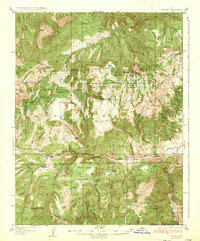 1935 Sevier1935 Print · USGSThe high country of Sevier and Millard Counties is captured here in the mid-1930s, documenting the early forest management and transit routes of the era. Genealogists and historians can trace old homesteads like Parker Ranch and find remote outposts such as Rockwood Ranger Sta and Pavant Ranger Sta.3 unique versions available
 - 1953 Map of Richfield, 1963 Print
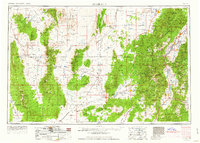 1953 Richfield1963 Print · USGSCentral Utah in the early fifties reveals a complex geography of high plateaus and desert basins tied together by the Union Pacific rail lines. Genealogists and historians can trace family roots in Richfield or Kanosh and locate remote operations like the Blue Star Mine or Newhouse.3 unique versions available
 - 1958 Map of Richfield
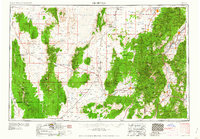 1958 Richfield1958 Print · USGSCentral Utah in the late fifties shows a landscape of mountain forests and desert basins connected by the Union Pacific Railroad. Genealogists and historians can trace rail stops at Nada Station, mines like the Blue Star Mine, and tribal lands of the Paiute Indian Reservation.2 unique versions available
 - 1980 Map of Richfield, 1987 Print
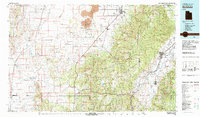 1980 Richfield1987 Print · USGSCentral Utah in the early eighties shows a landscape of volcanic fields and high mountain forests. Genealogists can trace family roots through the Sevier River valley in Richfield, Fillmore, and Monroe, or follow the Union Pacific rail lines.2 unique versions available
 - 1981 Map of Marysvale Canyon
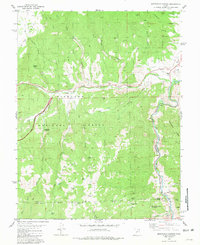 1981 Marysvale Canyon1981 Print · USGSThe Sevier River canyon in the early eighties shows a landscape shaped by industrial mining and heavy rail transport. You can trace the Denver and Rio Grande Western line past Big Rock Candy Mountain or locate high-altitude workings like the Yellow Cougar Mine.2 unique versions available
End of results
Showing maps 1-6 of 6
Top cities near Hoovers
- Richfield historical maps
- Monroe historical maps
- Elsinore historical maps
- Annabella historical maps
- Central Valley historical maps
- Marysvale historical maps
See more
Frequently asked questions
- What are the different types of historical maps available for Hoovers?
- What is the oldest map of Hoovers?
- Where can I purchase historical maps of Hoovers for my home or office?
- Where can I download high-res historical maps of Hoovers?
- Are there historical topographic maps available for Hoovers?
- Is there historical aerial imagery available for Hoovers?
- Where are historical maps of Hoovers sourced from?