1900s (20th Century) Maps of Pleasant Green, Virginia
Explore 9 historic maps of Pleasant Green from the 1900s (20th Century). These maps offer a rare glimpse into what life looked like during the 1900s — showing old roads, neighborhoods, homes, and landmarks that have changed or disappeared over time.
Whether you're researching your family's past, planning a metal detecting trip, or studying how Pleasant Green's landscape evolved across the 1900s, these high-resolution maps are a powerful tool for exploring the history of this region.
- Focus on a specific era: All maps on this page are from the 1900s, giving you a focused view of this time period.
- See what’s changed: Compare century-old streets, trails, and buildings to today's modern landscape using overlays and satellite layers.
- Research with precision: Use these maps for genealogy, historical research, land use analysis, or educational projects.
- View, download, or print: Maps are fully viewable online in high resolution, and can be downloaded or printed for your own records.
Start exploring Pleasant Green's history through authentic maps from the 1900s. This is your window into the past.
Pleasant Green, VA maps
(9)- 1943 Map of Fine Creek Mills
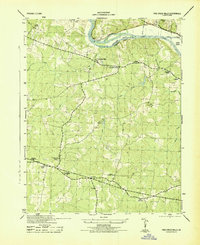 1943 Fine Creek Mills1943 Print · USGSThe rural landscape of Powhatan and Goochland counties is captured here in the mid-1940s, highlighting a river-and-rail economy along the James River. Genealogists and historians can trace community hubs like Fine Creek Mills and Subletts, or locate rural landmarks such as Quinns Store and Subletts School.2 unique versions available
 - 1943 Map of Richmond, 1972 Print
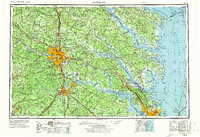 1943 Richmond1972 Print · USGSCoastal Virginia and the state capital are shown in detail during the mid-century era of infrastructure expansion. Genealogists and historians can trace the grounds of Richmond Nat Battlefield Park, locate the Yorktown Nat Cem, or follow the many rural routes through Amelia Court House and Tappahannock.
 - 1949 Map of Richmond, 1951 Print
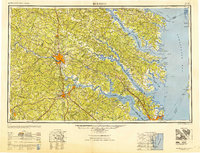 1949 Richmond1951 Print · USGSCoastal Virginia in the years following World War II remained a landscape of historic river towns and expanding military bases. Genealogists and historians can trace the rail lines of the Southern Ry and locate established landmarks from Camp Lee to the remote reaches of Dragon Swamp.
 - 1959 Map of Richmond
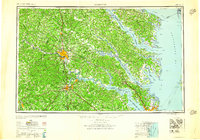 1959 Richmond1959 Print · USGSMid-century Virginia is captured here at its most vital rail and river junctions, from the capital city to the Chesapeake Bay. Genealogists and historians can trace the development of colonial settlements like Williamsburg and military landmarks including Fort Monroe and Camp Lee.
 - 1964 Map of Richmond
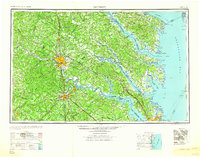 1964 Richmond1964 Print · USGSCoastal and central Virginia are mapped during the mid-twentieth century, showing the critical intersection of rail, river, and military life. Genealogists can trace family roots through rural county seats like Amelia or find vanished coastal neighborhoods near Phoebus and Hilton Village.
 - 1964 Map of Fine Creek Mills, 1966 Print
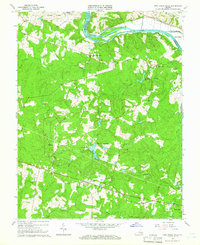 1964 Fine Creek Mills1966 Print · USGSThe James River corridor in the mid-sixties reveals a rural landscape of family cemeteries and riverside industry. Genealogists and researchers can locate Old Powhatan Ch, the Watkins Cem, and the historic community at Fine Creek Mills.4 unique versions available
 - 1973 Map of Richmond, 1974 Print
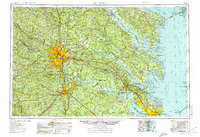 1973 Richmond1974 Print · USGSThe Virginia Tidewater and Piedmont come alive in the early seventies, showcasing a region defined by its great rivers and massive military installations. Researchers can trace the mid-century growth of Richmond or locate family sites near Amelia Court House and Highland Springs.2 unique versions available
 - 1979 Map of Fine Creek Mills, 1982 Print
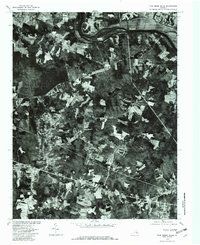 1979 Fine Creek Mills1982 Print · USGSPowhatan County’s riverfront and rural interior are captured here in the late seventies through detailed aerial orthophotography. Trace local landmarks like Fine Creek Mills, the banks of the James River, and the community of Flat Rock.
 - 1984 Map of Richmond, 1986 Print
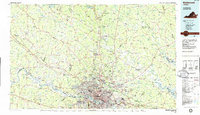 1984 Richmond1986 Print · USGSCentral Virginia during the mid-eighties shows a landscape of rapid suburban expansion centered on the state capital and its historic riverfront. Genealogists and historians can trace institutional sites like Randolph-Macon College, the grounds of Fort Lee, and small community landmarks like Hebron Ch.3 unique versions available
End of results
Showing maps 1-9 of 9
Top cities near Pleasant Green
Frequently asked questions
- What are the different types of historical maps available for Pleasant Green?
- What is the oldest map of Pleasant Green?
- Where can I purchase historical maps of Pleasant Green for my home or office?
- Where can I download high-res historical maps of Pleasant Green?
- Are there historical topographic maps available for Pleasant Green?
- Is there historical aerial imagery available for Pleasant Green?
- Where are historical maps of Pleasant Green sourced from?