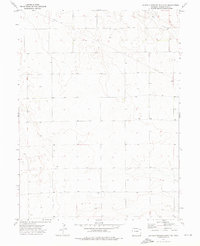
1973 Map of Buffalo Springs Ranch SE
USGS Topo · Published 1976About this map
The High Plains of Washington County during the early 1970s are defined by a sparse, utilitarian landscape shaped by ranching and resource extraction. Evidence of early settlement remains visible at the Curtis Cem, a small burial ground situated near the southern boundary of the quadrangle. The terrain is characterized by a high-density network of closed depressions and intermittent drainage patterns, including the winding course of Rock Creek in the northeastern corner. Human intervention in this open country is marked by a significant Pipeline corridor cutting diagonally across the landscape and scattered water infrastructure indicated by several Well sites. These features underscore the region's reliance on groundwater and modern energy transport within an otherwise open, unpopulated reach of eastern Colorado.
Find a feature on this map
4 named features on this map. Tap any name to fly to it.
Don’t see what you’re looking for? This feature index may not catch every label — zoom into the map to look around manually.
Map Details
Editions of this 1973 Buffalo Springs Ranch SE Map
This is the sole edition of this map. No revisions or reprints were ever made.
Other maps of this area
1954 · Sterling
USGS Topo · 1:250,000
1958 · Sterling
USGS Topo · 1:250,000
1972 · Glacken Hill
USGS Topo · 1:24,000
1972 · Otis
USGS Topo · 1:24,000
1972 · Burdett
USGS Topo · 1:24,000
1973 · Akron
USGS Topo · 1:24,000
1973 · Buffalo Springs Ranch NW
USGS Topo · 1:24,000
1973 · Platner
USGS Topo · 1:24,000
1973 · Buffalo Springs Ranch NE
USGS Topo · 1:24,000
1973 · Buffalo Springs Ranch
USGS Topo · 1:24,000