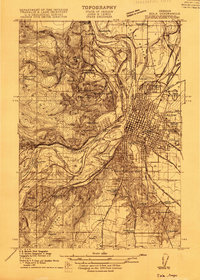
1915 Map of Eola
USGS Topo · Published 1915About this map
The Willamette River carves through this 1915 survey, separating the burgeoning city of Salem from the hills and orchards of West Salem. This period is characterized by the convergence of major state institutions and transit networks, including the Southern Pacific Railroad and the Oregon Electric Railway. The map reveals the extensive footprint of state facilities such as the State Insane Asylum, State Penitentiary, and the State Feeble Minded Asylum, illustrating the city's role as a regional administrative hub.
Find a feature on this map
69 named features on this map. Tap any name to fly to it.
Don’t see what you’re looking for? This feature index may not catch every label — zoom into the map to look around manually.
Map Details
Editions of this 1915 Eola Map
This is the sole edition of this map. No revisions or reprints were ever made.
Other maps of this area
1914 · Independence
USGS Topo · 1:31,680
1915 · Rickreall
USGS Topo · 1:31,680
1915 · Sidney
USGS Topo · 1:31,680
1917 · Salem
USGS Topo · 1:62,500
1923 · Mount Angel
USGS Topo · 1:62,500
1924 · Mc Minnville
USGS Topo · 1:48,000
1925 · Stayton
USGS Topo · 1:62,500
1926 · Mc Minnville
USGS Topo · 1:62,500
1940 · McMinnville
USGS Topo · 1:62,500
1940 · Salem
USGS Topo · 1:62,500