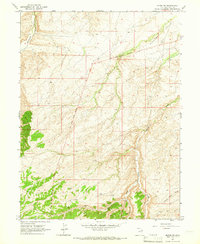
1964 Map of Myton SW
USGS Topo · Published 1966About this map
The Old Indian Treaty Boundary slices diagonally across this high desert landscape, marking a significant historical administrative division in Duchesne County. Surveyed in the mid-1960s, the terrain is defined by deep drainage systems including Pleasant Valley and the branching Wells Draw. Evidence of the region's mineral and energy extraction is visible through scattered Oil Wells and a specific area noted for Gilsonite, a unique solid hydrocarbon found in the Uinta Basin. The arid topography is further articulated by the steep walls of Antelope Canyon and the prominent rising form of Castle Peak in the southeast. A network of unimproved dirt tracks and a Jeep Trail provide the only access through these breaks and washes, illustrating the isolation and resource-driven geography of the area during this era.
Find a feature on this map
9 named features on this map. Tap any name to fly to it.
Don’t see what you’re looking for? This feature index may not catch every label — zoom into the map to look around manually.
Map Details
Editions of this 1964 Myton SW Map
This is the sole edition of this map. No revisions or reprints were ever made.
Other maps of this area
1885 · Uinta
USGS Topo · 1:250,000
1886 · Price River
USGS Topo · 1:250,000
1896 · Price River
USGS Topo · 1:250,000
1939 · Duchesne
USGS Topo · 1:125,000
1954 · Salt Lake City
USGS Topo · 1:250,000
1956 · Price
USGS Topo · 1:250,000
1958 · Salt Lake City
USGS Topo · 1:250,000
1960 · Salt Lake City
USGS Topo · 1:250,000
1960 · Price
USGS Topo · 1:250,000
1962 · Price
USGS Topo · 1:250,000