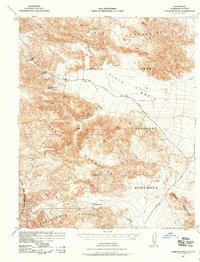
1943 Map of Pinkham Well
USGS Topo · Published 1960About this map
The Joshua Tree National Monument dominates this desert landscape, where high mountain ranges meet the arid expanse of the Pinto Basin. Surveyed by the War Department and Corps of Engineers, U.S. Army during the Second World War, the map illustrates a region defined by isolation and mineral exploration. The Hexie Mountains and Pinto Mountains flank the basin, while localized points of interest like Blondy, Jessie, and Bingo mark specific sites across the rugged terrain. These names, along with others like Lucy and Mary, often suggest small-scale mining or survey camps common to the era. Economic activity is anchored by the El Dorado Mine and the Golden Bee Mine, while the vital Pinkham Well provides a rare water source. The road network is sparse, centered on the West Pinto Basin Road and the crossing at Cottonwood Pass.
Find a feature on this map
18 named features on this map. Tap any name to fly to it.
Don’t see what you’re looking for? This feature index may not catch every label — zoom into the map to look around manually.
Map Details
Editions of this 1943 Pinkham Well Map
This is the sole edition of this map. No revisions or reprints were ever made.
Other maps of this area
1904 · Indio
USGS Topo · 1:125,000
1940 · Cottonwood Spring
USGS Topo · 1:62,500
1940 · Canyon Spring
USGS Topo · 1:62,500
1941 · Coachella
USGS Topo · 1:62,500
1942 · Amboy
USGS Topo · 1:250,000
1943 · Amboy
USGS Topo · 1:250,000
1943 · Canyon Spring
USGS Topo · 1:62,500
1943 · Coachella
USGS Topo · 1:62,500
1944 · Cottonwood Spring
USGS Topo · 1:62,500
1944 · Pinkham Well
USGS Topo · 1:62,500