1950s Maps of Ripon, California
Explore 6 historic maps of Ripon from the 1950s. These maps offer a rare glimpse into what life looked like during the 1950s — showing old roads, neighborhoods, homes, and landmarks that have changed or disappeared over time.
Whether you're researching your family's past, planning a metal detecting trip, or studying how Ripon's landscape evolved across the 1950s, these high-resolution maps are a powerful tool for exploring the history of this region.
- Focus on a specific era: All maps on this page are from the 1950s, giving you a focused view of this time period.
- See what’s changed: Compare century-old streets, trails, and buildings to today's modern landscape using overlays and satellite layers.
- Research with precision: Use these maps for genealogy, historical research, land use analysis, or educational projects.
- View, download, or print: Maps are fully viewable online in high resolution, and can be downloaded or printed for your own records.
Start exploring Ripon's history through authentic maps from the 1950s. This is your window into the past.
Ripon, CA maps
(6)- 1952 Map of Manteca, 1953 Print
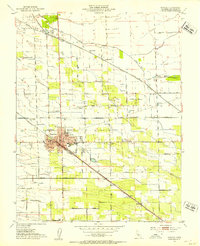 1952 Manteca1953 Print · USGSIn the early fifties, the San Joaquin Valley landscape around Manteca was a grid of orchards and vineyards tied together by two major rail lines. Researchers can trace the mid-century footprint of the Sugar Refinery, find vanished local school sites like Castle School, and locate family plots at Union Memorial Cemetery.6 unique versions available
 - 1952 Map of Avena, 1953 Print
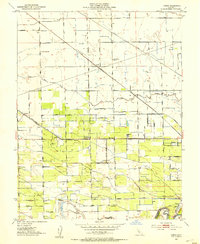 1952 Avena1953 Print · USGSSan Joaquin County agriculture is in full bloom during the early fifties, showcasing a complex grid of orchards and irrigation. Genealogists and rail historians can trace the paths of three different railroads and locate rural schoolhouses like Four Trees School and the town of Escalon.5 unique versions available
 - 1952 Map of Ripon, 1954 Print
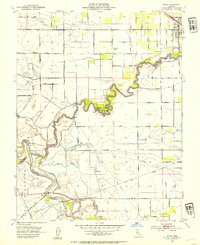 1952 Ripon1954 Print · USGSThe San Joaquin and Stanislaus rivers meet in this early 1950s survey of California's agricultural heartland. Trace irrigation history through the Hetch Hetchy Aqueduct and find family sites at Mapes Ranch or the San Joaquin School.
 - 1952 Map of Manteca, 1958 Print
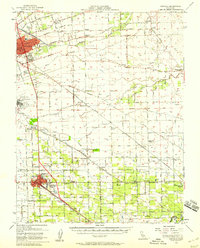 1952 Manteca1958 Print · USGSThe fertile San Joaquin Valley underwent significant post-war growth as irrigation and railroads connected agricultural hubs in the early fifties. Genealogists and local historians can trace rural school districts like Four Trees School and find industry landmarks such as the Sugar Refinery or the Union Memorial Cemetery.2 unique versions available
 - 1953 Map of Salida, 1954 Print
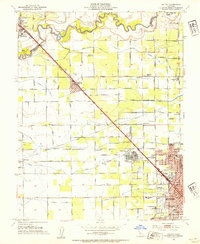 1953 Salida1954 Print · USGSStanislaus County agriculture and early urbanization are captured here just as the post-war boom reached the Central Valley. Genealogists and local historians can locate several rural schoolhouses like Ransom Sch or trace the extensive irrigation works from Lateral No 8 to the Hetch Hetchy Aqueduct.2 unique versions available
 - 1956 Map of San Jose
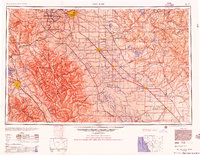 1956 San Jose1956 Print · USGSCentral California in the mid-fifties reveals the transition from sprawling orchards to growing urban hubs like San Jose and Stockton. Genealogists and historians can trace the rail-era landscape of the Mother Lode through Chinese Camp and Tuttletown, or follow the water through the Joaquin River and Calaveras Reservoir.
End of results
Showing maps 1-6 of 6
Top cities near Ripon
- Stockton historical maps
- Modesto historical maps
- Manteca historical maps
- Turlock historical maps
- Ceres historical maps
- Riverbank historical maps
See more
Top neighborhoods of Ripon
Frequently asked questions
- What are the different types of historical maps available for Ripon?
- What is the oldest map of Ripon?
- Where can I purchase historical maps of Ripon for my home or office?
- Where can I download high-res historical maps of Ripon?
- Are there historical topographic maps available for Ripon?
- Is there historical aerial imagery available for Ripon?
- Where are historical maps of Ripon sourced from?