1900s (20th Century) Maps of Parsons, Kansas
Explore 18 historic maps of Parsons from the 1900s (20th Century). These maps offer a rare glimpse into what life looked like during the 1900s — showing old roads, neighborhoods, homes, and landmarks that have changed or disappeared over time.
Whether you're researching your family's past, planning a metal detecting trip, or studying how Parsons's landscape evolved across the 1900s, these high-resolution maps are a powerful tool for exploring the history of this region.
- Focus on a specific era: All maps on this page are from the 1900s, giving you a focused view of this time period.
- See what’s changed: Compare century-old streets, trails, and buildings to today's modern landscape using overlays and satellite layers.
- Research with precision: Use these maps for genealogy, historical research, land use analysis, or educational projects.
- View, download, or print: Maps are fully viewable online in high resolution, and can be downloaded or printed for your own records.
Start exploring Parsons's history through authentic maps from the 1900s. This is your window into the past.
Parsons, KS maps
(18)- 1905 Map of Independence
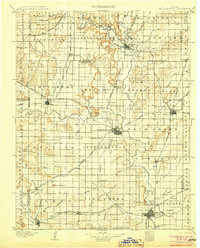 1905 Independence1905 Print · USGSSoutheastern Kansas at the turn of the century is a landscape of expanding rail-hubs and river commerce. Genealogists can trace early homesteads and rail-stops like Lafontaine, Havana, and Sycamore, or locate family landmarks near Table Mound and the Verdigris River.4 unique versions available
 - 1943 Map of McCune, 1968 Print
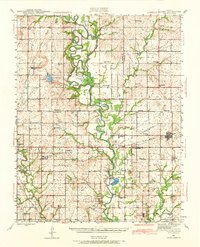 1943 McCune1968 Print · USGSSoutheast Kansas at the height of the Second World War reveals a landscape where traditional farming meets heavy military industry. Researchers can trace the massive Kansas Ordnance Plant alongside vanished rural school districts like Stone Palace Sch and Ideat Sch.
 - 1945 Map of Mc Cune
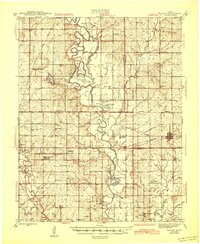 1945 Mc Cune1945 Print · USGSSoutheastern Kansas at the close of the Second World War shows a landscape of river-bottom farms and emerging industry. Genealogists can locate dozens of country schools like Quick Sch and trace family ties at the Franklin Cem or Oakwood Cem.2 unique versions available
 - 1945 Map of Parsons, 1956 Print
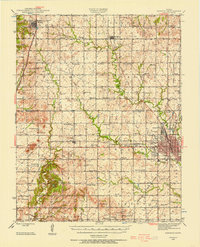 1945 Parsons1956 Print · USGSSoutheastern Kansas at the end of World War II reveals a landscape of thriving rail hubs and vanishing rural hamlets. Researchers can trace the legacy of school districts like New Hope Sch, the grounds of the State Asylum, and the location of the Site of Wilsonton.
 - 1946 Map of Parsons
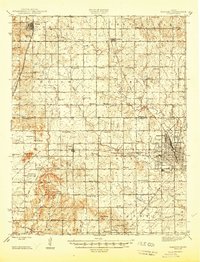 1946 Parsons1946 Print · USGSSoutheast Kansas at the close of the 1940s reveals a landscape defined by busy rail hubs and a dense network of one-room schoolhouses. Genealogists can trace family names through dozens of rural sites like Sylvandale Sch, Mt Calvary Cem, and the State Asylum at Parsons.
 - 1947 Map of Parsons
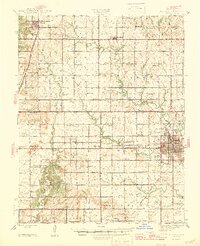 1947 Parsons1947 Print · USGSParsons and the surrounding Labette County plains are caught here in the mid-1940s, a time of heavy rail traffic and established rural townships. Genealogists can trace family roots through numerous small landmarks like Mt Calvary Cem, Shiloh Sch, and the Site of Wilsonton.2 unique versions available
 - 1947 Map of Joplin, 1954 Print
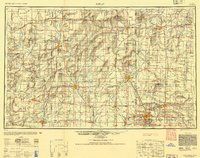 1947 Joplin1954 Print · USGSThe borderlands of Missouri, Kansas, and Oklahoma are shown here during the late 1940s, a period of heavy industrial and military activity. Researchers can trace the extensive Tri-State Mining District, the layout of Camp Crowder, and local landmarks like Mount Hope Cem.
 - 1949 Map of Joplin
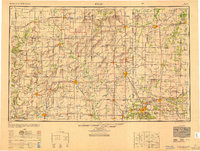 1949 Joplin1949 Print · USGSThe Kansas-Missouri borderlands thrive in the late 1940s, showing a robust network of railroad towns and river valleys. Researchers can trace historic rail lines like the Missouri Pacific RR and locate rural centers such as Chanute, Iola, and Fort Scott.
 - 1954 Map of Joplin, 1967 Print
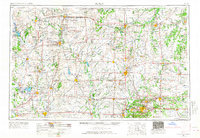 1954 Joplin1967 Print · USGSThe tri-state border region of Kansas, Missouri, and Oklahoma is captured here during a peak era of mid-century industrial and agricultural activity. Researchers can trace family history through dozens of rural cemeteries or locate landmarks like the Kansas Army Ammunition Plant and Pittsburg State University.3 unique versions available
 - 1958 Map of Joplin
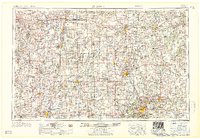 1958 Joplin1958 Print · USGSThe tri-state border region of Missouri, Kansas, and Oklahoma is shown during the late fifties, a time of heavy rail traffic and mining activity. Local historians can trace the industrial landscape through the Joplin & Pittsburg Ry or locate family sites like Zion Ch and Bender Mounds.
 - 1959 Map of Joplin
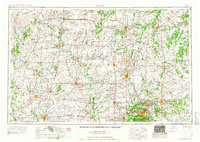 1959 Joplin1959 Print · USGSThe Tri-State region’s mining and rail-driven economy is on full display in the late fifties. Genealogists can locate Lead and Zinc Mines near Joplin, family markers at Oak Hill Cem, and military history at Camp Clark.
 - 1962 Map of Cherryvale, 1964 Print
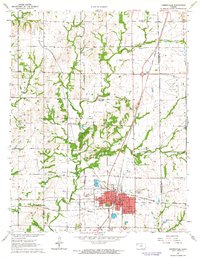 1962 Cherryvale1964 Print · USGSSoutheast Kansas in the early sixties is defined by the busy rail junction at Cherryvale and the surrounding oil and shale works. Researchers can trace the Old Indian Treaty Boundary or locate family roots at Hiltz Cem and Pleasant Dale Sch.2 unique versions available
 - 1973 Map of Parsons East, 1975 Print
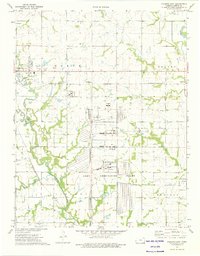 1973 Parsons East1975 Print · USGSLabette County's industrial and rural character is on full display in the early 1970s, as the massive Kansas Army Ammunition Plant operates alongside traditional prairie settlements. Researchers can trace family history through sites like Oakwood Cem and Center Bethel Ch or follow the paths of the St Louis - San Francisco railroad.
 - 1973 Map of South Mound, 1975 Print
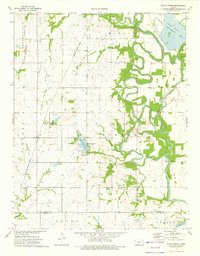 1973 South Mound1975 Print · USGSThe Neosho River valley in the early 1970s shows a landscape of tight river bends and established rail corridors. Trace local family roots at Union Cem or explore the infrastructure of the day, from the Parsons Dam to the South Mound settlement.
 - 1973 Map of Parsons West, 1975 Print
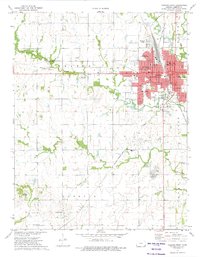 1973 Parsons West1975 Print · USGSParsons was a bustling Labette County hub in the early seventies, caught between its rail-industrial roots and its role as a regional medical and educational center. Researchers can trace family sites at Hopewell Ch, the Wilsonton Cem, or the Parsons State Hospital grounds.
 - 1973 Map of Galesburg, 1975 Print
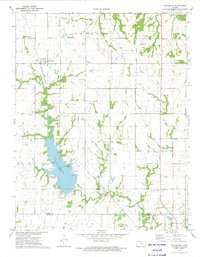 1973 Galesburg1975 Print · USGSThe rural border of Neosho and Labette Counties is captured here in the early seventies, dominated by the railroad and the waters of Lake Parsons. Genealogists can trace local history through a high density of rural cemeteries like Mt Hope Cem and Ladore Cem.
 - 1985 Map of Coffeyville
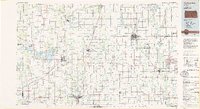 1985 Coffeyville1985 Print · USGSSoutheast Kansas in the mid-eighties shows a landscape of river-valley agriculture and heavy industry anchored by the rail hubs of Independence and Coffeyville. Genealogists and historians can trace rail lines like the Missouri Kansas Texas RR and locate sites like Fairview Cemetery or the Kansas Army Ammunition Plant.
 - 1990 Map of Coffeyville
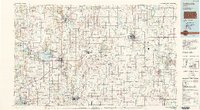 1990 Coffeyville1990 Print · USGSSoutheast Kansas in the late twentieth century is defined by its industrial sites and river valley rail hubs. Genealogists and historians can trace the infrastructure of the Army Ammunition Plant, the local graves at Fairview Cemetery, and the extensive Strip Mine operations.
End of results
Showing maps 1-18 of 18
Top cities near Parsons
- Cherryvale historical maps
- Erie historical maps
- Altamont historical maps
- Thayer historical maps
- Mound Valley historical maps
- Galesburg historical maps
See more
Top neighborhoods of Parsons
Frequently asked questions
- What are the different types of historical maps available for Parsons?
- What is the oldest map of Parsons?
- Where can I purchase historical maps of Parsons for my home or office?
- Where can I download high-res historical maps of Parsons?
- Are there historical topographic maps available for Parsons?
- Is there historical aerial imagery available for Parsons?
- Where are historical maps of Parsons sourced from?