1900s (20th Century) Maps of Northeast, Kansas City
Explore 11 historic maps of Northeast from the 1900s (20th Century). These maps offer a rare glimpse into what life looked like during the 1900s — showing old roads, neighborhoods, homes, and landmarks that have changed or disappeared over time.
Whether you're researching your family's past, planning a metal detecting trip, or studying how Northeast's landscape evolved across the 1900s, these high-resolution maps are a powerful tool for exploring the history of this region.
- Focus on a specific era: All maps on this page are from the 1900s, giving you a focused view of this time period.
- See what’s changed: Compare century-old streets, trails, and buildings to today's modern landscape using overlays and satellite layers.
- Research with precision: Use these maps for genealogy, historical research, land use analysis, or educational projects.
- View, download, or print: Maps are fully viewable online in high resolution, and can be downloaded or printed for your own records.
Start exploring Northeast's history through authentic maps from the 1900s. This is your window into the past.
Northeast, Kansas City maps
(11)- 1943 Map of Quindaro
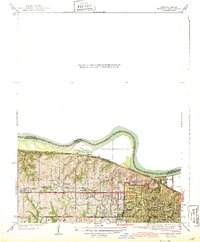 1943 Quindaro1943 Print · USGSThe Missouri-Kansas borderlands in the 1940s reveal a landscape of expanding schools and electric transit. Trace the routes of the Kansas City and Leavenworth Electric Road and find sites like Nearman Sch and Memorial Park Cemetery.
 - 1948 Map of Parkville, 1959 Print
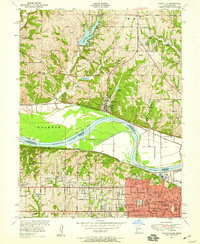 1948 Parkville1959 Print · USGSThe Missouri River state line near Parkville comes alive in the late 1940s as post-war suburban growth meets historic riverfront industry. Researchers can trace early family sites from St Marys Cemetery to the campus of Park College and the old Western University site.
 - 1950 Map of Kansas City
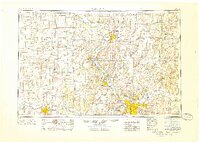 1950 Kansas City1950 Print · USGSMid-century Kansas and Missouri are captured here during a period of industrial growth and shifting transportation. Genealogists and historians can trace rail lines like the Wabash RR or locate ancestral homes near the Potawatomi Indian Reservation and Horton.
 - 1951 Map of Parkville
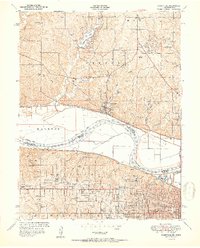 1951 Parkville1951 Print · USGSMid-century development straddles the Missouri River between Platte and Wyandotte counties as suburban growth reaches the river bluffs. Researchers can trace historic institutions like Park College and Western University alongside many local burial grounds like St Marys Cemetery.2 unique versions available
 - 1954 Map of Kansas City
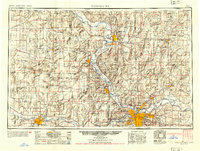 1954 Kansas City1954 Print · USGSThe Missouri-Kansas borderlands flourished in the post-war era as river commerce and rail networks converged at the Missouri River. Genealogists and historians can trace the foundations of Kansas City and smaller rural hubs like Hiawatha or Sabetha.
 - 1956 Map of Kansas City, 1967 Print
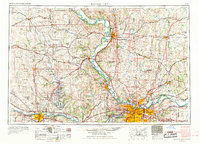 1956 Kansas City1967 Print · USGSThe Kansas-Missouri border region thrived during the mid-fifties, centered on the growing metropolitan cores and the busy river valleys. Researchers can trace the layout of significant government sites like Fort Leavenworth and the Lake City Army Ammunition Plant.4 unique versions available
 - 1960 Map of Kansas City
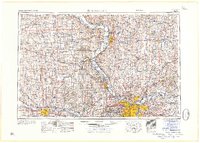 1960 Kansas City1960 Print · USGSMid-century Kansas and Missouri meet at the river forks, showing a sprawling rail-and-river economy during the 1950s growth era. Genealogists and researchers can trace tribal lands like the Kickapoo Indian Reservation or follow the early interstate corridors through Saint Joseph and Independence.3 unique versions available
 - 1964 Map of Parkville, 1965 Print
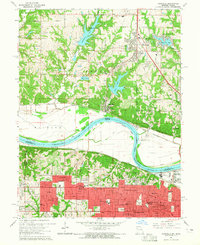 1964 Parkville1965 Print · USGSThe Missouri-Kansas borderlands come alive in the mid-sixties, showing the growth of Kansas City against the bluffs of Parkville. Researchers can trace old family sites at Nolan Cem and Sailor Cem or explore the early layout of Brenner Heights.8 unique versions available
 - 1983 Map of Kansas City
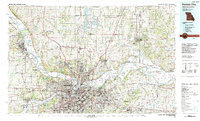 1983 Kansas City1983 Print · USGSThe Missouri-Kansas borderlands reached a peak of suburban and industrial connectivity by the early eighties. Researchers can trace established neighborhoods and major landmarks like the Fort Leavenworth Military Reservation, Swope Park, and the U.S. Army Ammunition Plant.
 - 1991 Map of Parkville, 1996 Print
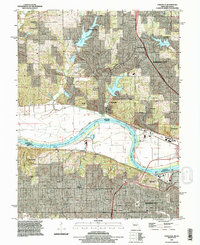 1991 Parkville1996 Print · USGSThe Missouri River loop dominates this early nineties survey of the Missouri-Kansas border area as suburban growth reaches the bluffs. Researchers can trace the development of Parkville and Weatherby Lake or locate ancestral sites like Quindaro Cem and Park College.
 - 1996 Map of Parkville, 2000 Print
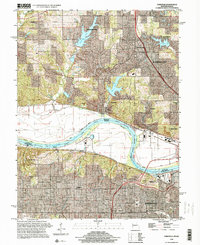 1996 Parkville2000 Print · USGSThe Missouri-Kansas state line follows the winding river valley in the mid-nineties, capturing the growth of communities on both sides of the water. Researchers can trace family history through several burial grounds, including Quindaro Cem and Nolan Cem, or explore the rail corridors of the Union Pacific RR.
End of results
Showing maps 1-11 of 11
Frequently asked questions
- What are the different types of historical maps available for Northeast?
- What is the oldest map of Northeast?
- Where can I purchase historical maps of Northeast for my home or office?
- Where can I download high-res historical maps of Northeast?
- Are there historical topographic maps available for Northeast?
- Is there historical aerial imagery available for Northeast?
- Where are historical maps of Northeast sourced from?