1950s Maps of Elliott County, Kentucky
Explore 14 historic maps of Elliott County from the 1950s. These maps offer a rare glimpse into what life looked like during the 1950s — showing old roads, neighborhoods, homes, and landmarks that have changed or disappeared over time.
Whether you're researching your family's past, planning a metal detecting trip, or studying how Elliott County's landscape evolved across the 1950s, these high-resolution maps are a powerful tool for exploring the history of this region.
- Focus on a specific era: All maps on this page are from the 1950s, giving you a focused view of this time period.
- See what’s changed: Compare century-old streets, trails, and buildings to today's modern landscape using overlays and satellite layers.
- Research with precision: Use these maps for genealogy, historical research, land use analysis, or educational projects.
- View, download, or print: Maps are fully viewable online in high resolution, and can be downloaded or printed for your own records.
Start exploring Elliott County's history through authentic maps from the 1950s. This is your window into the past.
Elliott County, KY maps
(14)- 1950 Map of Bruin, 1952 Print
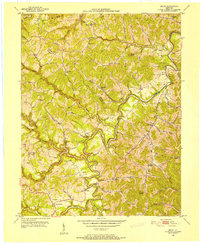 1950 Bruin1952 Print · USGSElliott and Carter counties in the early fifties show a landscape of deep hollows and winding creek-bottom settlements. Researchers can locate many family cemeteries and rural school sites such as Ibex Waddell Sch and Flannery Cem along the Little Sandy River.
 - 1950 Map of Isonville, 1952 Print
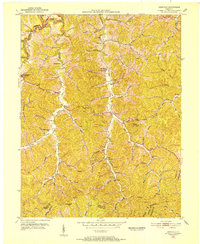 1950 Isonville1952 Print · USGSMid-century Elliott County is mapped here during a period of active rural life and early oil exploration. Researchers can trace ancestral locations through numerous schools like Fairview Sch and landmarks including Peters Hill Lookout Tower and Isonville.
 - 1950 Map of Olive Hill, 1952 Print
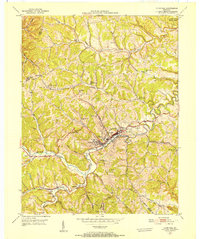 1950 Olive Hill1952 Print · USGSMid-century Carter County comes alive in this survey of the Olive Hill area, where the river-and-rail economy of the Appalachians is on full display. Genealogists and historians can trace family-named ridges and hollows, locating old landmarks like Erie College, James Chapel, and the settlement of Soldier.
 - 1950 Map of Ault, 1952 Print
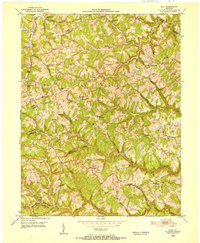 1950 Ault1952 Print · USGSNortheastern Kentucky life in the early fifties revolves around winding creek-beds and ridge-top schools. Trace ancestral roots through localized landmarks like Gimlet (PO), Mocabee Ford, and the many rural schools including Rock Springs Sch and Bunker Hill Sch.
 - 1950 Map of Sandy Hook, 1952 Print
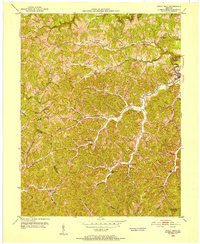 1950 Sandy Hook1952 Print · USGSThe hills of Elliott County were home to a dense network of valley settlements and country schools in the early fifties. Genealogists can trace family-named landmarks and rural hubs like Sandy Hook, Redwine, and Fannin Sch.
 - 1950 Map of Lenox, 1953 Print
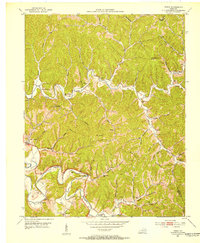 1950 Lenox1953 Print · USGSMorgan County in the early fifties is captured here through its intricate river valleys and remote ridge-top settlements. Researchers can locate numerous family-named landmarks like Adkins Cem, the community at Cottle Bend, and the historic Gordon Ford.
 - 1951 Map of Dingus, 1953 Print
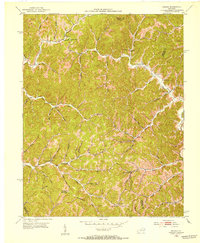 1951 Dingus1953 Print · USGSThe Morgan County backcountry in the early fifties reveals a network of tight-knit hollows defined by the coal and creek-bottom economy. Researchers can trace family history through numerous rural landmarks like Peddler Gap Sch, Lenton Ch, and the Daniel Cem.
 - 1951 Map of Lenox, 1953 Print
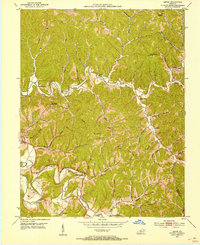 1951 Lenox1953 Print · USGSMorgan County's river valleys and ridgelines are captured here in the early fifties, showing a rural landscape organized around its creeks and hollows. Genealogists can locate family landmarks like Cottle Cem, Patton Cem, and the crossing at Gordon Ford.2 unique versions available
 - 1953 Map of Haldeman, 1954 Print
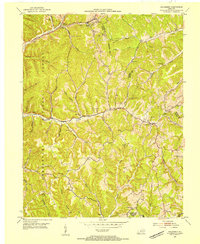 1953 Haldeman1954 Print · USGSRowan County in the early 1950s is shown here as a landscape of rural schools and winding creek valleys. Researchers can trace the Chesapeake and Ohio rail line or locate community hubs like Haldeman, Elliottville, and the Oak Grove Ch.2 unique versions available
 - 1953 Map of Wrigley, 1954 Print
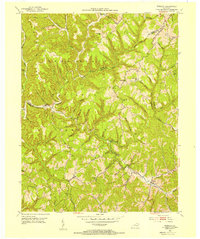 1953 Wrigley1954 Print · USGSEastern Kentucky's mountain communities were still centered on local valley schools and remote post offices in the early fifties. Genealogists and historians can trace family locations through Blairs Mills Sch, Oak Hill Sch, and the settlement at Wrigley.2 unique versions available
 - 1953 Map of Mazie, 1955 Print
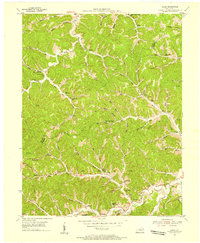 1953 Mazie1955 Print · USGSLawrence and Elliott Counties in the early 1950s reveal a landscape of ridge-top farms and creek-bottom communities. Genealogists can locate family landmarks like the Jason Boggs Cemetery, Mazie Church, and the widespread Gas and Oil Field.3 unique versions available
 - 1953 Map of Willard, 1955 Print
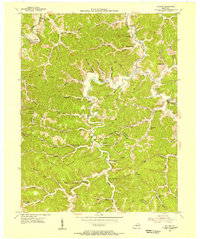 1953 Willard1955 Print · USGSThe hill country of Carter and Lawrence counties is captured here in the early fifties as small mining and farming communities lined the Little Sandy River. Local researchers can locate family landmarks like Kitchen Cem, several rural schoolhouses, and industrial sites such as E K Mines Br.2 unique versions available
 - 1957 Map of Huntington, 1966 Print
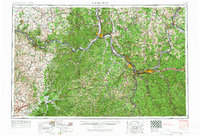 1957 Huntington1966 Print · USGSThe industrial heart of the Ohio River valley is captured here in the mid-sixties, showing the growth of Huntington and Ashland. Researchers can trace the extensive rail networks of the Chesapeake and Ohio RR and locate sites like the Chief Cornstalk Hunting Ground.3 unique versions available
 - 1957 Map of Jenkins, 1974 Print
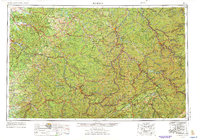 1957 Jenkins1974 Print · USGSThe Cumberland Plateau in the mid-twentieth century reveals a complex landscape of winding river valleys and deep-seated industry. Genealogists and historians can trace the development of Hazard, Jenkins, and Pikeville alongside extensive Numerous Oil and Gas Fields and the routes of the Chesapeake & Ohio Railway.
End of results
Showing maps 1-14 of 14
Top cities of Elliott County
Frequently asked questions
- What are the different types of historical maps available for Elliott County?
- What is the oldest map of Elliott County?
- Where can I purchase historical maps of Elliott County for my home or office?
- Where can I download high-res historical maps of Elliott County?
- Are there historical topographic maps available for Elliott County?
- Is there historical aerial imagery available for Elliott County?
- Where are historical maps of Elliott County sourced from?