1950s Maps of Calvert City, Kentucky
Explore 10 historic maps of Calvert City from the 1950s. These maps offer a rare glimpse into what life looked like during the 1950s — showing old roads, neighborhoods, homes, and landmarks that have changed or disappeared over time.
Whether you're researching your family's past, planning a metal detecting trip, or studying how Calvert City's landscape evolved across the 1950s, these high-resolution maps are a powerful tool for exploring the history of this region.
- Focus on a specific era: All maps on this page are from the 1950s, giving you a focused view of this time period.
- See what’s changed: Compare century-old streets, trails, and buildings to today's modern landscape using overlays and satellite layers.
- Research with precision: Use these maps for genealogy, historical research, land use analysis, or educational projects.
- View, download, or print: Maps are fully viewable online in high resolution, and can be downloaded or printed for your own records.
Start exploring Calvert City's history through authentic maps from the 1950s. This is your window into the past.
Calvert City, KY maps
(10)- 1950 Map of Paducah
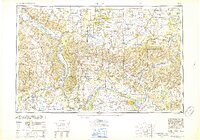 1950 Paducah1950 Print · USGSThe confluence of the great midwestern rivers defines this mid-century landscape at the intersection of Illinois, Kentucky, and Missouri. Genealogists and historians can trace the rail-and-river economy through the hubs of Paducah, Cairo, and Metropolis or locate family roots near the Wildcat Hills.
 - 1951 Map of Elva, 1956 Print
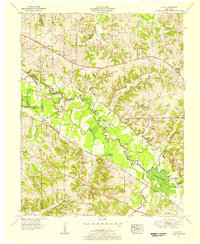 1951 Elva1956 Print · USGSWestern Kentucky's rural river bottoms and early highway corridors are captured here in the early fifties. Genealogists can trace family landmarks and community centers such as Bethlehem Ch, Belton Cem, and the crossing at McCoy Ford Bridge.2 unique versions available
 - 1954 Map of Paducah
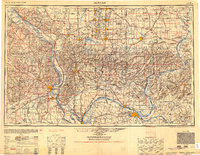 1954 Paducah1954 Print · USGSSouthern Illinois and Western Kentucky intersect at the great river confluences during this mid-century era of rail and river industry. Genealogists and historians can trace family roots and commerce through river towns like Cairo, Metropolis, and Golconda, or along the tracks of the Illinois Central Railroad.2 unique versions available
 - 1954 Map of Little Cypress, 1956 Print
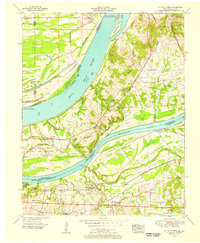 1954 Little Cypress1956 Print · USGSThe confluence of the great rivers in Western Kentucky and Southern Illinois is captured here in the mid-1950s. Trace family roots and local industry at Kincaid Mounds, the community of Possum Trot, and along the tracks of the ILLINOIS CENTRAL.
 - 1955 Map of Briensburg, 1956 Print
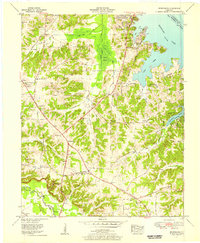 1955 Briensburg1956 Print · USGSMid-century Marshall County was a landscape of emerging lakeside recreation and managed wetlands following the creation of Kentucky Lake. Genealogists can locate family landmarks like Ruggles Cem and Zion Cause Ch or trace the early path of the Jefferson Davis Highway.2 unique versions available
 - 1955 Map of Calvert City, 1956 Print
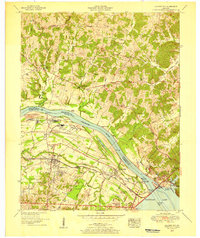 1955 Calvert City1956 Print · USGSMid-century Marshall County is caught between its rural roots and a burgeoning industrial future along the Tennessee River. Researchers can trace the legacy of local families at Wells Cem and Landrum Cem or locate former landmarks like Lutus Store.
 - 1955 Map of Benton, 1957 Print
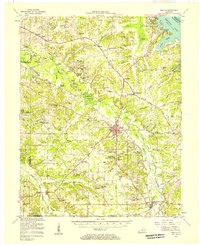 1955 Benton1957 Print · USGSWestern Kentucky in the mid-fifties shows a landscape redefined by the rising waters of Kentucky Lake and the legacy of the Kentucky Dam. Genealogists can trace family names through dozens of rural landmarks like Church Grove Ch, Oak Level Sch, and Steam Mill Bend.
 - 1956 Map of Dyersburg, 1960 Print
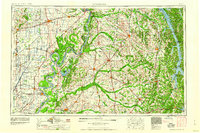 1956 Dyersburg1960 Print · USGSThe Four Rivers region comes alive in the mid-fifties, capturing the intricate borderlands of Tennessee, Kentucky, and Missouri. Genealogists and historians can trace the rail-and-river networks connecting Dyersburg, Caruthersville, and the shoreline of Reelfoot Lake.4 unique versions available
 - 1958 Map of Calvert City, 1959 Print
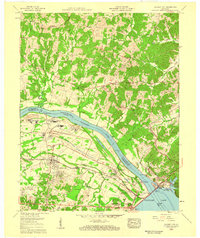 1958 Calvert City1959 Print · USGSMarshall County's riverfront was undergoing a massive transformation in the late fifties as industrial growth took hold near the new reservoirs. Genealogists and historians can trace family burial grounds like Wells Cem and Duke Cem alongside the heavy engineering of Kentucky Dam and the Illinois Central railroad.3 unique versions available
 - 1958 Map of Little Cypress, 1959 Print
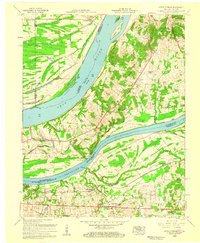 1958 Little Cypress1959 Print · USGSLivingston and Marshall Counties meet at the river forks in the late fifties, showing a landscape shaped by the Ohio River and Tennessee River. You can trace family roots at Vaughn Chapel or Oak Grove Cem and locate the rail lines through Little Cypress.2 unique versions available
End of results
Showing maps 1-10 of 10
Top cities near Calvert City
- Paducah historical maps
- Reidland historical maps
- Benton historical maps
- Kuttawa historical maps
- Smithland historical maps
- Grand Rivers historical maps
Top neighborhoods of Calvert City
Frequently asked questions
- What are the different types of historical maps available for Calvert City?
- What is the oldest map of Calvert City?
- Where can I purchase historical maps of Calvert City for my home or office?
- Where can I download high-res historical maps of Calvert City?
- Are there historical topographic maps available for Calvert City?
- Is there historical aerial imagery available for Calvert City?
- Where are historical maps of Calvert City sourced from?