1900s (20th Century) Maps of Farmington Historic District, Farmington
Explore 15 historic maps of Farmington Historic District from the 1900s (20th Century). These maps offer a rare glimpse into what life looked like during the 1900s — showing old roads, neighborhoods, homes, and landmarks that have changed or disappeared over time.
Whether you're researching your family's past, planning a metal detecting trip, or studying how Farmington Historic District's landscape evolved across the 1900s, these high-resolution maps are a powerful tool for exploring the history of this region.
- Focus on a specific era: All maps on this page are from the 1900s, giving you a focused view of this time period.
- See what’s changed: Compare century-old streets, trails, and buildings to today's modern landscape using overlays and satellite layers.
- Research with precision: Use these maps for genealogy, historical research, land use analysis, or educational projects.
- View, download, or print: Maps are fully viewable online in high resolution, and can be downloaded or printed for your own records.
Start exploring Farmington Historic District's history through authentic maps from the 1900s. This is your window into the past.
Farmington Historic District, Farmington maps
(15)- 1905 Map of Wayne
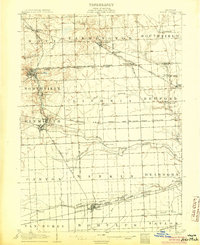 1905 Wayne1905 Print · USGSWestern Wayne and southern Oakland counties are seen here at a pivotal moment when electric interurban railways first linked rural townships. Genealogists can trace family footprints in Northville, Plymouth, and Farmington, or locate vanished landmarks like Perrinville and the Wayne County Home.4 unique versions available
 - 1912 Map of Wayne
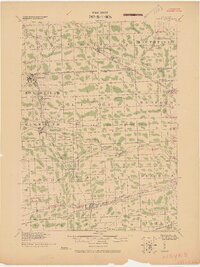 1912 Wayne1912 Print · USGSWestern Wayne County in the early twentieth century shows a landscape being reshaped by the first concrete roads and a dense network of electric interurban railways. Trace the early development of Livonia, Redford, and Plymouth, or locate long-standing sites like Eloise and Perrinville.
 - 1936 Map of Redford
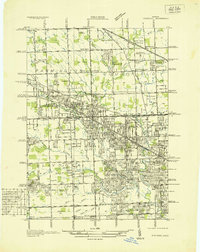 1936 Redford1936 Print · USGSNorthwestern Detroit suburbs emerge from farm tracts during the mid-1930s, showing early neighborhoods and grid-road expansion. Genealogists can find numerous burial grounds like Grand Lawn Cem and landmarks such as Bell Br Community Ch and the Redford Post Office.
 - 1936 Map of Northville
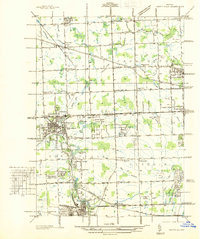 1936 Northville1936 Print · USGSNorthwest Wayne and southwest Oakland counties are captured here in the mid-1930s as the grid of mile roads and institutions matured. Researchers can trace family history at Rural Hill Cem or explore early landmarks like the US Fish Hatchery and Wayne County Training Sch.
 - 1942 Map of Redford
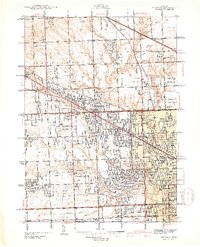 1942 Redford1942 Print · USGSNorthwest of Detroit during the early war years, this survey captures the transition from township farmsteads to suburban hubs. Trace family roots and local landmarks through sites like the Redford PO, Burns Airport, and Grand Lawn Cem.2 unique versions available
 - 1945 Map of Northville
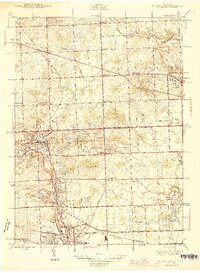 1945 Northville1945 Print · USGSThe border of Wayne and Oakland counties in the mid-1940s reveals a landscape of expanding townships and established institutions. Genealogists and historians can trace family locations near Glen Eden Cem, Waterford Sch, and the Pere Marquette rail line.2 unique versions available
 - 1952 Map of Northville, 1954 Print
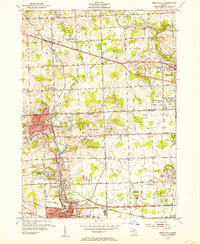 1952 Northville1954 Print · USGSThe settlement of Novi is shown at a pivotal moment in the early fifties before the rapid growth of the Detroit suburbs. Genealogists and local historians can trace the historical layout and early road systems centered around Novi.2 unique versions available
 - 1952 Map of Redford, 1954 Print
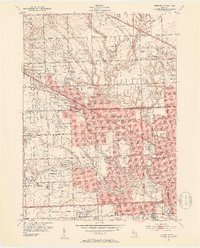 1952 Redford1954 Print · USGSNorthwest of Detroit in the early fifties, the landscape was quickly transforming from rural townships into a dense suburban grid. Genealogists and historians can trace family plots and school districts at Holy Sepulchre Cemetery, St Agatha Sch, and the Boys Republic campus.2 unique versions available
 - 1954 Map of Detroit
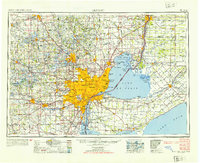 1954 Detroit1954 Print · USGSThe Detroit metro and its Ontario neighbors are shown at the height of the mid-century industrial era, just as the suburbs were rapidly expanding. Researchers can trace the massive rail networks of the Wabash Railroad or locate landmarks like Grosse Ile and Selfridge Air Force Base.
 - 1961 Map of Detroit, 1973 Print
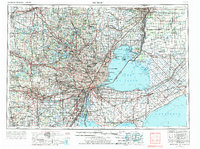 1961 Detroit1973 Print · USGSThe international border between Michigan and Ontario was a bustling industrial corridor in the early sixties. Researchers can trace the transit networks and riverfront infrastructure connecting Detroit to Windsor via the Detroit-Windsor Tunnel and major air hubs like Willow Run Airport.2 unique versions available
 - 1965 Map of Detroit
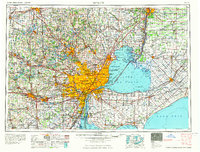 1965 Detroit1965 Print · USGSThe industrial corridor between Michigan and Ontario is captured here at mid-century, showing the dense rail and river networks of the Great Lakes. Local historians can trace the paths of the Grand Trunk Western RR and locate key landmarks like Selfridge Air Force Base and Grosse Ile.
 - 1968 Map of Redford, 1971 Print
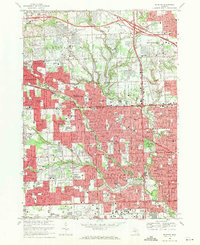 1968 Redford1971 Print · USGSRedford and northwest Detroit emerge in their mid-century form as the suburban grid solidifies along the county line. Genealogists can trace family sites near Holy Sepulchre Cemetery, Clarenceville Cem, and numerous parish schools like St Paul Sch.4 unique versions available
 - 1969 Map of Northville, 1971 Print
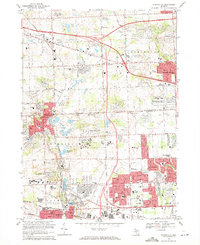 1969 Northville1971 Print · USGSThe Northville and Farmington area is captured here at a moment of intense postwar expansion and institutional development. Genealogists and researchers can trace the grounds of the Northville State Hospital, find family plots in Quaker Cem, and locate long-standing landmarks like Northville Downs.4 unique versions available
 - 1985 Map of Detroit
 1985 Detroit1985 Print · USGSSoutheast Michigan in the mid-eighties shows a landscape defined by industrial power and suburban reach from the Detroit River to the Huron Valley. Researchers can trace the rail lines of the Conrail, explore the grounds of the University of Michigan, and locate numerous sites like Mt Olivet Cem.
 - 1989 Map of Detroit, 1991 Print
 1989 Detroit1991 Print · USGSSoutheast Michigan and across the river into Ontario reached a point of peak metropolitan density at the end of the 1980s. Local researchers can trace the footprint of the University of Michigan campus, the industrial waterfronts of Wyandotte, and the extensive grounds of Glen Eden Cem.
End of results
Showing maps 1-15 of 15
Frequently asked questions
- What are the different types of historical maps available for Farmington Historic District?
- What is the oldest map of Farmington Historic District?
- Where can I purchase historical maps of Farmington Historic District for my home or office?
- Where can I download high-res historical maps of Farmington Historic District?
- Are there historical topographic maps available for Farmington Historic District?
- Is there historical aerial imagery available for Farmington Historic District?
- Where are historical maps of Farmington Historic District sourced from?