1900s (20th Century) Maps of Shelby, North Carolina
Explore 17 historic maps of Shelby from the 1900s (20th Century). These maps offer a rare glimpse into what life looked like during the 1900s — showing old roads, neighborhoods, homes, and landmarks that have changed or disappeared over time.
Whether you're researching your family's past, planning a metal detecting trip, or studying how Shelby's landscape evolved across the 1900s, these high-resolution maps are a powerful tool for exploring the history of this region.
- Focus on a specific era: All maps on this page are from the 1900s, giving you a focused view of this time period.
- See what’s changed: Compare century-old streets, trails, and buildings to today's modern landscape using overlays and satellite layers.
- Research with precision: Use these maps for genealogy, historical research, land use analysis, or educational projects.
- View, download, or print: Maps are fully viewable online in high resolution, and can be downloaded or printed for your own records.
Start exploring Shelby's history through authentic maps from the 1900s. This is your window into the past.
Shelby, NC maps
(17)- 1909 Map of Gaffney
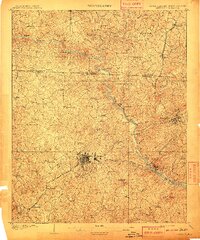 1909 Gaffney1909 Print · USGSCherokee County at the turn of the century centers on the growing textile and rail hubs of Gaffney and Blacksburg. Researchers can trace early river transport at Stacy Ferry or locate ancestral roots at Providence Church and the Sarratt School.4 unique versions available
 - 1909 Map of Lincolnton, 1968 Print
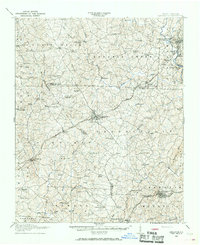 1909 Lincolnton1968 Print · USGSNorth Carolina's Piedmont region during the first decade of the twentieth century shows a landscape transitioning between agrarian roots and new rail-driven industry. Genealogists can trace family connections to rural landmarks like Bess Chapel, Double Chimney School, and the community of Laboratory.
 - 1911 Map of Lincolnton, 1944 Print
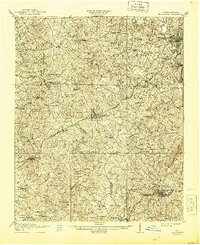 1911 Lincolnton1944 Print · USGSLincoln and Gaston Counties at the peak of the rail era show a landscape of growing textile hubs and rural crossroads. Genealogists can trace family footprints through sites like Double Chimney School, Snapp Cem, and the industry at Beam Mill.
 - 1950 Map of Shelby, 1952 Print
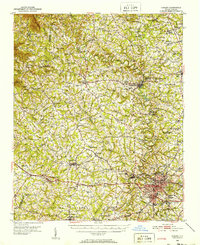 1950 Shelby1952 Print · USGSCleveland County's textile and rail infrastructure is at its peak in the early fifties, centering on the regional hub of Shelby. Genealogists and local historians can trace family roots through numerous country landmarks like Ora Mill, Belwood High Sch, and Double Springs Ch.2 unique versions available
 - 1953 Map of Charlotte, 1968 Print
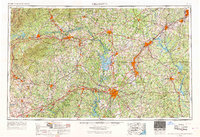 1953 Charlotte1968 Print · USGSThe North Carolina Piedmont and South Carolina borderlands are shown in detail during a period of significant growth and reservoir development. Trace the rail corridors of the Southern Railway or find family roots in towns like China Grove, Misenheimer, and Lincolnton.3 unique versions available
 - 1954 Map of Charlotte
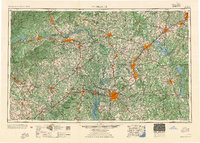 1954 Charlotte1954 Print · USGSThe North Carolina Piedmont in the mid-1950s shows a region of rapid growth and industrial expansion centered around Charlotte. Trace the era's infrastructure through the Southern railroad lines and locate significant landmarks like the Charlotte Naval Ammunition Depot and Lake Norman.2 unique versions available
 - 1960 Map of Charlotte
 1960 Charlotte1960 Print · USGSMid-century North Carolina and South Carolina meet in this 1960 survey of the Piedmont's industrial and textile heartland. Trace the growth of Charlotte alongside historic landmarks like Kings Mountain National Military Park and the Charlotte Naval Ammunition Depot.2 unique versions available
 - 1962 Map of Charlotte
 1962 Charlotte1962 Print · USGSThe North Carolina Piedmont in the early sixties showcases a landscape transformed by massive reservoirs and industrial growth. Researchers can trace the development of Lake Norman, locate the Charlotte Naval Ammunition Depot, or find family landmarks like Wesley Chapel and Brown & Norcott Mills.
 - 1971 Map of Blacksburg North, 1974 Print
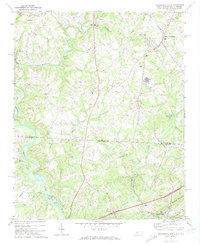 1971 Blacksburg North1974 Print · USGSThe Carolina borderlands come into focus in the early 1970s as the river-driven industry of the Piedmont matures. Researchers can trace family-named landmarks and rural centers like Patterson Springs, Old Falls Chapel, and the Stice Shoals Dam.
 - 1973 Map of Waco, 1976 Print
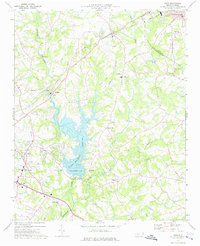 1973 Waco1976 Print · USGSCleveland County and the Gaston County border are captured here in the early seventies as the local landscape transitioned toward modern recreation and industry. Researchers can find numerous country landmarks like Washington Sch, Hullender Cem, and the Seaboard Coast Line railroad.
 - 1976 Map of Shelby SE, 1978 Print
 1976 Shelby SE1978 Print · USGSShelby was a hub of North Carolina textile production in the mid-seventies, surrounded by a changing Piedmont landscape. Trace the footprints of the Ora Mill and Dover Mill or follow the path of the Broad River.
 - 1976 Map of Blacksburg North, 1978 Print
 1976 Blacksburg North1978 Print · USGSThe borderlands of the Carolinas are captured in this mid-seventies aerial survey, showing the landscape as it transitioned toward modern development. Researchers can trace land use patterns around Blacksburg and locate historical structures near Earl and Patterson Springs.
 - 1976 Map of Waco, 1978 Print
 1976 Waco1978 Print · USGSCleveland County lands and the nascent shoreline of Kings Mountain Reservoir appear in this mid-seventies aerial survey. Researchers can trace the exact footprint of farms and woodlots surrounding Waco, Stubbs, and Oak Grove.
 - 1982 Map of Boiling Springs North, 1983 Print
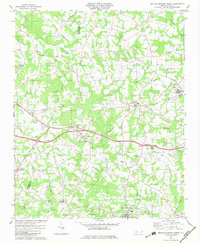 1982 Boiling Springs North1983 Print · USGSIn the early 1980s, this portion of Cleveland and Rutherford counties centered on the rail corridors and rural communities. Genealogists can trace family landmarks like McBrayer Cem, Goodey Grove Ch, and the McKinney Mill Bridge.
 - 1983 Map of Shelby
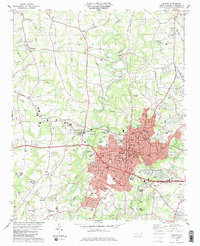 1983 Shelby1983 Print · USGSIn the early eighties, Shelby flourished as a textile and transit hub where the Seaboard and Southern railroads meet. Genealogists and local historians can trace family-named sites and vanished landmarks like Shanghai, Mulls Chapel, and Twelve Oaks Academy.2 unique versions available
 - 1986 Map of Gastonia
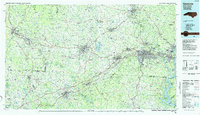 1986 Gastonia1986 Print · USGSThe Carolina Piedmont in the mid-eighties shows a landscape shaped by Revolutionary War history and the textile industry. Trace the footprints of early battles at Kings Mountain National Military Park and locate depots along the Southern Railway in Shelby and Gastonia.
 - 1991 Map of Gastonia
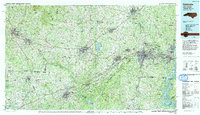 1991 Gastonia1991 Print · USGSThe Piedmont region along the North Carolina and South Carolina border shows a bustling industrial and transit corridor in the early nineties. Researchers can trace the sprawling footprints of Gastonia and Shelby or explore the grounds of Kings Mountain National Military Park and Lake Wylie.
End of results
Showing maps 1-17 of 17
Top cities near Shelby
- Gaffney historical maps
- Kings Mountain historical maps
- Cherryville historical maps
- Boiling Springs historical maps
- Blacksburg historical maps
- Belwood historical maps
See more
Top neighborhoods of Shelby
- Country Club Gardens historical maps
- Idlewild Terrace Apartments historical maps
- Valleyhall historical maps
- Village Square Townhouses historical maps
- Lake Street Apartments historical maps
- Washington Heights historical maps
See more
Frequently asked questions
- What are the different types of historical maps available for Shelby?
- What is the oldest map of Shelby?
- Where can I purchase historical maps of Shelby for my home or office?
- Where can I download high-res historical maps of Shelby?
- Are there historical topographic maps available for Shelby?
- Is there historical aerial imagery available for Shelby?
- Where are historical maps of Shelby sourced from?