1970s Maps of Gaston County, North Carolina
Explore 18 historic maps of Gaston County from the 1970s. These maps offer a rare glimpse into what life looked like during the 1970s — showing old roads, neighborhoods, homes, and landmarks that have changed or disappeared over time.
Whether you're researching your family's past, planning a metal detecting trip, or studying how Gaston County's landscape evolved across the 1970s, these high-resolution maps are a powerful tool for exploring the history of this region.
- Focus on a specific era: All maps on this page are from the 1970s, giving you a focused view of this time period.
- See what’s changed: Compare century-old streets, trails, and buildings to today's modern landscape using overlays and satellite layers.
- Research with precision: Use these maps for genealogy, historical research, land use analysis, or educational projects.
- View, download, or print: Maps are fully viewable online in high resolution, and can be downloaded or printed for your own records.
Start exploring Gaston County's history through authentic maps from the 1970s. This is your window into the past.
Gaston County, NC maps
(18)- 1970 Map of Mount Holly, 1972 Print
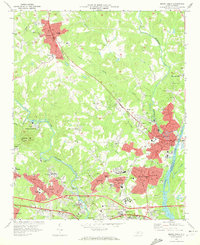 1970 Mount Holly1972 Print · USGSGaston County’s textile and rail corridor thrives in the early seventies, centered on the Catawba River and the bustling hub of Mount Holly. Genealogists can trace family landmarks like Hillcrest Cem and Belmont Abbey College or follow the path of the Seaboard Coast Line.
 - 1970 Map of Lake Norman South, 1972 Print
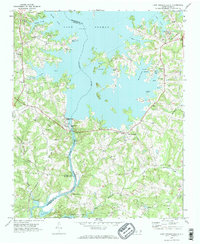 1970 Lake Norman South1972 Print · USGSMecklenburg County enters the seventies as a newly created lakeside community following the damming of the Catawba River. Genealogists and historians can trace the local landscape through landmarks like Triangle Sch, the Seaboard Coast Line rail, and Allison Ferry.2 unique versions available
 - 1970 Map of Lincolnton East, 1972 Print
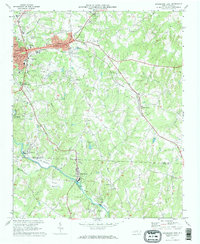 1970 Lincolnton East1972 Print · USGSEastern Lincoln County at the start of the 1970s shows a landscape of textile towns and busy rail corridors. Researchers can trace family roots through City Memorial Gardens, locate old neighborhood schools like Asbury Sch, or map the industrial reach of the SOUTHERN railroad.2 unique versions available
 - 1970 Map of Lowesville, 1972 Print
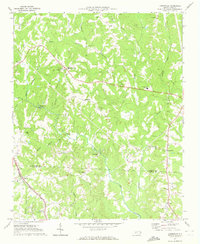 1970 Lowesville1972 Print · USGSThe rural landscape of Lincoln and Gaston Counties is captured here in the early seventies, just as modern infrastructure began to weave through established farming communities. Genealogists can trace family landmarks like Tuckers Grove Ch Cem, Keever Cem, and the old rail stop at Alexis.
 - 1970 Map of Gastonia North, 1972 Print
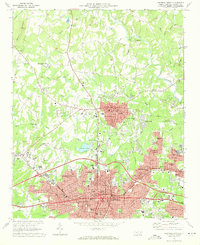 1970 Gastonia North1972 Print · USGSGaston County enters a period of significant suburban growth in the early seventies, centered on the expansion of Gastonia and Dallas. Researchers can trace local genealogy at Hollywood Cem or locate vanished landmarks like the Ashley High Sch and the original Gaston Memorial Hospital.
 - 1971 Map of Kings Mountain, 1973 Print
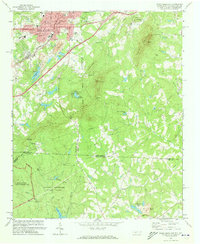 1971 Kings Mountain1973 Print · USGSThe foothills of the Carolinas come into focus during the early seventies as the industrial growth of Kings Mountain meets the preserved heights of the state and military parks. Researchers can trace the legacy of rural congregations and local landmarks like Pisgah Cem, Camp Rotary, and The Pinnacle.
 - 1973 Map of Gastonia South, 1975 Print
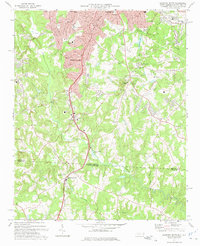 1973 Gastonia South1975 Print · USGSThe North Carolina and South Carolina borderlands south of Gastonia appear here in the early seventies, capturing the city's suburban reach and industrial growth. Researchers can trace family sites like Firestone Mem Cem or locate the Gastonia Airport and Bowling Green along the SOUTHERN rail line.
 - 1973 Map of Bessemer City, 1976 Print
 1973 Bessemer City1976 Print · USGSGaston and Cleveland counties come into sharp focus in the early seventies as industrial centers and rural crossroads meet along the rail lines. Genealogists can locate family landmarks like Patterson Grove Ch, while researchers can trace the footprint of local industry at the Mines and Tailings Ponds.
 - 1973 Map of Cherryville, 1976 Print
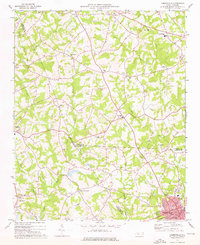 1973 Cherryville1976 Print · USGSThe foothills of the North Carolina Piedmont come alive in this early 1970s survey of the tri-county border region. Genealogists and historians can trace the rural landscape through family-named landmarks like Beam Mill, local schools such as North Brook Sch No 2, and churches like Indian Creek Ch.
 - 1973 Map of Lincolnton West, 1976 Print
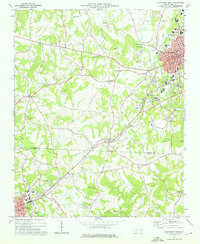 1973 Lincolnton West1976 Print · USGSThe Piedmont landscape of the mid-1970s comes to life here, centered on the historic textile and rail hub of Lincolnton. Genealogists can trace local landmarks like Bethphage Ch, Love Memorial Sch, and the riverside community of Laboratory.
 - 1973 Map of Waco, 1976 Print
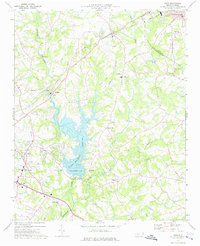 1973 Waco1976 Print · USGSCleveland County and the Gaston County border are captured here in the early seventies as the local landscape transitioned toward modern recreation and industry. Researchers can find numerous country landmarks like Washington Sch, Hullender Cem, and the Seaboard Coast Line railroad.
 - 1973 Map of Belmont, 1976 Print
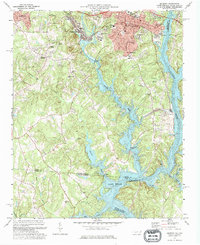 1973 Belmont1976 Print · USGSThe industrial corridor of Gaston County comes to life in the early seventies, showing the textile centers and river life at the South Carolina border. Trace family roots at Bethesda Ch or Smith Cem, and locate landmarks like Sacred Heart College.
 - 1976 Map of Lincolnton West, 1978 Print
 1976 Lincolnton West1978 Print · USGSLincoln County is shown in the mid-seventies through detailed aerial imagery that captures the era's rural and industrial patterns. Genealogists and historians can trace the precise footprints of Lincolnton, Laboratory, and Crouse as they appeared decades ago.
 - 1976 Map of Cherryville, 1978 Print
 1976 Cherryville1978 Print · USGSCherryville and the surrounding Piedmont farmlands are captured in this mid-1970s aerial survey just as rural development began to accelerate. Researchers can identify precise property lines and land use patterns near Cherryville, Fallston, and Baker Crossroads.
 - 1976 Map of Kings Mountain, 1978 Print
 1976 Kings Mountain1978 Print · USGSKings Mountain and the surrounding Piedmont landscape are captured in mid-1970s aerial detail, showing the era's mining and forest clearings. Trace early residential footprints near Mountain View or study the industrial sites near Kings Mountain and Lake York.
 - 1976 Map of Belmont, 1978 Print
 1976 Belmont1978 Print · USGSGaston County enters the late seventies with its textile towns expanding toward the water. Trace the shoreline of Lake Wylie and identify early suburban growth patterns near Belmont, Cramerton, and Elmore Crossroads.
 - 1976 Map of Bessemer City, 1978 Print
 1976 Bessemer City1978 Print · USGSGaston County enters the mid-seventies with a landscape defined by industrial growth and traditional farming. Researchers can trace the literal footprint of the era's textile and mining operations near Bessemer City, Kings Mountain, and Tryon.
 - 1976 Map of Waco, 1978 Print
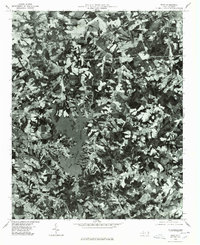 1976 Waco1978 Print · USGSCleveland County lands and the nascent shoreline of Kings Mountain Reservoir appear in this mid-seventies aerial survey. Researchers can trace the exact footprint of farms and woodlots surrounding Waco, Stubbs, and Oak Grove.
End of results
Showing maps 1-18 of 18
Top cities of Gaston County
- Gastonia historical maps
- Mount Holly historical maps
- Belmont historical maps
- Cherryville historical maps
- Bessemer City historical maps
- Dallas historical maps
See more
Frequently asked questions
- What are the different types of historical maps available for Gaston County?
- What is the oldest map of Gaston County?
- Where can I purchase historical maps of Gaston County for my home or office?
- Where can I download high-res historical maps of Gaston County?
- Are there historical topographic maps available for Gaston County?
- Is there historical aerial imagery available for Gaston County?
- Where are historical maps of Gaston County sourced from?