1950s Maps of Spokane, Washington
Explore 12 historic maps of Spokane from the 1950s. These maps offer a rare glimpse into what life looked like during the 1950s — showing old roads, neighborhoods, homes, and landmarks that have changed or disappeared over time.
Whether you're researching your family's past, planning a metal detecting trip, or studying how Spokane's landscape evolved across the 1950s, these high-resolution maps are a powerful tool for exploring the history of this region.
- Focus on a specific era: All maps on this page are from the 1950s, giving you a focused view of this time period.
- See what’s changed: Compare century-old streets, trails, and buildings to today's modern landscape using overlays and satellite layers.
- Research with precision: Use these maps for genealogy, historical research, land use analysis, or educational projects.
- View, download, or print: Maps are fully viewable online in high resolution, and can be downloaded or printed for your own records.
Start exploring Spokane's history through authentic maps from the 1950s. This is your window into the past.
Spokane, WA maps
(12)- 1950 Map of Spokane NE, 1952 Print
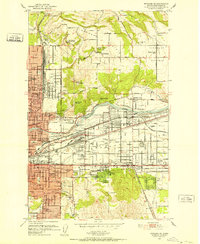 1950 Spokane NE1952 Print · USGSSpokane and its eastern valleys are captured here at a peak of rail and aviation development in the early fifties. Genealogists and local historians can trace family plots and school districts from Hillyard Cemeteries to the Hutton Settlement and Felts Field.2 unique versions available
 - 1950 Map of Spokane SE, 1952 Print
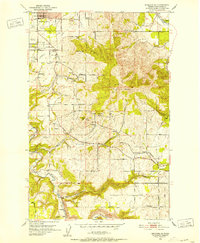 1950 Spokane SE1952 Print · USGSSpokane and the surrounding prairies and mountains are captured here in the early postwar years as rural crossroads were still the heart of the community. Genealogists and historians can locate Moran Cem, the Grange Hall, and several local schools like Sunnyside Sch and Adams Sch.2 unique versions available
 - 1950 Map of Spokane SW, 1952 Print
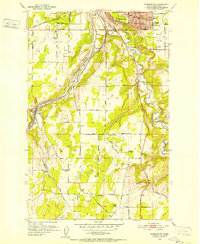 1950 Spokane SW1952 Print · USGSThe outskirts of mid-century Spokane reveal a busy intersection of major railroads and rural community life on the edge of Moran Prairie. Genealogists can locate family landmarks like Windsor School, Glenora Church, and several grange halls serving the farms along LATAH CREEK.
 - 1950 Map of Spokane NW, 1952 Print
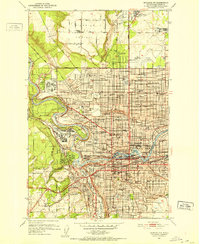 1950 Spokane NW1952 Print · USGSSpokane enters the early fifties as a major military and rail hub, with neighborhoods expanding across the Spokane River. Genealogists and historians can locate legacy institutions like Gonzaga University, George Wright Air Force Base, and Holy Cross Cemetery.2 unique versions available
 - 1950 Map of Spokane, 1955 Print
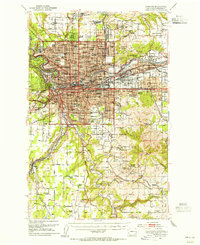 1950 Spokane1955 Print · USGSSpokane was a bustling rail and aviation hub during the early fifties, caught in a moment of rapid post-war expansion. Genealogists and local historians can trace family roots through numerous parish schools, cemeteries like Holy Cross Cem, and outlying settlements such as Marshall and Pleasant Prairie.2 unique versions available
 - 1950 Map of Clayton, 1970 Print
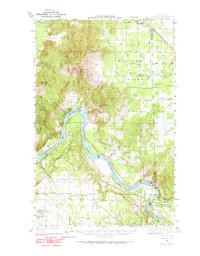 1950 Clayton1970 Print · USGSThe Stevens and Spokane county line in the mid-twentieth century shows a landscape of river-fed prairies and mountain peaks. Genealogists can locate family landmarks like Haines Ranch, Williams Valley Cem, and the Fort Spokane Historic Site.
 - 1951 Map of Deer Park
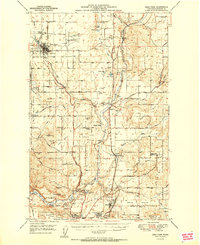 1951 Deer Park1951 Print · USGSSpokane County's northern agricultural and industrial landscapes are captured here during the post-war era. Genealogists and researchers can trace the rural church and school networks at Wild Rose Ch, Mead, and the Peone-Foothills Grange.
 - 1954 Map of Airway Heights, 1955 Print
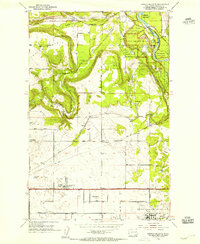 1954 Airway Heights1955 Print · USGSAirway Heights and the surrounding West Plains are captured in the mid-fifties, just as the region’s aviation and military identity was taking hold. Genealogists and local historians can locate early landmarks like the Warsaw School, Stevens Township Hall, and the original footprint of Fairchild Air Force Base.
 - 1954 Map of Medical Lake, 1956 Print
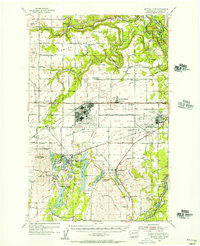 1954 Medical Lake1956 Print · USGSSpokane County's military and institutional landscape is captured here during the mid-fifties, dominated by massive airfields and state facilities. Genealogists and historians can trace Fairchild Air Force Base, the Deno School, and early burial sites like Greenwood Prairie Cem.2 unique versions available
 - 1954 Map of Four Lakes, 1956 Print
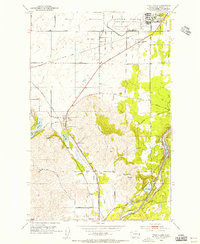 1954 Four Lakes1956 Print · USGSSpokane County's aviation and rail corridors are at their height in the mid-1950s, bridging the gap between the city and the grain country. Researchers can trace family sites near Green Mound Cemetery or locate the old whistle stops of Hayford and Scribner.
 - 1955 Map of Spokane, 1965 Print
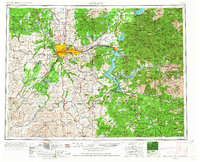 1955 Spokane1965 Print · USGSInland Empire life in the fifties and sixties centers on the growth of Spokane and the heavy mining industry of northern Idaho. Trace mid-century landmarks like Fairchild Air Force Base, the Bunker Hill Mine, and early campuses such as Gonzaga University.2 unique versions available
 - 1958 Map of Spokane
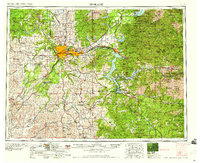 1958 Spokane1958 Print · USGSThe Inland Empire is shown at a mid-century peak of industrial and military activity, from the rail hubs of Spokane to the deep silver mines of northern Idaho. Researchers can trace the sprawling rail lines of the Union Pacific RR or locate landmarks like Fairchild Air Force Base and the Bunker Hill Smelter & Mine.
End of results
Showing maps 1-12 of 12
Top cities near Spokane
- Spokane Valley historical maps
- Cheney historical maps
- Airway Heights historical maps
- Colbert historical maps
- Fairwood historical maps
- Mead historical maps
See more
Top neighborhoods of Spokane
- Hillyard historical maps
- Balboa / South Indian Trail historical maps
- Shiloh Hills historical maps
- Lincoln Heights historical maps
- Nevada Heights historical maps
- Northwest historical maps
See more
Frequently asked questions
- What are the different types of historical maps available for Spokane?
- What is the oldest map of Spokane?
- Where can I purchase historical maps of Spokane for my home or office?
- Where can I download high-res historical maps of Spokane?
- Are there historical topographic maps available for Spokane?
- Is there historical aerial imagery available for Spokane?
- Where are historical maps of Spokane sourced from?