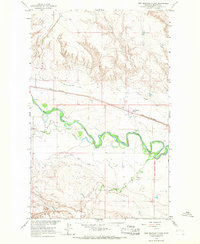
1964 Map of Fort Belknap Siding
USGS Topo · Published 1967About this map
The Milk River meanders through the heart of this North Central Montana landscape, defining the agricultural and logistical character of the Paradise Valley. In the mid-1960s, the irrigation infrastructure of the Fort Belknap Canal and Harlem Canal supported the valley's ranching and farming operations. The Great Northern railroad runs parallel to the river, serving as the primary transit artery with a key stop at Fort Belknap Siding. North of the tracks, the terrain rises into higher ground marked by coulees, while to the south, the Fort Belknap Indian Reservation Boundary marks a significant jurisdictional line. Local industrial activity is evident at the Gravel Pit near the siding and the Pumping Sta located near a sharp bend in the river, illustrating how water and rail shaped this Blaine County corridor.
Find a feature on this map
13 named features on this map. Tap any name to fly to it.
Don’t see what you’re looking for? This feature index may not catch every label — zoom into the map to look around manually.
Map Details
Editions of this 1964 Fort Belknap Siding Map
This is the sole edition of this map. No revisions or reprints were ever made.
Other maps of this area
1904 · Chinook
USGS Topo · 1:62,500
1905 · Harlem
USGS Topo · 1:62,500
1912 · Zurich
USGS Topo · 1:125,000
1913 · Cherry Ridge
USGS Topo · 1:125,000
1953 · Havre
USGS Topo · 1:250,000
1956 · Cleveland
USGS Topo · 1:62,500
1957 · Havre
USGS Topo · 1:250,000
1958 · Havre
USGS Topo · 1:250,000
1964 · Fort Belknap Agency
USGS Topo · 1:24,000
1964 · Big Coulee
USGS Topo · 1:24,000