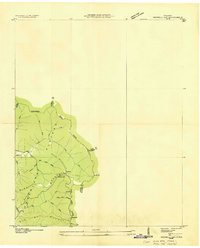
1936 Map of Hogbell Gap
USGS Topo · Published 1936About this map
Cumberland Mountains terrain dominates this 1936 advance sheet, where the Tennessee Basin Divide carves a jagged path across the plateau. This high-country landscape is defined by its deep hollows and prominent ridges, including Bird Mountain and Fork Mountain, which shaped the early movement and settlement patterns of this Tennessee region. The drainage network of the Emory River and its many tributaries, such as Loudon Creek and Dry Branch, illustrates the complex hydrology of the watershed before mid-century developments. Significant gaps in the ridgeline, notably Horseshoe Gap, Long Gap, and the eponymous Hogbell Gap, represent the critical natural passes used by locals. Aerial photography from the era captured the isolation of high-altitude landmarks like Bald Knob and The Garden Spot, providing a precise record of the tri-county boundary where Morgan, Scott, and Anderson counties meet.
Find a feature on this map
27 named features on this map. Tap any name to fly to it.
Don’t see what you’re looking for? This feature index may not catch every label — zoom into the map to look around manually.
Map Details
Editions of this 1936 Hogbell Gap Map
This is the sole edition of this map. No revisions or reprints were ever made.
Other maps of this area
1893 · Briceville
USGS Topo · 1:125,000
1895 · Wartburg
USGS Topo · 1:125,000
1895 · Briceville
USGS Topo · 1:125,000
1896 · Wartburg
USGS Topo · 1:125,000
1896 · Briceville
USGS Topo · 1:125,000
1935 · Gobey
USGS Topo · 1:24,000
1935 · Camp Austin
USGS Topo · 1:24,000
1936 · Block
USGS Topo · 1:24,000
1936 · Duncan Flats
USGS Topo · 1:24,000
1936 · Windrock
USGS Topo · 1:24,000