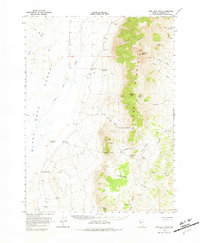
1966 Map of King Lear Peak
USGS Topo · Published 1981About this map
The Jackson Mountains dominate this 1966 topographic survey, rising sharply from the eastern edge of the Black Rock Desert. In this arid landscape, the economy of the mid-1960s is defined by isolated livestock outposts and mineral exploration. Winter Camp and Buckbrush Springs represent the sparse human footprint on the desert floor, while the rugged interior of the range is dotted with numerous extraction sites. Prospectors and miners targeted the slopes of King Lear Peak and Navajo Peak, leaving behind the Red Butte Mine, Stroud Mine, and Red Boy Mine. A complex network of springs, such as Hot Spring and Fish Pond Spring, provides critical water sources in a region where the Quinn River and the Slough are the primary drainage features. The map illustrates a reliance on primitive transportation, with a web of jeep trails and unnamed trails connecting these remote mines to the desert basin.
Find a feature on this map
46 named features on this map. Tap any name to fly to it.
Don’t see what you’re looking for? This feature index may not catch every label — zoom into the map to look around manually.
Map Details
Editions of this 1966 King Lear Peak Map
This is the sole edition of this map. No revisions or reprints were ever made.
Other maps of this area
1886 · Disaster
USGS Topo · 1:250,000
1893 · Disaster
USGS Topo · 1:250,000
1931 · Lovelock
USGS Topo · 1:250,000
1935 · Lovelock
USGS Topo · 1:250,000
1954 · Vya
USGS Topo · 1:250,000
1955 · Lovelock
USGS Topo · 1:250,000
1958 · Vya
USGS Topo · 1:250,000
1959 · Lovelock
USGS Topo · 1:250,000
1961 · Bottle Creek
USGS Topo · 1:62,500
1962 · Vya
USGS Topo · 1:250,000