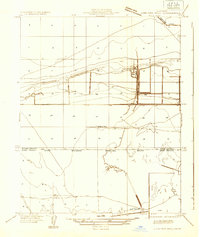
1932 Map of Lone Tree Well
USGS Topo · Published 1932About this map
Agricultural irrigation and water management define this Central Valley landscape during the early 1930s. The survey, directed by State Engineer Edward Hyatt and Division Engineer H. H. Hodgeson, captures a grid of drainage and supply channels that transformed this arid basin into productive farmland. Most prominent is the Homeland Canal cutting through the northeast corner, while a centralized Water Well serves as a critical infrastructure point in the center of the sheet. The terrain is marked by the Sixth Standard Parallel South, which serves as the primary boundary line between Kings County and Kern County. This map reveals the precise engineering required to manage water rights and land divisions in a region defined by its flat, low-lying topography.
Find a feature on this map
2 named features on this map. Tap any name to fly to it.
Don’t see what you’re looking for? This feature index may not catch every label — zoom into the map to look around manually.
Map Details
Editions of this 1932 Lone Tree Well Map
This is the sole edition of this map. No revisions or reprints were ever made.
Other maps of this area
1914 · Lost Hills
USGS Topo · 1:125,000
1929 · Hacienda Ranch
USGS Topo · 1:31,680
1929 · West Alpaugh
USGS Topo · 1:31,680
1930 · Miramonte Ranch
USGS Topo · 1:31,680
1931 · Harvester
USGS Topo · 1:31,680
1932 · Dudley Ridge
USGS Topo · 1:31,680
1932 · Antelope Plain
USGS Topo · 1:31,680
1932 · Reynolds Ranch
USGS Topo · 1:31,680
1932 · West Camp
USGS Topo · 1:31,680
1935 · West Camp
USGS Topo · 1:31,680