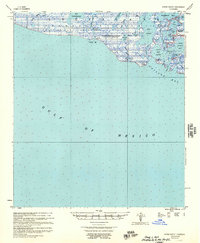
1957 Map of Oyster Bayou
USGS Topo · Published 1957About this map
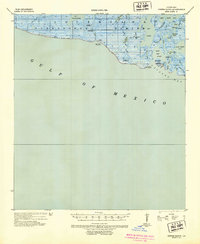
Bay Junop and the surrounding marshlands of Terrebonne Parish reveal a landscape defined by the shifting interface of freshwater and brine in the mid-1950s. This survey, published by the Mississippi River Commission and the Corps of Engineers, documents the industrial presence of the Bay Junop Oil Field and numerous shrimp platforms dotting the waters of Caillou Bay. The intricate network of waterways, including Oyster Bayou and Hellhole Bayou, connects inland features like Big Hellhole Lake to the open Gulf of Mexico. A notable navigational landmark, the Oyster Bayou LH, stands near the western edge of Point Au Fer Island. The map records a specific ecological boundary where the line of demarcation between salt marsh and fresh marsh was not yet determined, offering a snapshot of the coastal environment before significant late-20th-century erosion changed these shorelines.
Find a feature on this map
29 named features on this map. Tap any name to fly to it.
Don’t see what you’re looking for? This feature index may not catch every label — zoom into the map to look around manually.
Map Details
Editions of this 1957 Oyster Bayou Map
This is the sole edition of this map. No revisions or reprints were ever made.
Other maps of this area
1894 · Bayou De Large
USGS Topo · 1:62,500
1932 · Lake Decade
USGS Topo · 1:62,500
1935 · Lake Mechant
USGS Topo · 1:31,680
1935 · Oyster Bayou
USGS Topo · 1:62,500
1940 · Bayou Du Large
USGS Topo · 1:62,500
1941 · Bayou Du Large
USGS Topo · 1:62,500
1944 · Bayou Du Large
USGS Topo · 1:62,500
1945 · New Orleans
USGS Topo · 1:250,000
1947 · West Derniere
USGS Topo · 1:31,680
1949 · Grand Bayou Du Large
USGS Topo · 1:31,680