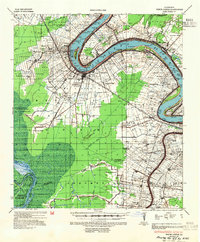
1936 Map of White Castle
USGS Topo · Published 1954About this map
The Mississippi River defines the landscape of this riverfront corridor during the mid-1930s, winding past a dense concentration of historic river estates and agrarian settlements. The town of White Castle and nearby Bayou Goula serve as primary hubs, connected to the broader region by the Texas and Pacific railroad line. This era captures the transition of the local economy, where traditional sugar estates like the Belle Grove Plantation, Eureka Plantation, and Tally-Ho Plantation dominate the riverbanks while new industrial footprints emerge at the Wilbert Oil Field Shell Petroleum Corp. Social life is anchored by several rural institutions, including the St Marys Ch & Cem and the Augusta Sch. Inland, the terrain shifts toward the swampy reaches of Lake Natchez and Grand Bayou, illustrating the distinct boundary between the cultivated riverfront and the low-lying wetlands.
Find a feature on this map
93 named features on this map. Tap any name to fly to it.
Don’t see what you’re looking for? This feature index may not catch every label — zoom into the map to look around manually.
Map Details
Editions of this 1936 White Castle Map
2 editions found
Other maps of this area
1892 · Donaldsonville
USGS Topo · 1:62,500
1892 · Thibodaux
USGS Topo · 1:62,500
1908 · Baton Rouge
USGS Topo · 1:62,500
1927 · Thibodaux NW
USGS Topo · 1:31,680
1934 · Denham Springs
USGS Topo · 1:62,500
1935 · Gonzales
USGS Topo · 1:31,680
1935 · Chicot Lake
USGS Topo · 1:62,500
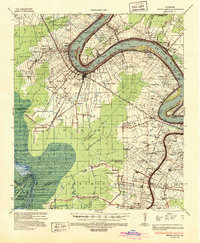
1936 · White Castle
USGS Topo · 1:62,500
1939 · Denham Springs
USGS Topo · 1:62,500
1939 · Baton Rouge
USGS Topo · 1:62,500