1950s Maps of Marion County, Alabama
Explore 11 historic maps of Marion County from the 1950s. These maps offer a rare glimpse into what life looked like during the 1950s — showing old roads, neighborhoods, homes, and landmarks that have changed or disappeared over time.
Whether you're researching your family's past, planning a metal detecting trip, or studying how Marion County's landscape evolved across the 1950s, these high-resolution maps are a powerful tool for exploring the history of this region.
- Focus on a specific era: All maps on this page are from the 1950s, giving you a focused view of this time period.
- See what’s changed: Compare century-old streets, trails, and buildings to today's modern landscape using overlays and satellite layers.
- Research with precision: Use these maps for genealogy, historical research, land use analysis, or educational projects.
- View, download, or print: Maps are fully viewable online in high resolution, and can be downloaded or printed for your own records.
Start exploring Marion County's history through authentic maps from the 1950s. This is your window into the past.
Marion County, AL maps
(11)- 1950 Map of Vina, 1977 Print
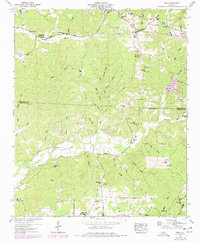 1950 Vina1977 Print · USGSThe Alabama-Mississippi borderlands come to life in this mid-century survey of the upland country near Vina. Genealogists and historians can trace isolated landmarks like Good Spring Church, the Newburg Cem, and the path of the Illinois Central railroad.
 - 1951 Map of Vina
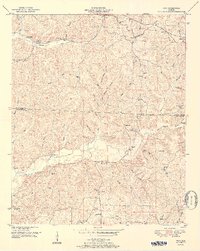 1951 Vina1951 Print · USGSNorthwest Alabama at mid-century centers on the corridor between Vina and Shottsville as the rural landscape evolves. Researchers can trace family-named landmarks like Buzzard Bluff, several country schools, and old burial sites such as Brazel Cem and Nichols Cem.2 unique versions available
 - 1953 Map of Birmingham, 1964 Print
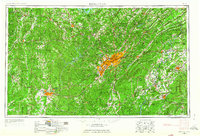 1953 Birmingham1964 Print · USGSCentral Alabama at mid-century shows a landscape defined by industrial expansion and the iron-rich ridges surrounding Birmingham. Researchers can trace the extensive rail networks of the L & N RR or locate historic federal sites like the Anniston Ordnance Depot.4 unique versions available
 - 1956 Map of Birmingham
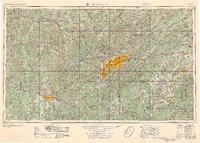 1956 Birmingham1956 Print · USGSCentral Alabama in the mid-fifties exhibits a landscape of growing cities and deep-rooted industrial corridors. Genealogists and historians can trace the development of suburban Mountain Brook or locate regional hubs like Sylacauga and Jasper.
 - 1956 Map of Gadsden, 1966 Print
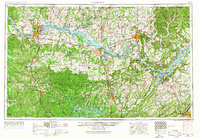 1956 Gadsden1966 Print · USGSNorth Alabama in the mid-1950s shows a region transformed by river engineering and federal industry. Genealogists and local historians can trace the development of the Tennessee Valley through the growth of Huntsville, the sprawling Redstone Arsenal, and the expansive Guntersville Lake.3 unique versions available
 - 1956 Map of Tupelo, 1967 Print
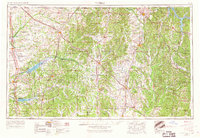 1956 Tupelo1967 Print · USGSNortheast Mississippi and parts of Tennessee and Alabama are shown here during the mid-fifties, a time of major reservoir construction and forestry management. Researchers can trace the St Louis-San Francisco RR through Tupelo or locate historic sites like Tishomingo State Park and the University.2 unique versions available
 - 1957 Map of Birmingham
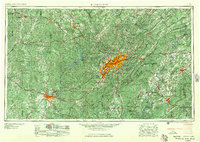 1957 Birmingham1957 Print · USGSNorth-Central Alabama in the mid-fifties is an industrial powerhouse centered on the steel valleys and sprawling iron ridges. Genealogists and historians can trace the rail-linked growth of Birmingham and Tuscaloosa, or locate rural landmarks like Talladega College and the Anniston Ordnance Depot.
 - 1958 Map of Tupelo
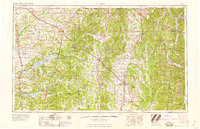 1958 Tupelo1958 Print · USGSNortheast Mississippi and neighboring Alabama and Tennessee appear here during the late fifties as a region defined by new reservoirs and historic rail lines. Genealogists can trace family locations near Sardis Lake, Woodall Mountain, and the St Louis-San Francisco Ry.
 - 1958 Map of Gadsden
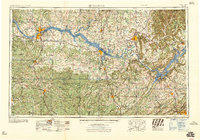 1958 Gadsden1958 Print · USGSNorth Alabama comes alive in the late 1950s as the Tennessee Valley Authority’s massive river projects and the rise of the space industry reshaped the landscape. Researchers can trace the mid-century footprints of Huntsville, Redstone Arsenal, and the riverside rail networks of the Southern railroad.
 - 1958 Map of Haleyville West, 1960 Print
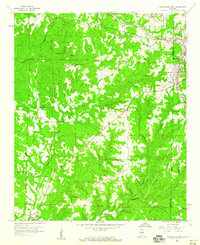 1958 Haleyville West1960 Print · USGSMarion County in the late fifties remains a landscape of remote hollows and high ridges near the William B Bankhead National Forest. Genealogists and historians can trace family locations through sites like Old Ireland Cem, Goddard, and the Craft Sch.3 unique versions available
 - 1958 Map of Gold Mine, 1960 Print
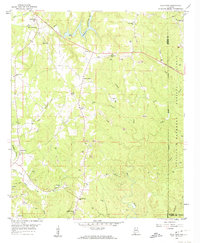 1958 Gold Mine1960 Print · USGSMarion County during the late 1950s was a landscape of transitioning industries and deep-rooted rural communities. Local historians can trace the development of extraction sites like Gold Mine and Brilliant alongside landmarks such as Bethel Ch and Crooked Creek Cem.4 unique versions available
End of results
Showing maps 1-11 of 11
Top cities of Marion County
- Hamilton historical maps
- Guin historical maps
- Hackleburg historical maps
- Bear Creek historical maps
- Brilliant historical maps
- Twin historical maps
See more
Frequently asked questions
- What are the different types of historical maps available for Marion County?
- What is the oldest map of Marion County?
- Where can I purchase historical maps of Marion County for my home or office?
- Where can I download high-res historical maps of Marion County?
- Are there historical topographic maps available for Marion County?
- Is there historical aerial imagery available for Marion County?
- Where are historical maps of Marion County sourced from?