1950s Maps of Lawton, Oklahoma
Explore 9 historic maps of Lawton from the 1950s. These maps offer a rare glimpse into what life looked like during the 1950s — showing old roads, neighborhoods, homes, and landmarks that have changed or disappeared over time.
Whether you're researching your family's past, planning a metal detecting trip, or studying how Lawton's landscape evolved across the 1950s, these high-resolution maps are a powerful tool for exploring the history of this region.
- Focus on a specific era: All maps on this page are from the 1950s, giving you a focused view of this time period.
- See what’s changed: Compare century-old streets, trails, and buildings to today's modern landscape using overlays and satellite layers.
- Research with precision: Use these maps for genealogy, historical research, land use analysis, or educational projects.
- View, download, or print: Maps are fully viewable online in high resolution, and can be downloaded or printed for your own records.
Start exploring Lawton's history through authentic maps from the 1950s. This is your window into the past.
Lawton, OK maps
(9)- 1955 Map of Lawton, 1958 Print
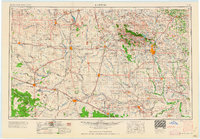 1955 Lawton1958 Print · USGSSouthwestern Oklahoma and North Texas are shown here in the mid-fifties, dominated by the Wichita Mountains and the vital Red River watershed. Genealogists and historians can trace the foundations of Lawton alongside rural landmarks like Rainy Mountain Church and Pleasant Hill School.5 unique versions available
 - 1956 Map of Ninemile Creek, 1959 Print
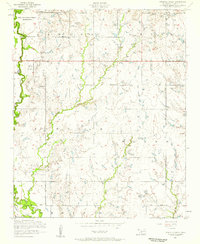 1956 Ninemile Creek1959 Print · USGSComanche County was transitioning into an energy-rich landscape in the mid-fifties as oil production expanded near the Ninemile Creek drainage. Genealogists and historians can locate rural landmarks like Mineral Wells School, Roseland School, and the Fort Sill Indian School Reservation.3 unique versions available
 - 1956 Map of Arbuckle Hill, 1959 Print
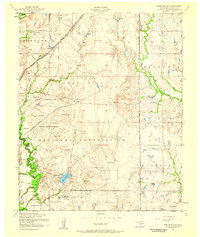 1956 Arbuckle Hill1959 Print · USGSMid-century Comanche County is shown here during a period of heavy military and industrial activity. Genealogists and researchers can locate the Fort Sill Indian School, the Indian Cemetery, and oil operations near Zella.4 unique versions available
 - 1956 Map of Mount Scott, 1959 Print
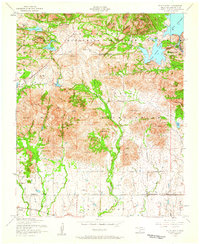 1956 Mount Scott1959 Print · USGSThe Wichita Mountains in the mid-fifties reveal a unique landscape shared between the Fort Sill Military Reservation and federal wildlife lands. Researchers can trace the layout of Medicine Park, find the Holy City Church, and locate the St Louis San Francisco rail line through Cache.5 unique versions available
 - 1956 Map of Fort Sill, 1959 Print
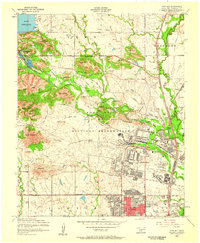 1956 Fort Sill1959 Print · USGSFort Sill and northern Lawton show their mid-century military and residential character just as the post-war era transformed the plains. Trace family roots and local landmarks from Medicine Park to the Mt Scott Comanche Mission and Artillery Village.4 unique versions available
 - 1956 Map of Taupa, 1959 Print
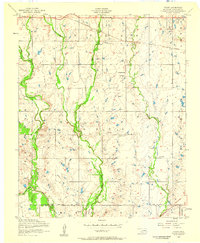 1956 Taupa1959 Print · USGSSouthern Oklahoma at the height of the 1950s reveals a landscape of rural homesteads and winding creek beds south of the Wichita Mountains. Researchers can locate family landmarks like Deyo Cemetery, Wesley Chapel, and the whistle-stop of Taupa.3 unique versions available
 - 1956 Map of Lawton, 1959 Print
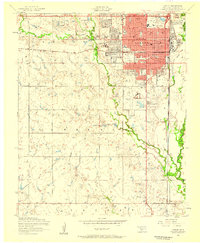 1956 Lawton1959 Print · USGSLawton and its surrounding Comanche County prairie are captured here during a period of significant mid-century growth. Researchers can trace the development of local schools and churches like Johnson Chapel or locate the historic McMahon Memorial Bldg Cem and Mercer Minnow Ponds.3 unique versions available
 - 1956 Map of Cache, 1960 Print
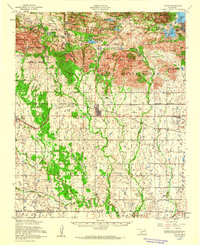 1956 Cache1960 Print · USGSSouthwestern Oklahoma at the peak of the mid-century era shows a landscape defined by federal land reserves and rural rail towns. Researchers can trace family history at the Deyo Memorial Chapel or explore the early footprints of Cache and Indiahoma.3 unique versions available
 - 1956 Map of Lawton, 1960 Print
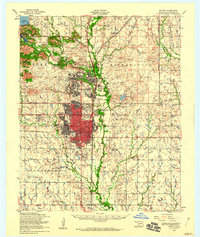 1956 Lawton1960 Print · USGSOklahoma's military and tribal heritage are on full display during the mid-fifties as Lawton grows alongside the sprawling Fort Sill. Genealogists and historians can trace Indian Cemetery, the Mt Scott Comanche Mission, and family landmarks like Mercer-Minnieua Pond.
End of results
Showing maps 1-9 of 9
Top cities near Lawton
- Walters historical maps
- Cache historical maps
- Elgin historical maps
- Geronimo historical maps
- Fletcher historical maps
- Chattanooga historical maps
See more
Top neighborhoods of Lawton
- Dempsey Bridge historical maps
- Pig Farm Crossing historical maps
- White Wolf Bridge historical maps
- Craig Crossing historical maps
- Geronimo Acres historical maps
- Henry Post Manor historical maps
See more
Frequently asked questions
- What are the different types of historical maps available for Lawton?
- What is the oldest map of Lawton?
- Where can I purchase historical maps of Lawton for my home or office?
- Where can I download high-res historical maps of Lawton?
- Are there historical topographic maps available for Lawton?
- Is there historical aerial imagery available for Lawton?
- Where are historical maps of Lawton sourced from?