1940s Maps of Polk County, Tennessee
Explore 15 historic maps of Polk County from the 1940s. These maps offer a rare glimpse into what life looked like during the 1940s — showing old roads, neighborhoods, homes, and landmarks that have changed or disappeared over time.
Whether you're researching your family's past, planning a metal detecting trip, or studying how Polk County's landscape evolved across the 1940s, these high-resolution maps are a powerful tool for exploring the history of this region.
- Focus on a specific era: All maps on this page are from the 1940s, giving you a focused view of this time period.
- See what’s changed: Compare century-old streets, trails, and buildings to today's modern landscape using overlays and satellite layers.
- Research with precision: Use these maps for genealogy, historical research, land use analysis, or educational projects.
- View, download, or print: Maps are fully viewable online in high resolution, and can be downloaded or printed for your own records.
Start exploring Polk County's history through authentic maps from the 1940s. This is your window into the past.
Polk County, TN maps
(15)- 1940 Map of Benton
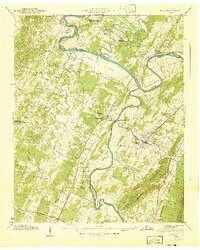 1940 Benton1940 Print · USGSPolk County life in the early 1940s centers on the fertile river bottoms and the rail lines connecting these valley communities. Researchers can trace family roots through numerous local landmarks, from Chestuee Mills to rural sites like New Harmony Ch and Baker Chapel Cem.3 unique versions available
 - 1941 Map of Mineral Bluff, 1956 Print
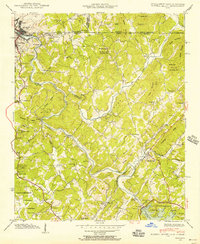 1941 Mineral Bluff1956 Print · USGSThe tri-state borderlands of Georgia, Tennessee, and North Carolina come alive in the early 1940s as the river-and-rail economy hums near Mineral Bluff. Genealogists and researchers can locate the Galloway Cem, trace the Louisville and Nashville Railroad, and find the CCC Camp 3467 TVA 29 site.4 unique versions available
 - 1941 Map of Epworth, 1957 Print
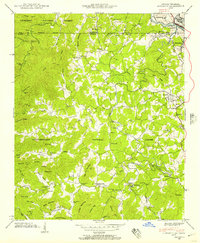 1941 Epworth1957 Print · USGSThe Tennessee-Georgia state line and the industrial copper basin are captured here in the early 1940s. Genealogists and historians can trace family landmarks like Hipp Chapel, Patterson Mill, and the small settlement of Madola along the Fightingtown Creek.3 unique versions available
 - 1942 Map of Epworth
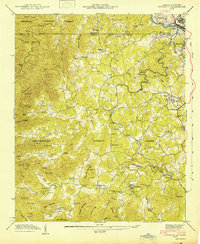 1942 Epworth1942 Print · USGSThe Georgia-Tennessee border comes alive in the early 1940s, showing the rugged mountain corridor between McCaysville and Epworth. Researchers can trace old mountain homesteads, country schools like Payne Sch, and historic local landmarks such as Higdon Store and Patterson Mill.
 - 1942 Map of Parksville, 1960 Print
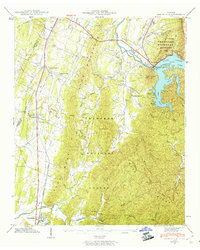 1942 Parksville1960 Print · USGSPolk County at the start of the 1940s shows the impact of hydropower and rail on the Appalachian landscape. Genealogists and historians can trace family locations through Oldfort and Conasauga, or locate rural landmarks like Horns Creek School and Antioch Church.2 unique versions available
 - 1943 Map of Tellico
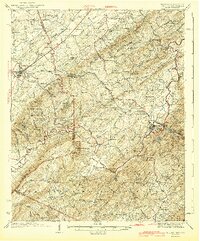 1943 Tellico1943 Print · USGSThe valleys and mountain foothills of eastern Tennessee appear here in the 1930s and 40s during the height of the rural schoolhouse era. Genealogists can trace family names through dozens of landmarks like Isbell Cem, Union Grove Ch, and schools such as Manila Sch or Hance Sch.2 unique versions available
 - 1943 Map of Mineral Bluff
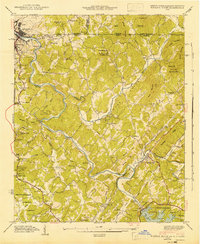 1943 Mineral Bluff1943 Print · USGSFannin County and the tri-state border region are shown here in the early 1940s, just after the completion of the Blue Ridge Dam. Researchers can trace family history through sites like Galloway Cem or follow the Louisville and Nashville tracks through Mineral Bluff.
 - 1943 Map of Ducktown
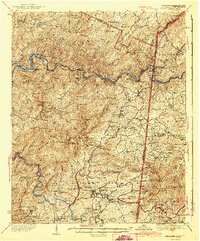 1943 Ducktown1943 Print · USGSSoutheast Tennessee mining country is captured here during the 1940s as the regional copper industry reached its peak. Genealogists and historians can trace industrial footprints at the Burra Burra Mine or locate families near Freelingtown and the Ironsburg Sch.2 unique versions available
 - 1943 Map of Dalton
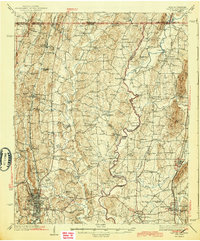 1943 Dalton1943 Print · USGSWhitfield and Murray counties come alive in the 1940s, showing the early industrial growth of the carpet capital and the surrounding farming settlements. Researchers can locate family landmarks like Praters Mill, Gregorys Mill, and the many rural sites such as Shiloh Ch or Oak Grove Sch.2 unique versions available
 - 1943 Map of Parksville, 1946 Print
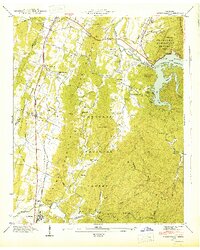 1943 Parksville1946 Print · USGSPolk County enters the mid-1940s as a landscape of forested ridges and harnessed river power. Local historians can trace the early footprint of Lake Ocoee and locate rural landmarks like Horns Creek Sch and the Hillard-Ladd Cem.
 - 1943 Map of Etowah, 1960 Print
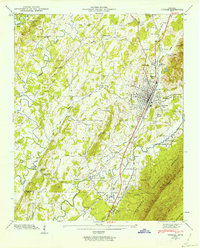 1943 Etowah1960 Print · USGSMcMinn County in the early 1940s centers on the bustling rail hub of Etowah as it expands along the Louisville and Nashville line. Genealogists and historians can trace family locations at rural landmarks like Old Salem Ch, Gravel Hill Sch, and the Buttram Cem.2 unique versions available
 - 1943 Map of Calhoun, 1960 Print
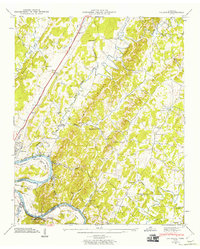 1943 Calhoun1960 Print · USGSThe Hiwassee River valley at the onset of the 1940s reveals a rural landscape of ridges and river bends at the borders of McMinn and Bradley counties. Genealogists and historians can trace family locations near Whites Mill, Gentry Store, and the Womack Cem.2 unique versions available
 - 1944 Map of Calhoun, 1946 Print
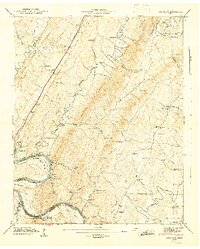 1944 Calhoun1946 Print · USGSThe Hiwassee River corridor in the 1940s reveals a landscape of river bends and rural crossroads. Local historians can trace the foundations of the community at Whites Mill, the small rail siding at Sanford, and early schools like Claxton Sch.2 unique versions available
 - 1944 Map of Etowah, 1946 Print
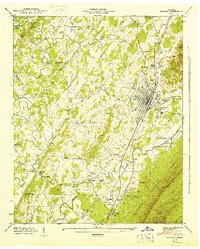 1944 Etowah1946 Print · USGSMcMinn County in the mid-1940s reveals a landscape defined by the Louisville and Nashville railroad and rural life. Researchers can trace family roots at Buttram Cem or locate vanished schools like Wesleyana Sch.
 - 1946 Map of Felker, 1947 Print
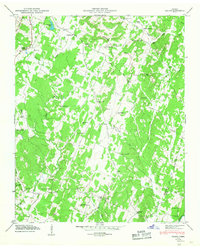 1946 Felker1947 Print · USGSSoutheast Tennessee rural life is captured here in the mid-1940s, showing a landscape of ridge-top schools and creek-side churches. Genealogists can locate family landmarks like Kinser Tabernacle, Liberty Cem, and the small settlement of Pumpkin Center.2 unique versions available
End of results
Showing maps 1-15 of 15
Top cities of Polk County
Frequently asked questions
- What are the different types of historical maps available for Polk County?
- What is the oldest map of Polk County?
- Where can I purchase historical maps of Polk County for my home or office?
- Where can I download high-res historical maps of Polk County?
- Are there historical topographic maps available for Polk County?
- Is there historical aerial imagery available for Polk County?
- Where are historical maps of Polk County sourced from?