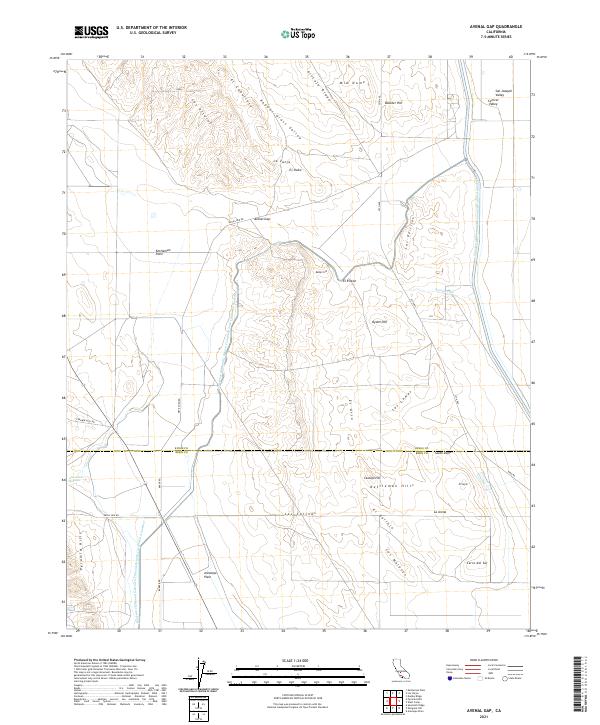
2021 Map of Avenal Gap
USGS Topo · Published 2021About this map
The Governor Edmund G Brown Coastal Branch California Aqueduct serves as a modern engineering spine through this arid corridor of Kings and Kern Counties, cutting between the Kettleman Hills and the Pyramid Hills. This landscape is defined by its dramatic geological transitions, where the Kettleman Plain meets the Antelope Plain at the narrow passage of the Avenal Gap. The map illustrates the physical geography of the Central Valley's western edge, documenting prominent rises like South Dome, Mid Dome, and Boulder Hill. In a region where water management is paramount, the presence of Alamo Solo Spring and the drainage of Arroyo Pozo highlight the natural hydrology that predated the massive aqueduct system. Cattle-ranching and oil-industry heritage are suggested by the network of ridges and canyons, including Pintojo Ridge and Pepper Grass Valley, which provide a detailed topographical context for the 21st-century land use of this San Joaquin Valley borderland.
Find a feature on this map
42 named features on this map. Tap any name to fly to it.
Don’t see what you’re looking for? This feature index may not catch every label — zoom into the map to look around manually.
Map Details
Editions of this 2021 Avenal Gap Map
This is the sole edition of this map. No revisions or reprints were ever made.
Other maps of this area
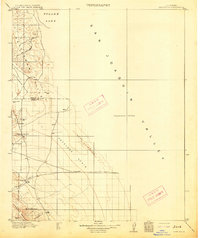
1914 · Lost Hills
USGS Topo · 1:125,000
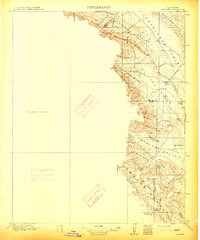
1914 · Cholame
USGS Topo · 1:125,000
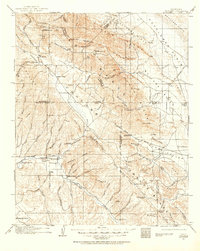
1915 · Cholame
USGS Topo · 1:125,000
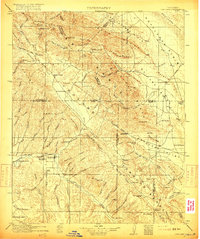
1917 · Cholame
USGS Topo · 1:125,000
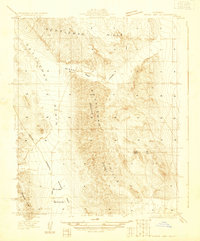
1930 · Avenal Gap
USGS Topo · 1:31,680
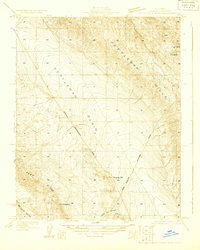
1930 · Kettleman Plain
USGS Topo · 1:31,680
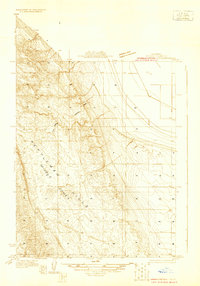
1930 · Middle Dome
USGS Topo · 1:31,680
1932 · Dudley Ridge
USGS Topo · 1:31,680
1932 · Antelope Plain
USGS Topo · 1:31,680
1932 · West Camp
USGS Topo · 1:31,680