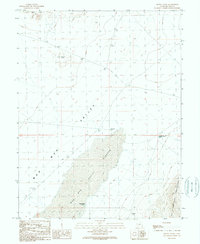
1989 Map of Brown Knoll
USGS Topo · Published 1989About this map
The Wah Wah Valley Hardpan dominates this arid landscape, showing a vast playa environment before it meets the rising slopes of the San Francisco Mountains in the southeast. This 1989 provisional survey reveals a remote desert region where water management is critical to the few human activities present. Isolated water sources such as Wah Wah Well, Charlie Nielsen Pond, and the East Hardpan Reservoir are the primary landmarks in an area otherwise defined by dramatic elevation changes between the Black Hills and the prominent Brown Knoll. The presence of the Bagnall Corral and a Gravel Pit indicates sparse agricultural and industrial utility, while the precise section lines and benchmarks reflect the methodical effort by the U.S. Geological Survey to map this difficult Utah terrain.
Find a feature on this map
11 named features on this map. Tap any name to fly to it.
Don’t see what you’re looking for? This feature index may not catch every label — zoom into the map to look around manually.
Map Details
Editions of this 1989 Brown Knoll Map
This is the sole edition of this map. No revisions or reprints were ever made.
Other maps of this area
1953 · Richfield
USGS Topo · 1:250,000
1958 · Richfield
USGS Topo · 1:250,000
1960 · Frisco Peak
USGS Topo · 1:62,500
1960 · Beaver Lake Mts.
USGS Topo · 1:62,500
1960 · The Barn
USGS Topo · 1:62,500
1972 · Sevier Lake SW
USGS Topo · 1:24,000
1980 · Wah Wah Mts. North
USGS Topo · 1:100,000
1989 · High Rock
USGS Topo · 1:24,000
1989 · Frisco Peak
USGS Topo · 1:24,000
1989 · Wah Wah Cove
USGS Topo · 1:24,000