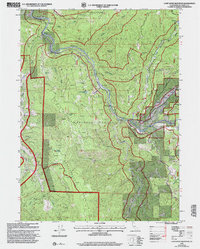
1997 Map of Cant Hook Mountain
USGS Topo · Published 2001About this map
The South Fork Smith River carves through the heart of this landscape, anchoring the Smith River National Recreation Area within the Six Rivers National Forest. This 1997 revision captures a region defined by its complex hydrology and vertical relief, featuring prominent summits like Cant Hook Mountain and the high ridges of Snake Mountain. Significant for local history and resource management, the map identifies numerous small-scale mining efforts, marked simply as Prospects or Mine, concentrated near the Boulder Ridge and Rattlesnake Lake vicinity. Along the river, established access points such as Sand Camp River Access and Steven Bridge River Access reflect the area's transition from an industrial timber and mining frontier to one of managed recreation. Notable landmarks like the Hurdygurdy Bridge and Soldier Well provide specific points of interest for those tracing old forest service routes and historical land use patterns.
Find a feature on this map
54 named features on this map. Tap any name to fly to it.
Don’t see what you’re looking for? This feature index may not catch every label — zoom into the map to look around manually.
Map Details
Editions of this 1997 Cant Hook Mountain Map
This is the sole edition of this map. No revisions or reprints were ever made.
Other maps of this area
1922 · Preston Peak
USGS Topo · 1:125,000
1929 · Crescent City
USGS Topo · 1:125,000
1945 · Ship Mountain
USGS Topo · 1:62,500
1945 · Gasquet
USGS Topo · 1:62,500
1945 · Point St. George
USGS Topo · 1:62,500
1945 · Requa
USGS Topo · 1:62,500
1948 · Weed
USGS Topo · 1:250,000
1949 · Eureka
USGS Topo · 1:250,000
1950 · Weed
USGS Topo · 1:250,000
1951 · Gasquet
USGS Topo · 1:62,500