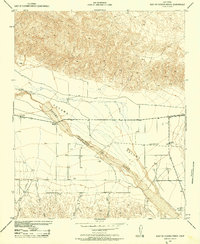
1942 Map of East of Cuyama Ranch
USGS Topo · Published 1959About this map
The Cuyama Valley landscape on this 1942 survey is defined by the broad, braided course of the Cuyama River, which serves as the natural boundary between San Luis Obispo and Santa Barbara counties. At this time, the region is characterized by large agricultural holdings and early petroleum exploration, evidenced by the scattered Coulter Ranch, Whitner Ranch, and an isolated Oil Well. The small settlement of Cuyama sits at the western edge of the valley, supported by the Cuyama School. To the south, a network of rugged drainages including Castro Canyon, Olive Canyon, and Tennison Canyon cut into the hills, while the eastern edge is marked by the winding path of Ballinger Canyon. The dominance of ranching and the emerging oil industry illustrate a remote California interior during the early war years, just before more intensive post-war development reached the valley floor.
Find a feature on this map
15 named features on this map. Tap any name to fly to it.
Don’t see what you’re looking for? This feature index may not catch every label — zoom into the map to look around manually.
Map Details
Editions of this 1942 East of Cuyama Ranch Map
This is the sole edition of this map. No revisions or reprints were ever made.
Other maps of this area
1902 · Santa Ynez
USGS Topo · 1:125,000
1903 · Mt. Pinos
USGS Topo · 1:125,000
1905 · Santa Ynez
USGS Topo · 1:125,000
1910 · Buena Vista Lake
USGS Topo · 1:125,000
1912 · McKittrick
USGS Topo · 1:125,000
1912 · Buena Vista Lake
USGS Topo · 1:125,000
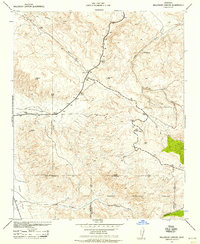
1942 · Ballinger Canyon
USGS Topo · 1:24,000
1943 · Maricopa
USGS Topo · 1:31,680
1943 · Cuyama Ranch
USGS Topo · 1:31,680
1943 · Ballinger Canyon
USGS Topo · 1:24,000